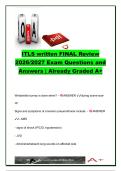
This ITLS Written Final Review 2026/2027 provides 30+ exam-focused questions with answers across 7 pages for students preparing for an International Trauma Life Support written final, certification review, or prehospital trauma assessment. The study material emphasizes rapid recognition of life-threatening injuries and appropriate management priorities, beginning with the windshield survey, scene size-up, rapid trauma assessment, significant mechanisms of injury, load-and-go criteria, and primary assessment. It also reviews considerations for elderly trauma patients and identifies bilateral femur fractures as a load-and-go presentation within the material.
A major portion concentrates on thoracic trauma, tension pneumothorax, cardiac tamponade, and pleural decompression. Students review altered mental status, shock, jugular venous distension, and diminished or absent unilateral breath sounds as findings associated with tension pneumothorax. The guide differentiates a simple pneumothorax from a tension pneumothorax through the development of shock and discusses tension pneumothorax as a form of mechanical shock. It also covers the decompression landmarks presented in the notes and reviews cardiac tamponade findings, including hypotension, JVD, muffled heart tones, and pulsus paradoxus.
The airway and respiratory section examines pediatric respiratory failure, bag-valve-mask ventilation, endotracheal intubation, capnography, stridor, and ventilation of patients with flail chest or cerebral herniation. Students review waveform capnography as confirmation of endotracheal tube placement, visualization of the vocal cords, external laryngeal manipulation, and the CO₂ ranges presented for routine ventilation versus suspected cerebral herniation. The material also discusses respiratory support for a grunting pediatric patient and emphasizes urgent airway management when traumatic stridor indicates significant airway compromise.
Another high-yield section covers traumatic brain injury and cerebral herniation. The brief neurologic examination includes pupils, Glasgow Coma Scale, and blood glucose level. Candidates review hypertension, bradycardia, rapidly decreasing consciousness, decerebrate posturing, dilated pupils, and contralateral paralysis as findings associated with cerebral herniation. The document also addresses oxygenation, capnography, ventilation, and systolic blood-pressure targets presented for head-injured patients.
The review further addresses shock, hemorrhage control, fluid resuscitation, and crush injury. Topics include systolic blood-pressure considerations during trauma resuscitation, KVO IV rates in the scenario presented, direct pressure with hemostatic agents for uncontrolled bleeding, persistent tachycardia as an early sign of pediatric shock, and fluid-volume calculations for trauma patients without head injury. Candidates also review sodium bicarbonate and fluids in the document's crush-injury scenario and the need to consider an underlying medical event when a trauma patient shows shock without an obvious traumatic explanation.
Special-population and musculoskeletal content includes pregnancy trauma, pediatric trauma, knee dislocations, spinal precautions, sternum fractures, and toxic inhalation. The guide discusses left-lateral positioning for a pregnant trauma patient, vomiting while under spinal precautions, neurovascular concerns associated with knee dislocation, cardiac monitoring following an isolated sternal fracture, and toxic inhalation following a structure fire. It also reinforces the ITLS principle that not every trauma patient automatically requires a backboard, using isolated penetrating chest trauma as an example.
For deeper study, the most directly relevant academic reference is the current edition of International Trauma Life Support for Emergency Care Providers, which covers patient assessment, airway management, shock, chest trauma, traumatic brain injury, hemorrhage, and special populations. Current EMS protocols and evidence-based trauma guidelines should also be consulted because several interventions and numerical targets in exam-review documents can vary by ITLS edition, jurisdiction, and protocol revision. The uploaded document does not identify a separate course code or university, so none has been invented in the title.
Relevant Students: ITLS written final candidates, ITLS certification candidates, ITLS recertification candidates, EMT students, AEMT students, paramedic students, EMS students, emergency medical technicians, prehospital trauma students, first responders, firefighter EMT students, trauma-care students, emergency nursing students, flight paramedics, critical care transport students, prehospital emergency-care professionals
Keywords: ITLS Written Final Review, ITLS Written Final , ITLS final exam questions and answers, International Trauma Life Support exam, ITLS exam review, ITLS practice questions, ITLS certification exam, ITLS trauma assessment, windshield survey, scene size up, rapid trauma assessment, load and go trauma, mechanism of injury, tension pneumothorax, tension pneumothorax signs, pleural decompression, cardiac tamponade, mechanical shock, shock trauma, hemorrhage control, hemostatic agents, trauma fluid resuscitation, pediatric shock, trauma airway management, endotracheal intubation, waveform capnography, ETCO2 trauma, flail chest, traumatic brain injury, cerebral herniation, Glasgow Coma Scale, GCS trauma, head injury management, neurogenic shock, spinal motion restriction, crush injury, pregnancy trauma, pediatric trauma, toxic inhalation, EMS trauma exam, EMT final exam, paramedic trauma exam, prehospital trauma care
Content preview
ITLS written FINAL Review
2026/2027 Exam Questions and
Answers | Already Graded A+
Windshield survey is done when? - ANSWER ✔✔during scene size-
up
Signs and symptoms of a tension pneumothorax include: - ANSWER
✔✔- AMS
- signs of shock (P/C/D, hypotension)
- JVD
- diminished/absent lung sounds on affected side
, What priority is increased bag resistance in trauma? - ANSWER
✔✔the lowest
What sort of assessment is done for an elderly patient involved in a
moderate auto accident? - ANSWER ✔✔a rapid trauma assessment
Which is considered a "load-and-go" situation: open femur fracture or
bilateral femur fractures? - ANSWER ✔✔bilateral femur fractures
A tension pneumothorax is considered what kind of shock? -
ANSWER ✔✔mechanical
All trauma patients EXCEPT which are fluid resuscitated until a systolic
BP of 80-90: - ANSWER ✔✔head injury patients
Pleural decompression entails what? - ANSWER ✔✔- mid-clavicular
- second intercostal space
- above the third rib (*do not go under the second rib to avoid damage to
the blood vessels and nerves)
If you have a pediatric patient who is grunting, this is indicative of what?
How to treat? - ANSWER ✔✔respiratory failure; MUST provide vent.
support (BVM)