This comprehensive ITLS Test Questions 2026/2027 study guide provides 100+ exam questions, answers, clinical review points, and trauma-management scenarios across 13 pages for students preparing for International Trauma Life Support examinations and prehospital trauma coursework. The material begins with the ITLS Primary Survey and Initial Assessment, covering scene safety, airway and cervical-spine considerations, breathing, circulation, major hemorrhage control, mechanism of injury, rapid trauma survey versus focused examination, and identification of load-and-go patients. It also reviews the Golden Period, critical scene-time concepts, Glasgow Coma Scale, External Laryngeal Manipulation (ELM), spinal motion restriction (SMR), and circumstances requiring immediate interruption of the assessment, such as scene hazards, airway obstruction, or cardiac arrest.
A major section concentrates on airway management, ventilation, oxygenation, and capnography. Students review abnormal adult respiratory rates, airway obstruction, stridor, bag-valve-mask ventilation, the BOOTS mnemonic for difficult BVM ventilation, endotracheal tube movement with neck flexion and extension, and airway considerations in pediatric patients. End-tidal carbon dioxide concepts include normal ETCO₂ ranges, findings associated with impending respiratory deterioration, and ETCO₂ targets presented for hyperventilation in suspected cerebral herniation. The document also distinguishes Sellick’s maneuver from External Laryngeal Manipulation and integrates airway decisions into trauma assessment rather than treating them as isolated procedures.
The guide provides extensive review of shock, hemorrhage, perfusion, and fluid management. It organizes shock into low-space/absolute hypovolemia, high-space/relative hypovolemia, and mechanical shock, with examples including hemorrhage, burns, spinal injury, sepsis, myocardial contusion, myocardial infarction, cardiac tamponade, tension pneumothorax, and massive pulmonary embolism. Students also review early hemorrhagic-shock findings, pulse pressure, peripheral perfusion, IV fluid concepts, pediatric blood volume, fluid replacement, tourniquet use, hemostatic agents, and the Parkland formula for burn resuscitation.
Another high-yield component covers traumatic brain injury, increased intracranial pressure, and herniation syndrome. Topics include severe-head-injury Glasgow Coma Scale findings, altered-patient assessment, pupil changes, Cushing’s triad/reflex, posturing, decreasing consciousness, cerebral perfusion pressure, blood-pressure considerations, oxygenation and ventilation. The study guide also identifies clinical findings associated with suspected herniation and reviews the hyperventilation approach presented in the source material. Pediatric head trauma receives separate attention, emphasizing oxygenation and adequate ventilation.
Thoracic-trauma content provides focused preparation in simple versus tension pneumothorax, hemopneumothorax, pulmonary contusion, myocardial contusion, flail chest, cardiac tamponade, and chest decompression. Students review clinical indicators such as respiratory distress, cyanosis, diminished pulses, altered consciousness, jugular venous distension, flat neck veins, hyperresonance, and hypoxemia. The document additionally presents anterior and lateral needle-decompression landmarks and uses scenarios such as a bent steering wheel to connect mechanism of injury with suspected myocardial contusion.
The remaining material broadens preparation to burns, crush injury, fractures, pelvic trauma, pregnancy, pediatrics, lightning injury, and special trauma situations. Topics include the Parkland formula, sodium bicarbonate in crush-injury scenarios, estimated blood loss associated with femur fractures, smoke inhalation, physiologic changes during pregnancy, left-lateral positioning, maternal oxygenation, pediatric fluid replacement, lightning-associated dysrhythmias, and exceptions discussed for traumatic cardiac arrest. This breadth makes the resource useful for candidates who need a condensed but wide-ranging review of ITLS principles before an examination.
For deeper academic preparation, the most relevant reference is the current edition of International Trauma Life Support for Emergency Care Providers, the core textbook associated with ITLS education. The document should also be supplemented with current evidence-based EMS and trauma guidance for hemorrhage control, traumatic brain injury, airway management, chest decompression, spinal motion restriction, burns, and fluid resuscitation. Some numerical thresholds and treatment statements in the uploaded notes may correspond to a particular ITLS edition or local teaching approach, so candidates should verify them against their current ITLS manual and EMS protocols before applying them clinically. The document does not identify a university or separate course code, so neither has been invented for SEO purposes.
Relevant Students: ITLS exam candidates, ITLS certification candidates, ITLS recertification candidates, EMT students, AEMT students, paramedic students, EMS students, emergency medical technicians, prehospital trauma students, first responders, firefighter EMT students, emergency nursing students, trauma-care students, flight paramedics, critical care transport students, emergency medical services professionals
Keywords: ITLS Test Questions , ITLS exam questions and answers, International Trauma Life Support exam, ITLS practice test, ITLS study guide, ITLS certification exam, ITLS Primary Survey, ITLS Initial Assessment, trauma assessment questions, Golden Period trauma, load and go trauma, Glasgow Coma Scale, GCS trauma, spinal motion restriction, SMR trauma, External Laryngeal Manipulation, ELM airway, BOOTS mnemonic, trauma airway management, bag valve mask ventilation, ETCO2 trauma, capnography trauma, hemorrhagic shock, hypovolemic shock, neurogenic shock, mechanical shock, cardiogenic shock, trauma fluid resuscitation, tourniquet trauma, hemostatic agents, Parkland formula, traumatic brain injury, TBI exam questions, increased intracranial pressure, Cushings triad, herniation syndrome, tension pneumothorax, hemopneumothorax, pulmonary contusion, cardiac tamponade, myocardial contusion, flail chest, needle decompression, chest trauma, pediatric trauma, pregnancy trauma, crush injury, burn trauma, EMS trauma exam, EMT trauma test, paramedic trauma questions, prehospital trauma care
Content preview
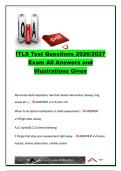
ITLS Test Questions 2026/2027
Exam All Answers and
Illustrations Given
Abnormal adult respiratory rate that needs intervention (airway, bag
assist etc..) - ANSWER ✔✔<8 and >24
When to do spinal mobilization in initial assessment - ANSWER
✔✔Right after airway
A,(C-spine)B,C,(Control bleeding)
3 things that stop your assessment right away. - ANSWER ✔✔scene
hazard, airway obstruction, cardiac arrest
, During the Primary Survey, when do you Control major bleeding -
ANSWER ✔✔In the Initial assessment
Airway, breathing, circulation, control bleeding
When the injury occurs, what clock just started? - ANSWER ✔✔The
"Golden Period" (used to be the golden hour)
Max length of your initial assessment - ANSWER ✔✔2 min.
Max length of "load and go" scene time? - ANSWER ✔✔Critical
trauma scene time is 5 min. or less.
ELM stands for? - ANSWER ✔✔External Laryngeal Manipulation
Selick vs. ELM - ANSWER ✔✔Selick is when you close the
esophagus to prevent air in the gastric.
ELM is a manipulation technique to move the airway into alignment for
intubation.
SMR stands for? - ANSWER ✔✔Spinal Mobilization RESTRICTION
Best GCS score is? - ANSWER ✔✔Eyes 4
Verbal 5
Motor 6