

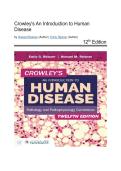
Crowley's An Introduction to Human
Disease
by Howard Reisner (Author), Emily Reisner (Author)
12th Edition
,TABLE OF CONTENTS
Chapter 1 General Concepts of Disease: Principles of Diagnosis
Chapter 2 Cells and Tissues: Their Structure and Function in Health and Disease
Chapter 3 Genes and Genetic Disease
Chapter 4 Inflammation and Repair
Chapter 5 Immunity, Hypersensitivity, Immunodeficiency, and Autoimmune Diseases
Chapter 6 Neoplastic Disease
Chapter 7 Pathogenic Microorganisms
Chapter 8 Parasitic Disease
Chapter 9 The Cardiovascular System
Chapter 10 Diseases of Blood Circulation
Chapter 11 Diseases of the Lymphatic Systems
Chapter 12 Diseases of Red Blood Cells, Thrombocytes, and Hemostasis
Chapter 13 The Respiratory System
Chapter 14 The Breast
,Chapter 15 Pregnancy and Infertility
Chapter 16 Congenital and Developmental Diseases
Chapter 17 The Urinary System and Fluid Hemostasis
Chapter 18 The Female and Male Reproductive Systems
Chapter 19 The Liver and the Biliary System
Chapter 20 The Pancreas and Diabetes Mellitus
Chapter 21 The Gastrointestinal Tract
Chapter 22 The Endocrine Glands
Chapter 23 The Nervous System
Chapter 24 The Musculoskeletal System
, Test Bank: An Introduction to Human Disease
Pathology and Pathophysiology Correlations, 12th Edition
Crowley/Reisner (2026) — Chapters 1–24
CHAPTER 1: INTRODUCTION TO DISEASE AND PATHOLOGY
Multiple Choice Questions
1. The study of the structural and functional changes in cells, tissues, and organs that cause or are
caused by disease is called:
A) Physiology
B) Pathology
C) Epidemiology
D) Etiology
Answer: B
Rationale: Pathology is defined as the study of structural and functional changes in cells, tissues, and
organs that underlie disease.
2. The cause of a disease is referred to as its:
A) Pathogenesis
B) Prognosis
C) Etiology
D) Sequela
Answer: C
Rationale: Etiology refers to the cause or origin of a disease. Pathogenesis describes the mechanism by
which disease develops.
3. The mechanism by which a causative agent produces disease is called:
Disease
by Howard Reisner (Author), Emily Reisner (Author)
12th Edition
,TABLE OF CONTENTS
Chapter 1 General Concepts of Disease: Principles of Diagnosis
Chapter 2 Cells and Tissues: Their Structure and Function in Health and Disease
Chapter 3 Genes and Genetic Disease
Chapter 4 Inflammation and Repair
Chapter 5 Immunity, Hypersensitivity, Immunodeficiency, and Autoimmune Diseases
Chapter 6 Neoplastic Disease
Chapter 7 Pathogenic Microorganisms
Chapter 8 Parasitic Disease
Chapter 9 The Cardiovascular System
Chapter 10 Diseases of Blood Circulation
Chapter 11 Diseases of the Lymphatic Systems
Chapter 12 Diseases of Red Blood Cells, Thrombocytes, and Hemostasis
Chapter 13 The Respiratory System
Chapter 14 The Breast
,Chapter 15 Pregnancy and Infertility
Chapter 16 Congenital and Developmental Diseases
Chapter 17 The Urinary System and Fluid Hemostasis
Chapter 18 The Female and Male Reproductive Systems
Chapter 19 The Liver and the Biliary System
Chapter 20 The Pancreas and Diabetes Mellitus
Chapter 21 The Gastrointestinal Tract
Chapter 22 The Endocrine Glands
Chapter 23 The Nervous System
Chapter 24 The Musculoskeletal System
, Test Bank: An Introduction to Human Disease
Pathology and Pathophysiology Correlations, 12th Edition
Crowley/Reisner (2026) — Chapters 1–24
CHAPTER 1: INTRODUCTION TO DISEASE AND PATHOLOGY
Multiple Choice Questions
1. The study of the structural and functional changes in cells, tissues, and organs that cause or are
caused by disease is called:
A) Physiology
B) Pathology
C) Epidemiology
D) Etiology
Answer: B
Rationale: Pathology is defined as the study of structural and functional changes in cells, tissues, and
organs that underlie disease.
2. The cause of a disease is referred to as its:
A) Pathogenesis
B) Prognosis
C) Etiology
D) Sequela
Answer: C
Rationale: Etiology refers to the cause or origin of a disease. Pathogenesis describes the mechanism by
which disease develops.
3. The mechanism by which a causative agent produces disease is called:


