

[NSG 1]
NSG 1
Study online at https://quizlet.com/_iy4jmd
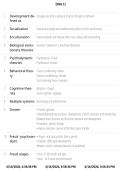
1. Development de- Changes iver time in physical structure thought or behavior
fined as
2. Socialization How we are taught and conditioned by others to fit in and function
3. Enculturation How we absorb and observe info in our culture and surrounding
4. Biological evolu- Evolution- Darwinism ( attachment theories)
tionary theories
5. Psychodynamic Psychosexual - Freud
theories Psychosocial- erikson
6. Behavioral theo- Classic conditioning- Pavlov
ry Operant conditioning- skinner
Social learning theory- bandura
7. Cognitive theo- Adaption - Piaget
ries Social cognitive- vygotsky
8. Multiple systems Bio ecological bronfenbrenner
9. Darwin • Human genome
• Developmental neuroscience- development of brain structures and relationship
between brain structure and functions behavior and development
• Evolution- species change
• Natural selection- survival of the fittest gene transfer
10. Freud - psychoan- • Stages- oral, anal, phallic, latent, genital
alytic • Fixation- difficulty w development
•fixation result in primitive behavior in adulthood
11. Freud stages • Oral - 0-18 (mouth and lips)
• Anal - 18-3 (anus and elimination)
4/16/2026, 4:58:38 PM 4/16/2026,1 /4:58:36
6
PM 4/16/2026, 4:58:34 PM
, [NSG 1]
NSG 1
Study online at https://quizlet.com/_iy4jmd
• phallic - 3-6 (genitals)
• Latent - 6-12 (repress sexual urge)
• Genital - 12+ (sexual impulses return)
12. Psychosocial - Er- • Neo Freudian
ickson • ego identity - who we are
• conscious forces and stages through life
13. Erickson • trust vs mistrust- 0-12 (trust of environment from caregiver
• autonomy vs shame 12-3 (discover own body)
• initiative vs guilt 3-6 (children explore beyond themselves)
• industry vs inferiority 6-12 (skills learned at school home and world)
• identity vs diffusion 12-18 (learning roles)
• intimacy vs isolation 18-40 (conflict)
• Generativity vs self absorb 40-65 (assistance of others)
•integrity vs despair 65+ (look back, judge)
14. Classical condi- Pavlov
tioning
15. Operant Rewards and punishments
16. social learning Social behavior of others and how it impacts our learning
theory
17. Watson: Classical Conditioned emotional response
Conditioning
18. Bandura Behavior shaped by observe in others (bobo)
19. Skinner's Oper- Increase or decrease behavior based in + and - reinforcement and punishment
ant Conditioning
20.
4/16/2026, 4:58:38 PM 4/16/2026,2 /4:58:36
6
PM 4/16/2026, 4:58:34 PM
NSG 1
Study online at https://quizlet.com/_iy4jmd
1. Development de- Changes iver time in physical structure thought or behavior
fined as
2. Socialization How we are taught and conditioned by others to fit in and function
3. Enculturation How we absorb and observe info in our culture and surrounding
4. Biological evolu- Evolution- Darwinism ( attachment theories)
tionary theories
5. Psychodynamic Psychosexual - Freud
theories Psychosocial- erikson
6. Behavioral theo- Classic conditioning- Pavlov
ry Operant conditioning- skinner
Social learning theory- bandura
7. Cognitive theo- Adaption - Piaget
ries Social cognitive- vygotsky
8. Multiple systems Bio ecological bronfenbrenner
9. Darwin • Human genome
• Developmental neuroscience- development of brain structures and relationship
between brain structure and functions behavior and development
• Evolution- species change
• Natural selection- survival of the fittest gene transfer
10. Freud - psychoan- • Stages- oral, anal, phallic, latent, genital
alytic • Fixation- difficulty w development
•fixation result in primitive behavior in adulthood
11. Freud stages • Oral - 0-18 (mouth and lips)
• Anal - 18-3 (anus and elimination)
4/16/2026, 4:58:38 PM 4/16/2026,1 /4:58:36
6
PM 4/16/2026, 4:58:34 PM
, [NSG 1]
NSG 1
Study online at https://quizlet.com/_iy4jmd
• phallic - 3-6 (genitals)
• Latent - 6-12 (repress sexual urge)
• Genital - 12+ (sexual impulses return)
12. Psychosocial - Er- • Neo Freudian
ickson • ego identity - who we are
• conscious forces and stages through life
13. Erickson • trust vs mistrust- 0-12 (trust of environment from caregiver
• autonomy vs shame 12-3 (discover own body)
• initiative vs guilt 3-6 (children explore beyond themselves)
• industry vs inferiority 6-12 (skills learned at school home and world)
• identity vs diffusion 12-18 (learning roles)
• intimacy vs isolation 18-40 (conflict)
• Generativity vs self absorb 40-65 (assistance of others)
•integrity vs despair 65+ (look back, judge)
14. Classical condi- Pavlov
tioning
15. Operant Rewards and punishments
16. social learning Social behavior of others and how it impacts our learning
theory
17. Watson: Classical Conditioned emotional response
Conditioning
18. Bandura Behavior shaped by observe in others (bobo)
19. Skinner's Oper- Increase or decrease behavior based in + and - reinforcement and punishment
ant Conditioning
20.
4/16/2026, 4:58:38 PM 4/16/2026,2 /4:58:36
6
PM 4/16/2026, 4:58:34 PM


