

Written by students who passed Immediately available after payment Read online or as PDF Wrong document? Swap it for free 4.6 TrustPilot
logo-home
Document preview thumbnail
Preview 4 out of 75 pages
Summary

Summary Grade 11 - Mathematics Study Guide (Paper 1 and 2)

Document preview thumbnail
Preview 4 out of 75 pages

OverviewMaster Grade 11 Mathematics with this structured, visually engaging study reference. Divided into Book A (Algebra) and Book B (Geometry & Trigonometry), this guide synthesizes core curriculum concepts into clear diagrams, step-by-step methods, worked examples, and quick-reference formula sheets. Designed specifically for exam preparation and deep conceptual understanding, it bridges basic algebraic reasoning with advanced geometric and trigonometric problem-solving. Detailed Curriculum CoverageBook A: Algebra, Equations, Functions & Financial MathematicsChapter 1: Number Systems & Operations Number Sets: Classification of Natural ($mathbb{N}$), Counting ($mathbb{N}_0$), Integer ($mathbb{Z}$), Rational ($mathbb{Q}$), Irrational ($mathbb{Q}'$), Real ($mathbb{R}$), and Non-Real numbers. Fractions & Operations: Common vs. decimal fractions, proper/improper classification, arithmetic rules, converting repeating decimals to fractions using algebraic subtraction, and rounding rules. Core Arithmetic: BODMAS/PEMDAS rules, sign conventions, root simplification rules, and prime factor techniques for LCM and GCD/HCF. Percentages & Algebra: Percentage increases/decreases, factorizing algebraic fractions, performing fractional operations, and setting denominator restrictions ($x neq text{value}$). Chapter 2: Exponents & Roots (Surds) The 8 fundamental laws of exponents, rational exponents, and base conversion using prime factorization. Factoring multi-term exponential expressions. Root properties, surd simplification, and denominator rationalization using conjugate surds. Chapter 3: Equations & Inequalities Linear & Quadratic Equations: Standard form $ax^2 + bx + c = 0$, solving via factorization, completing the square, and the Quadratic Formula derivation. The Discriminant ($Delta = b^2 - 4ac$): Determining the nature of roots (real, equal, rational, irrational, non-real). Systems & Exponential Equations: Simultaneous linear-linear and linear-quadratic equations, exponential equations with variables in the exponent or base, and power-equating rules. Inequalities & Advanced Equations: Solving linear inequalities (sign flips) and quadratic inequalities using parabola/number line sketches. Subject Change & Root Equations: Isolating variables, clearing radical expressions, and detecting extraneous solutions. Chapter 4: Graphs & Functions in the Cartesian Plane Straight Line: $y = mx + c$, slope types, domain, and range. Parabola: Standard, root, and turning point forms $y = a(x-p)^2 + q$. Hyperbola: $y = frac{a}{x-p} + q$, vertical/horizontal asymptotes, quadrant placement, and axes of symmetry. Exponential Graph: $y = a cdot b^{x-p} + q$, growth/decay, asymptotes, and axis reflections. Parameter Effects: Comprehensive breakdown of horizontal shifts ($p$), vertical shifts ($q$), and stretches/reflections ($a$) across all function types. Chapter 5: Financial Mathematics Simple Interest ($A = P(1 + in)$) vs. Compound Interest ($A = P(1 + i)^n$) models. Straight-line depreciation vs. reducing balance depreciation. Converting nominal interest rates ($i_{text{nom}}$) to effective annual rates ($i_{text{eff}}$) across daily, monthly, quarterly, and semi-annual compounding periods. Chapter 6: Sequences & Series Linear (Arithmetic) Sequences: Constant first difference ($T_n = a + (n-1)d$). Geometric Sequences: Constant ratio ($T_n = a cdot r^{n-1}$). Quadratic Sequences: Constant second difference ($T_n = an^2 + bn + c$). Chapter 7: Probability & Counting Principles Theoretical probability, sample space ($S$), and event definitions. Rules for mutually exclusive, non-exclusive ($P(A cup B) = P(A) + P(B) - P(A cap B)$), and independent events. Venn diagrams, set notation ($cap, cup, text{complements}$), Fundamental Counting Principle, and factorials ($n!$) with repetition rules. Book B: Geometry, Measurement & TrigonometryChapter 1: 2D Geometry & Polygons Quadrilateral hierarchy and properties: Square, Rectangle, Rhombus, Parallelogram, Trapezium, and Kite. Triangle classification (Equilateral, Isosceles, Right-angled) and angle relationships (interior sums, exterior angle theorem). Fundamental line relationships: Supplementary, complementary, vertically opposite, co-interior, corresponding, and alternate angles. Chapter 2: Analytical Geometry Gradient ($m$), Distance ($d$), and Midpoint ($M$) formulas. Parallel ($m_1 = m_2$) vs. Perpendicular ($m_1 cdot m_2 = -1$) line conditions, collinearity checks, and finding line equations. Inclination angle ($tan theta = m$) and calculating acute/obtuse angles between intersecting lines. Triangle line segments: Medians, Altitudes, and Perpendicular Bisectors. Chapter 3: 2D/3D Measurement & Geometry Perimeter and Area formulas for 2D shapes (Squares, Rectangles, Circles, Triangles, Rhombuses, Parallelograms, Trapeziums, Kites). Volume and Total Surface Area (TSA) formulas for 3D solids: Rectangular/Triangular Prisms, Pyramids, Cylinders, Cones, Spheres, and Hemispheres. Platonic Solids: Structural breakdown (faces, face shapes, vertices, edges) for Tetrahedron, Cube, Octahedron, Dodecahedron, and Icosahedron. Chapter 4: Trigonometry & Triangles Right-angled trigonometry (SOH-CAH-TOA) and exact values for special angles ($0^circ, 30^circ, 45^circ, 60^circ, 90^circ, 180^circ, 270^circ, 360^circ$). CAST diagram for quadrant signs and reduction formulas ($180^circ pm theta$, $360^circ pm theta$, negative angles, co-functions $90^circ - theta$). Quotient, Pythagorean, Compound, and Double angle identities. Solving trigonometric equations (reference angles, CAST placement, domain restrictions, and general solutions). Non-right-angled triangle rules: Sine Rule, Cosine Rule, and Area Rule with step-by-step proofs. Trigonometric function graphs ($y = sin x, y = cos x, y = tan x$), transformations ($a, p, q$), symmetry properties, and proof techniques. Summary & Study Resources:Comprehensive Formula Reference Card: Quick access to all crucial Algebra, Trigonometry, Finance, and Analytical Geometry formulas. Exam Strategy & Tips: Advice on showing working steps, identifying variable restrictions early, checking for extraneous solutions, and reading parameter transformations on graphs. Key FeaturesVisual Mind Maps & Diagrams: Includes clear flowcharts for number classifications, quadrilateral hierarchies, CAST diagrams, and graph transformations. Worked Solutions & Proofs: Step-by-step derivations (such as the Quadratic Formula derivation, Sine Rule proof, and Area Rule proof) alongside fully worked algebraic and trigonometric examples. Exam-Oriented Layout: Highlights common traps—such as root restrictions, non-real numbers, sign flips in inequalities, and undefined trigonometric ratios.

Content preview

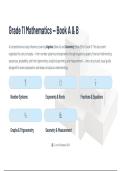
Grade 11 Mathematics — Book A & B
A comprehensive study reference covering Algebra (Book A) and Geometry (Book B) for Grade 11. This document
organizes the core concepts — from number systems and exponents through equations, graphs, financial mathematics,
sequences, probability, and into trigonometry, analytical geometry, and measurement — into a structured, visual guide
designed for exam preparation and deep conceptual understanding.


Number Systems Exponents & Roots Fractions & Equations


Graphs & Trigonometry Geometry & Measurement

© E-Loné Scheepers 2026

, CHAPTER 1 — BOOK A


The Number Family: Types of Numbers
Mathematics is built upon a hierarchy of number sets. Understanding the family of numbers — from the simplest
counting numbers to the complex — is the foundation for all algebraic reasoning. The diagram below summarizes the
four main branches of the number family, each of which contains distinct subsets with specific properties.


© E-Loné Scheepers 2026

,Natural Numbers, Counting Numbers & Integers
Natural Numbers N Counting Numbers N0 ​


The set of positive integers used for counting: N0 = {0; 1; 2; 3; … }


N = {1; 2; 3; … } Counting numbers are natural numbers extended to
include zero. Zero is neither positive nor negative.
Even numbers: 2; 4; 6; 8; …
Odd numbers: 1; 3; 5; 7; … Integers Z
Prime numbers: 2; 3; 5; 7; 11; 13; … (note: 1 is NOT prime)
Z = {… ; −2; −1; 0; 1; 2; … }
Composite numbers: 4; 6; 8; 9; 10; 12; … (more than 2
factors) Integers include all positive natural numbers, zero, and all
Square numbers: 1; 4; 9; 16; 25; … negative whole numbers. They extend the number line in

Cube numbers: 1; 8; 27; 64; 125; … both directions without limit.


Every natural number is an integer, but not every
integer is a natural number.


© E-Loné Scheepers 2026

, Rational and Irrational Numbers
Rational Numbers Q Irrational Numbers Q′
Any number that can be written as a fraction A
B
​ where Numbers that cannot be written as a fraction — they
A, B ∈ Z and B =
 0. have infinite, non-repeating digits after the decimal
point.
All integers
All common fractions All non-finite, non-repeating decimals

All finite decimal fractions Pi: π ≈ 3.14159 …

All repeating decimal fractions positive non-perfect-square ​


3
positive non-perfect-cube ​


© E-Loné Scheepers 2026

Document information

Schooljaar
200
Uploaded on
August 12, 2026
Number of pages
75
Written in
2026/2027
Type
Summary
$9.55

Wrong document? Swap it for free Within 14 days of purchase and before downloading, you can choose a different document. You can simply spend the amount again.
Written by students who passed
Immediately available after payment
Read online or as PDF

Seller avatar
e-lonescheepers
4.0
(2)
Sold
6
Followers
4
Items
32
Last sold
1 year ago


Why students choose Stuvia

Created by fellow students, verified by reviews

Quality you can trust: written by students who passed their exams and reviewed by others who've used these revision notes.

Didn't get what you expected? Choose another document

No problem! You can straightaway pick a different document that better suits what you're after.

Pay as you like, start learning straight away

No subscription, no commitments. Pay the way you're used to via credit card and download your PDF document instantly.

Student with book image

“Bought, downloaded, and smashed it. It really can be that simple.”

Alisha Student

Working on your references?

Create accurate citations in APA, MLA and Harvard with our free citation generator.

Working on your references?

Frequently asked questions

