

Written by students who passed Immediately available after payment Read online or as PDF Wrong document? Swap it for free 4.6 TrustPilot
logo-home
Document preview thumbnail
Preview 3 out of 26 pages
Exam (elaborations)

PPCT Defensive Tactics 2026/2027 | 150+ Questions & Answers | Use of Force, Survival Stress, Handcuffing & Control Tactics

Document preview thumbnail
Preview 3 out of 26 pages

This PPCT Defensive Tactics 2026/2027 exam study guide contains 150+ questions and correct answers across 26 pages, providing comprehensive written-exam preparation on survival stress, the autonomic nervous system, memory and reaction time, motor performance, use-of-force concepts, levels of resistance and control, tactical positioning, handcuffing, control principles, officer safety and defensive-tactics terminology. The document's first page identifies it as a 2026/2027 PPCT Defensive Tactics exam question-and-answer resource, while the subsequent pages develop the physiological, cognitive and tactical concepts assessed throughout the material. The opening chapters examine combat anxiety, survival stress and combat stress, together with the sympathetic and parasympathetic branches of the Autonomic Nervous System (ANS). Students review sympathetic nervous system activation, vasoconstriction and vasodilation, perceptual narrowing, increased heart rate, rapid breathing, muscular tremors and concentration difficulties. The guide also covers the Inverted-U Law, an optimal-performance heart-rate range presented in the source, and the differences among fine, complex and gross motor skills. Memory and performance under stress form another important component. The document distinguishes the short-term sensory store, short-term memory and long-term memory and discusses memory recovery across sleep periods following stressful incidents. It connects these concepts with tactical performance through hydration, nutrition, protein, carbohydrates, tactical breathing, visualization drills, confidence and the "faith factor." The material additionally examines PNS backlash, including the triggers and physiological symptoms described by the course. A major portion of the study guide covers the PPCT control continuum and resistance classifications. Students distinguish officer presence, verbal direction, soft empty-hand control, hard empty-hand control, intermediate options and deadly force. Corresponding resistance categories include psychological intimidation, verbal noncompliance, passive resistance, defensive resistance, active aggression and deadly-force assault. The document also introduces tactical, legal and medical acceptability as considerations associated with force options. The material then examines reaction time, tactical positioning and control principles. Topics include perception, threat analysis, response formulation and motor initiation; stimulus-response training; reactionary distance; Hick's Law; frontal, frontal-oblique, neutral, rear-oblique and rear positions; and the control concepts of pain compliance, stunning, distraction, balance displacement and motor dysfunction. The document also reviews the Total Control and One-Plus-One theories used within the PPCT curriculum. The handcuffing and subject-control section addresses cooperative, potentially uncooperative and totally uncooperative subjects, approach-to-contact considerations, control upon touch, application speed, checking cuff tightness and double-locking when appropriate. It also reviews the course's criteria for restraint, positioning terminology and follow-up control. These questions are especially relevant for learners preparing for the theoretical component of an authorized defensive-tactics course. Later sections cover the document's terminology for pressure-point concepts, joint-control concepts, motor dysfunction and defensive counter-strikes, followed by material on weapon retention, disarming concepts and impact-weapon theory. The final pages address baton terminology, control-level classifications, medical implications and post-force considerations such as requesting emergency medical assistance following an injury. Because these sections concern potentially dangerous physical techniques, this description summarizes them as examination subjects rather than reproducing operational instructions; practical skills should be learned through qualified instructors and current agency policy. Overall, this document provides an extensive PPCT Defensive Tactics theory review and exam question bank, combining stress physiology, cognitive performance, resistance assessment, control options, reaction time, positioning, handcuffing theory and officer-safety concepts. The uploaded file does not identify a formal course code, university, police academy or other institution, so the title uses Institution Not Specified rather than inventing an affiliation. Relevant students: This document is relevant for PPCT Defensive Tactics trainees, authorized law-enforcement academy students, corrections trainees, criminal justice students, public-safety learners and personnel completing approved defensive-tactics education. It is particularly useful for written-exam revision involving the autonomic nervous system, survival stress, motor skills, reaction time, levels of resistance, control options, tactical positioning, handcuffing theory, officer safety and PPCT terminology. Keywords: PPCT Defensive Tactics 2026, PPCT Defensive Tactics 2027, PPCT exam questions and answers, PPCT Defensive Tactics exam, PPCT study guide, PPCT certification, defensive tactics exam, defensive tactics questions and answers, law enforcement defensive tactics, police defensive tactics, survival stress, combat stress, autonomic nervous system, sympathetic nervous system, parasympathetic nervous system, Inverted U Law, motor skills, reaction time, Hicks Law, stimulus response training, use of force, use of force continuum, control continuum, levels of resistance, levels of control, officer presence, verbal direction, soft empty hand control, hard empty hand control, tactical positioning, reactionary gap, pain compliance, motor dysfunction, handcuffing theory, officer safety, Total Control Theory, One Plus One Theory, PPCT training, law enforcement academy exam, criminal justice study guide

Content preview

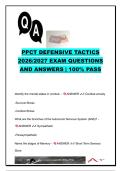
PPCT DEFENSIVE TACTICS
2026/2027 EXAM QUESTIONS
AND ANSWERS | 100% PASS


Identify the mental states in combat. - ANSWER ✔✔-Combat anxiety


-Survival Stress

-Combat Stress

What are the branches of the Autonomic Nervous System (ANS)? -

ANSWER ✔✔-Sympathetic


-Parasympathetic


Name the stages of Memory - ANSWER ✔✔-Short Term Sensory

Store

,-Short Term Memory

-Long Term Memory

What percentage does a person's peripheral field reduce to during SNS?

- ANSWER ✔✔- 70%


The Vascular activity that causes the blood vessels to narrow sending

blood to the core of the body to protect the vital organs? - ANSWER

✔✔Vasoconstriction


What is Vasodilation? - ANSWER ✔✔Creates a backlash effect for

normal blood flow to resume when SNS winds down.


Symptoms of SNS activation. - ANSWER ✔✔- Rapid Breathing


- Cottonmouth

- Muscular tremors

- Increased Heart rate

- Sweaty palms

- Visual difficulty

- Loss of ability to concentrate


What are the 3 motor skill classifications? - ANSWER ✔✔- Fine

, - Complex

- Gross


Describe Inverted-U Law. - ANSWER ✔✔The relationship between

heart rate and performance.


What is optimal heart rate? - ANSWER ✔✔115-145 BPM


A skill that requires hand/eye coordination + hand dexterity. -

ANSWER ✔✔Fine Motor Skill


A skill referring to shooting in a isosceles stance. - ANSWER

✔✔Gross Motor Skill


A skill including those that are used to perform a takedown with multiple

independent components. - ANSWER ✔✔Complex Motor Skill


What does the Short Term Sensory Store do? - ANSWER

✔✔Receives information and holds an image using perceptual senses.


What is short term memory? - ANSWER ✔✔Analyzes info and forms

a strategy based on training.


What is long term memory? - ANSWER ✔✔1. Used when STM can't

process.

2. Reaction time increases.

COPYRIGHT©NINJANERD 2025/2026. YEAR PUBLISHED 2026. COMPANY REGISTRATION NUMBER: 619652435. TERMS OF USE. PRIVACY
STATEMENT. ALL RIGHTS RESERVED
3


Document information

Uploaded on
August 12, 2026
Number of pages
26
Written in
2026/2027
Type
Exam (elaborations)
Contains
Questions & answers
$18.99

Wrong document? Swap it for free Within 14 days of purchase and before downloading, you can choose a different document. You can simply spend the amount again.
Written by students who passed
Immediately available after payment
Read online or as PDF

Seller avatar
Reputation scores are based on the amount of documents a seller has sold for a fee and the reviews they have received for those documents. There are three levels: Bronze, Silver and Gold. The better the reputation, the more your can rely on the quality of the sellers work.
NinjaNerd
3.4
(76)
Sold
397
Followers
6
Items
15334
Last sold
10 hours ago


Why students choose Stuvia

Created by fellow students, verified by reviews

Quality you can trust: written by students who passed their tests and reviewed by others who've used these notes.

Didn't get what you expected? Choose another document

No worries! You can instantly pick a different document that better fits what you're looking for.

Pay as you like, start learning right away

No subscription, no commitments. Pay the way you're used to via credit card and download your PDF document instantly.

Student with book image

“Bought, downloaded, and aced it. It really can be that simple.”

Alisha Student

Working on your references?

Create accurate citations in APA, MLA and Harvard with our free citation generator.

Working on your references?

Frequently asked questions
