

Written by students who passed Immediately available after payment Read online or as PDF Wrong document? Swap it for free 4.6 TrustPilot
logo-home
Document preview thumbnail
Preview 2 out of 9 pages
Exam (elaborations)

CPA Tax Module 2026/2027 | 40+ Questions & Answers | CCA, Capital Gains, Taxable Income, Dividends & Property

Document preview thumbnail
Preview 2 out of 9 pages

This CPA Tax Module 2026/2027 study guide contains 40+ exam questions and correct answers covering core Canadian taxation concepts relevant to CPA tax preparation. Across 9 pages, the document concentrates on taxable income calculations, Income Tax Act divisions, employment and property income, Capital Cost Allowance (CCA), capital gains and losses, dividends, the Principal Residence Exemption (PRE), superficial losses, capital gains reserves and personal-use property. The question-and-answer format makes the material suitable for rapid exam revision and testing of technical tax rules. The opening section examines the important distinction between capital property and inventory, explaining how a taxpayer's primary and secondary intentions can influence whether a disposition generates a capital gain or business income. It identifies practical factors used when assessing intention, including the relationship of a transaction to the taxpayer's business, the nature of the asset, transaction frequency, period of ownership, feasibility of the stated intention and the extent to which that intention was actually carried out. The document provides a structured review of taxable income and the Income Tax Act framework. Students work through the calculation of Division B net income and Division C taxable income while reviewing employment, business, property and other income, taxable capital gains, allowable capital losses, ABILs and other deductions. It also distinguishes the functions of Divisions A, B, C and E and identifies the Income Tax Regulations as a source for prescribed rates and CCA information. A particularly detailed portion covers Capital Cost Allowance, making the guide useful for candidates who need to memorize or distinguish major CCA classes. The material discusses Classes 1, 3, 8, 10, 10.1, 12, 13, 14, 14.1, 17, 43.1, 43.2, 44, 50 and 53, alongside available-for-use rules and assets maintained in separate CCA classes. It also addresses tax adjustments involving CCA, recapture, terminal losses, amortization, financing expenses, reserves, contingent liabilities, warranties, unpaid remuneration and non-deductible meals and entertainment. The investment and property-income section reviews eligible and non-eligible Canadian dividends, capital dividends and foreign dividends, together with carrying charges, soft costs and interest deductions associated with income-producing property. Students also review the calculation of capital gains and losses using proceeds of disposition, adjusted cost base and disposition expenses, as well as the moving weighted-average approach for determining the ACB of identical properties. Capital-property planning receives additional attention through superficial losses, capital gains reserves and the Principal Residence Exemption. The document explains the PRE formula and how designation decisions may be approached when a taxpayer owns two properties. It also identifies events that can cause a deemed disposition, including a change in property use, death, ceasing Canadian residency and gifting property. The final portion covers Personal-Use Property (PUP) and Listed Personal Property (LPP), including minimum cost/proceeds rules and the treatment of gains and losses. It also discusses the interaction between a terminal loss on a building and a capital gain on the associated land, convention-expense deductions, the tax treatment of dividends and the stage at which tax credits are applied. These topics make the resource useful for candidates who need a concise but technically broad review of Canadian income and property taxation. Relevant students: This document is most relevant for CPA PEP Taxation candidates, Canadian CPA students, accounting and taxation students, public accounting trainees, junior tax professionals and learners preparing for Canadian income-tax examinations. It is particularly useful for students reviewing CCA classes, taxable-income calculations, capital versus income treatment, capital gains and losses, dividend taxation, property income, PRE, PUP/LPP and common accounting-to-tax adjustments. Keywords: CPA Tax Module 2026, CPA Tax Module 2027, CPA Tax questions and answers, CPA Tax exam, CPA PEP Taxation, CPA Canada Tax, Canadian taxation exam, Canadian income tax, taxable income calculation, Income Tax Act, Division B income, Division C income, capital property vs inventory, business income, employment income, property income, Capital Cost Allowance, CCA, CCA classes, Class 1 CCA, Class 8 CCA, Class 10 CCA, Class 10.1, Class 12 CCA, Class 13 CCA, Class 14.1, Class 43.1, Class 43.2, Class 44, Class 50, Class 53, recapture, terminal loss, eligible dividends, non eligible dividends, capital dividends, foreign dividends, capital gains, capital losses, adjusted cost base, ACB, superficial loss, capital gains reserve, Principal Residence Exemption, PRE, deemed disposition, personal use property, PUP, listed personal property, LPP, tax deductions, CPA tax study guide, CPA tax exam preparation

Content preview

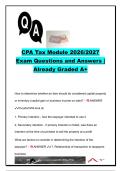
CPA Tax Module 2026/2027
Exam Questions and Answers |
Already Graded A+


How to determine whether an item should be considered capital property

or inventory (capital gain or business income on sale)? - ANSWER

✔✔Courts/CRA look at:


1. Primary Intention - how the taxpayer intended to use it

2. Secondary intention - if primary intention is foiled, was there an

intention at the time of purchase to sell the property at a profit

What are factors to consider in determining the intention of the

taxpayer? - ANSWER ✔✔1. Relationship of transaction to taxpayers

business

, 2. Nature of the asset (if can be used over lots of time it could be a

capital asset)

3. Number and frequency of transactions (if lots then could be inventory)

4. Length of period of ownership (longer time could be capital asset)

5. Feasibility of taxpayers intention - if primary intention unlikely to

succeed then secondary intention may have been main play

6. Extent to which the intention carried out by the taxpayer - if little or no

effort to use it as a capital asset then it may be inventory


What is the formula for taxable income? - ANSWER ✔✔Income from

employment, business, property and other income

Add: Taxable capital gains less allowable capital losses

Less: Other deductions

Less: Losses from employment, business, property and allowable

business investment losses (ABIL)

= Division B Income (net income for tax purposes)

Less: Division C deductions (stock option and lifetime capital gains

deductions for individuals and dividends from taxable Canadian

corporations and charitable donations for corporations, non-capital and

net capital losses for all taxpayers)

Document information

Uploaded on
August 12, 2026
Number of pages
9
Written in
2026/2027
Type
Exam (elaborations)
Contains
Questions & answers
$18.99

Wrong document? Swap it for free Within 14 days of purchase and before downloading, you can choose a different document. You can simply spend the amount again.
Written by students who passed
Immediately available after payment
Read online or as PDF

Seller avatar
Reputation scores are based on the amount of documents a seller has sold for a fee and the reviews they have received for those documents. There are three levels: Bronze, Silver and Gold. The better the reputation, the more your can rely on the quality of the sellers work.
NinjaNerd
3.4
(76)
Sold
397
Followers
6
Items
15334
Last sold
10 hours ago


Why students choose Stuvia

Created by fellow students, verified by reviews

Quality you can trust: written by students who passed their tests and reviewed by others who've used these notes.

Didn't get what you expected? Choose another document

No worries! You can instantly pick a different document that better fits what you're looking for.

Pay as you like, start learning right away

No subscription, no commitments. Pay the way you're used to via credit card and download your PDF document instantly.

Student with book image

“Bought, downloaded, and aced it. It really can be that simple.”

Alisha Student

Working on your references?

Create accurate citations in APA, MLA and Harvard with our free citation generator.

Working on your references?

Frequently asked questions

