

ATI RN Concept-Based Assessment
Level 3 — Practice Exam
(Representative Sample)
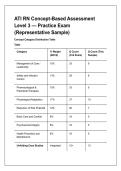
Concept Category Distribution Table
Table
Category % Weight Q Count Q Count (This
(220 Q) (Full Exam) Sample)
Management of Care / 15% 33 9
Leadership
Safety and Infection 13% 29 8
Control
Pharmacological & 15% 33 9
Parenteral Therapies
Physiological Adaptation 17% 37 10
Reduction of Risk Potential 12% 26 7
Basic Care and Comfort 8% 18 5
Psychosocial Integrity 8% 18 5
Health Promotion and 8% 18 5
Maintenance
Unfolding Case Studies Integrated 12+ 12
, Category % Weight Q Count Q Count (This
(220 Q) (Full Exam) Sample)
TOTAL 100% 220 60
CASE STUDY 1: Postoperative Complications & Clinical Judgment
CASE STUDY: M.T. is a 68-year-old male who underwent an open right hemicolectomy
for colon cancer 18 hours ago. He has a history of hypertension, type 2 diabetes
mellitus, and hyperlipidemia. Current medications include metoprolol, metformin (held
post-op), lispro insulin sliding scale, and enoxaparin 40 mg subQ daily. He has a Foley
catheter, NG tube to low intermittent suction, and a Jackson-Pratt drain to the right
lower quadrant. Vital signs: BP 142/88, HR 96, RR 22, Temp 38.2°C (100.8°F), SpO₂
94% on 2L NC. He reports pain 6/10 at the incision site. Lung sounds are diminished
bilaterally at the bases. The nurse notes the JP drain has 45 mL of serosanguineous
fluid in 4 hours.
Q1: The nurse is prioritizing hypotheses about M.T.'s elevated temperature and
tachycardia. Which hypothesis should the nurse prioritize first?
A. Postoperative atelectasis related to shallow breathing and pain
B. Surgical site infection related to colon resection contamination risk
C. Venous thromboembolism related to postoperative immobility
D. Hypovolemia related to inadequate fluid resuscitation
Correct Answer: A [CORRECT]
Rationale: At 18 hours post-op, atelectasis is the most common cause of low-grade
fever and tachycardia. The diminished lung sounds at the bases, shallow respirations
(RR 22, pain 6/10), and SpO₂ of 94% support this hypothesis. While infection and VTE
are possible, atelectasis is the most immediate and likely cause in this timeframe and
requires prompt intervention (incentive spirometry, early mobilization, pain control)
before complications like pneumonia develop.
Q2: The nurse reviews M.T.'s morning laboratory results. Which finding requires
immediate follow-up?
A. WBC 12,200/mm³
B. Potassium 3.2 mEq/L
,C. Blood glucose 198 mg/dL
D. Hemoglobin 10.8 g/dL
Correct Answer: B [CORRECT]
Rationale: A potassium of 3.2 mEq/L is below normal (3.5–5.0 mEq/L) and places M.T.
at risk for cardiac dysrhythmias, especially given his postoperative state and metoprolol
use. While the elevated WBC and glucose are expected postoperatively, and the
hemoglobin reflects surgical blood loss, hypokalemia requires immediate replacement
and cardiac monitoring to prevent life-threatening arrhythmias.
Q3: M.T. is ordered to begin clear liquids. Which assessment finding indicates he is
ready to advance his diet?
A. Presence of bowel sounds in all four quadrants
B. Passage of flatus or stool
C. JP drain output less than 30 mL in 8 hours
D. NG tube output less than 200 mL in 8 hours
Correct Answer: B [CORRECT]
Rationale: Passage of flatus or stool indicates the return of peristalsis, which is the
primary indicator for advancing diet after abdominal surgery. While bowel sounds are
assessed, they are not definitive evidence of gut motility return. Drain and NG tube
outputs guide fluid management but do not confirm readiness for oral intake.
Q4: The nurse is evaluating M.T.'s pain management plan. Which outcome indicates
effective pain control?
A. Patient states pain is "tolerable" at 3/10 within 30 minutes of analgesic administration
B. Patient refuses to use the incentive spirometer due to incisional pain
C. Patient requests PRN opioid every 2 hours around the clock
D. Patient is somnolent with respiratory rate of 10 breaths/minute
Correct Answer: A [CORRECT]
Rationale: Effective pain management is evidenced by the patient reporting a tolerable
pain level (typically ≤3/10) after analgesic administration, allowing participation in
recovery activities like deep breathing and mobilization. Refusing spirometry, frequent
PRN requests, or somnolence with respiratory depression indicate inadequate or
excessive pain management requiring plan revision.
, Q5: On postoperative day 2, M.T. suddenly develops dyspnea, tachypnea (RR 28), and
reports pleuritic chest pain. SpO₂ drops to 88% on 2L NC. Which is the nurse's priority
action?
A. Administer a STAT dose of IV morphine for chest pain
B. Apply supplemental oxygen and prepare for possible CT pulmonary angiography
C. Obtain a 12-lead ECG to rule out myocardial infarction
D. Increase the enoxaparin dose to therapeutic levels
Correct Answer: B [CORRECT]
Rationale: The sudden onset of dyspnea, tachypnea, pleuritic chest pain, and
hypoxemia in a postoperative patient is highly suggestive of pulmonary embolism. The
priority is to increase oxygenation and prepare for diagnostic confirmation (CTPA or V/Q
scan). While ECG and pain management are relevant, addressing oxygenation and
facilitating rapid diagnosis takes precedence. Increasing enoxaparin requires a provider
order.
Q6: The nurse is delegating tasks to the unlicensed assistive personnel (UAP). Which
task is appropriate to delegate?
A. Assess M.T.'s abdominal incision for signs of dehiscence
B. Measure and record M.T.'s JP drain output
C. Evaluate M.T.'s pain level after ambulation
D. Teach M.T. about signs of surgical site infection
Correct Answer: B [CORRECT]
Rationale: Measuring and recording drain output is a task that falls within the UAP's
scope of practice, as it involves routine data collection without requiring clinical
judgment or interpretation. Assessment of incisions, evaluation of pain, and patient
teaching require nursing judgment and cannot be delegated to UAP.
CASE STUDY 2: Complex Medical-Surgical & Ethical Considerations
CASE STUDY: J.D. is a 54-year-old female admitted to the ICU with acute respiratory
distress syndrome (ARDS) secondary to aspiration pneumonia. She is intubated,
mechanically ventilated (AC/VC, TV 400, RR 14, FiO₂ 60%, PEEP 12), sedated with
propofol, and receiving norepinephrine for septic shock. Her husband presents her living
will, which states she does not want "prolonged mechanical ventilation or artificial
nutrition" if her prognosis is poor. However, her two adult children insist "everything
possible" be done. The attending physician believes J.D. has a reasonable chance of
recovery with continued supportive care for 48–72 hours.
Level 3 — Practice Exam
(Representative Sample)
Concept Category Distribution Table
Table
Category % Weight Q Count Q Count (This
(220 Q) (Full Exam) Sample)
Management of Care / 15% 33 9
Leadership
Safety and Infection 13% 29 8
Control
Pharmacological & 15% 33 9
Parenteral Therapies
Physiological Adaptation 17% 37 10
Reduction of Risk Potential 12% 26 7
Basic Care and Comfort 8% 18 5
Psychosocial Integrity 8% 18 5
Health Promotion and 8% 18 5
Maintenance
Unfolding Case Studies Integrated 12+ 12
, Category % Weight Q Count Q Count (This
(220 Q) (Full Exam) Sample)
TOTAL 100% 220 60
CASE STUDY 1: Postoperative Complications & Clinical Judgment
CASE STUDY: M.T. is a 68-year-old male who underwent an open right hemicolectomy
for colon cancer 18 hours ago. He has a history of hypertension, type 2 diabetes
mellitus, and hyperlipidemia. Current medications include metoprolol, metformin (held
post-op), lispro insulin sliding scale, and enoxaparin 40 mg subQ daily. He has a Foley
catheter, NG tube to low intermittent suction, and a Jackson-Pratt drain to the right
lower quadrant. Vital signs: BP 142/88, HR 96, RR 22, Temp 38.2°C (100.8°F), SpO₂
94% on 2L NC. He reports pain 6/10 at the incision site. Lung sounds are diminished
bilaterally at the bases. The nurse notes the JP drain has 45 mL of serosanguineous
fluid in 4 hours.
Q1: The nurse is prioritizing hypotheses about M.T.'s elevated temperature and
tachycardia. Which hypothesis should the nurse prioritize first?
A. Postoperative atelectasis related to shallow breathing and pain
B. Surgical site infection related to colon resection contamination risk
C. Venous thromboembolism related to postoperative immobility
D. Hypovolemia related to inadequate fluid resuscitation
Correct Answer: A [CORRECT]
Rationale: At 18 hours post-op, atelectasis is the most common cause of low-grade
fever and tachycardia. The diminished lung sounds at the bases, shallow respirations
(RR 22, pain 6/10), and SpO₂ of 94% support this hypothesis. While infection and VTE
are possible, atelectasis is the most immediate and likely cause in this timeframe and
requires prompt intervention (incentive spirometry, early mobilization, pain control)
before complications like pneumonia develop.
Q2: The nurse reviews M.T.'s morning laboratory results. Which finding requires
immediate follow-up?
A. WBC 12,200/mm³
B. Potassium 3.2 mEq/L
,C. Blood glucose 198 mg/dL
D. Hemoglobin 10.8 g/dL
Correct Answer: B [CORRECT]
Rationale: A potassium of 3.2 mEq/L is below normal (3.5–5.0 mEq/L) and places M.T.
at risk for cardiac dysrhythmias, especially given his postoperative state and metoprolol
use. While the elevated WBC and glucose are expected postoperatively, and the
hemoglobin reflects surgical blood loss, hypokalemia requires immediate replacement
and cardiac monitoring to prevent life-threatening arrhythmias.
Q3: M.T. is ordered to begin clear liquids. Which assessment finding indicates he is
ready to advance his diet?
A. Presence of bowel sounds in all four quadrants
B. Passage of flatus or stool
C. JP drain output less than 30 mL in 8 hours
D. NG tube output less than 200 mL in 8 hours
Correct Answer: B [CORRECT]
Rationale: Passage of flatus or stool indicates the return of peristalsis, which is the
primary indicator for advancing diet after abdominal surgery. While bowel sounds are
assessed, they are not definitive evidence of gut motility return. Drain and NG tube
outputs guide fluid management but do not confirm readiness for oral intake.
Q4: The nurse is evaluating M.T.'s pain management plan. Which outcome indicates
effective pain control?
A. Patient states pain is "tolerable" at 3/10 within 30 minutes of analgesic administration
B. Patient refuses to use the incentive spirometer due to incisional pain
C. Patient requests PRN opioid every 2 hours around the clock
D. Patient is somnolent with respiratory rate of 10 breaths/minute
Correct Answer: A [CORRECT]
Rationale: Effective pain management is evidenced by the patient reporting a tolerable
pain level (typically ≤3/10) after analgesic administration, allowing participation in
recovery activities like deep breathing and mobilization. Refusing spirometry, frequent
PRN requests, or somnolence with respiratory depression indicate inadequate or
excessive pain management requiring plan revision.
, Q5: On postoperative day 2, M.T. suddenly develops dyspnea, tachypnea (RR 28), and
reports pleuritic chest pain. SpO₂ drops to 88% on 2L NC. Which is the nurse's priority
action?
A. Administer a STAT dose of IV morphine for chest pain
B. Apply supplemental oxygen and prepare for possible CT pulmonary angiography
C. Obtain a 12-lead ECG to rule out myocardial infarction
D. Increase the enoxaparin dose to therapeutic levels
Correct Answer: B [CORRECT]
Rationale: The sudden onset of dyspnea, tachypnea, pleuritic chest pain, and
hypoxemia in a postoperative patient is highly suggestive of pulmonary embolism. The
priority is to increase oxygenation and prepare for diagnostic confirmation (CTPA or V/Q
scan). While ECG and pain management are relevant, addressing oxygenation and
facilitating rapid diagnosis takes precedence. Increasing enoxaparin requires a provider
order.
Q6: The nurse is delegating tasks to the unlicensed assistive personnel (UAP). Which
task is appropriate to delegate?
A. Assess M.T.'s abdominal incision for signs of dehiscence
B. Measure and record M.T.'s JP drain output
C. Evaluate M.T.'s pain level after ambulation
D. Teach M.T. about signs of surgical site infection
Correct Answer: B [CORRECT]
Rationale: Measuring and recording drain output is a task that falls within the UAP's
scope of practice, as it involves routine data collection without requiring clinical
judgment or interpretation. Assessment of incisions, evaluation of pain, and patient
teaching require nursing judgment and cannot be delegated to UAP.
CASE STUDY 2: Complex Medical-Surgical & Ethical Considerations
CASE STUDY: J.D. is a 54-year-old female admitted to the ICU with acute respiratory
distress syndrome (ARDS) secondary to aspiration pneumonia. She is intubated,
mechanically ventilated (AC/VC, TV 400, RR 14, FiO₂ 60%, PEEP 12), sedated with
propofol, and receiving norepinephrine for septic shock. Her husband presents her living
will, which states she does not want "prolonged mechanical ventilation or artificial
nutrition" if her prognosis is poor. However, her two adult children insist "everything
possible" be done. The attending physician believes J.D. has a reasonable chance of
recovery with continued supportive care for 48–72 hours.


