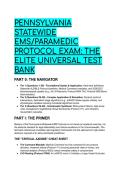
PENNSYLVANIA
STATEWIDE
EMS/PARAMEDIC
PROTOCOL EXAM: THE
ELITE UNIVERSAL TEST
BANK
PART 0: THE NAVIGATOR
● Tier 1 (Questions 1–28) - Foundational Syntax & Application: Hard-deck definitions,
Statewide ALS/BLS Protocol baselines, Medical Command mandates, and 2026/2027
pharmacological updates (e.g., Act 34 Naloxone, Protocol 6094 TXA, Protocol 6095 Blood
Administration).
● Tier 2 (Questions 29–58) - Complex Application & Simulation: Dynamic protocol
intersections, destination triage algorithms (e.g., mRACE Stroke bypass criteria), and
physiological variables requiring immediate algorithmic pivots.
● Tier 3 (Questions 59–88) - Grandmaster Synthesis: Multi-system failures, high-acuity
crisis management, legal/ethical refusal frameworks (Protocol 111), and refractory
resuscitation cascades.
PART I: THE PRIMER
Mastery of the Pennsylvania Statewide EMS Protocols is not merely an academic exercise; it is
the absolute standard for legal defensibility and clinical excellence in the Commonwealth. This
test bank meticulously translates rigid regulatory frameworks into the split-second, high-stakes
decisions required of an elite prehospital practitioner.
THE "CRITICAL AXIOMS" CHEAT SHEET
● The Command Mandate: Medical Command must be contacted for any protocol
deviation, treatment refusal (Protocol 111) involving abnormal vitals or minors, and
chemical sedation (Protocol 8003) unless immediate safety is compromised.
● LVO Routing (Protocol 7006): An mRACE score ≥ 5 dictates a Large Vessel Occlusion.
, You MUST bypass closer facilities for a Comprehensive or Thrombectomy-Capable
Stroke Center if transport is < 45 minutes.
● Push-Dose Pressors (Protocol 7005): Standard Push-Dose EPINEPHrine is mixed by
combining 1 mL of 1:10,000 (0.1 mg/mL) with 9 mL NSS to yield 10 mcg/mL.
● The Act 34 Firewall: Naloxone Leave-Behind packages distributed under EMSIB
2025-08 must have their distribution date and dosage recorded on the package or a
retrievable log, but STRICTLY NEVER in the Patient Care Record (PCR).
Protocol Intervention / Metric 2026 PA Statewide Standard
6094 Tranexamic Acid (TXA) 1 gram IV/IO infusion over 10
minutes (Loading Dose).
6095 Blood Administration Indicated for MAP < 60 mmHg
or SBP < 90 mmHg with
penetrating trauma.
3091 Termination of Resuscitation Requires Medical Command
order; highly supported by
EtCO2 < 10 mmHg after 20
mins.
11002 Eclampsia Magnesium Sulfate 1 g/min IV
(maximum 4 g).
PART II: THE ELITE TEST BANK
TIER 1: FOUNDATIONAL SYNTAX & APPLICATION
Q1: Under the guidelines established by Act 34 (EMSIB 2025-08) for the Naloxone
Leave-Behind program, a Paramedic distributes a 4mg dose package to the family of an
overdose patient. Which action regarding the documentation of this distribution is
IMMEDIATELY required? A) Document the patient's personally identifiable information (PII)
along with the lot number in the narrative of the ePCR. B) Record the date and dosage
distributed exclusively within the official electronic Patient Care Record (ePCR) to ensure
statewide tracking. C) Record the date and dosage on the dose package or an agency log, but
explicitly exclude this data from the Patient Care Record (PCR). D) Obtain a signed refusal of
transport (Protocol 111) and attach the Naloxone distribution serial number to the physical
signature pad.
● The Answer: C (Record the date and dosage on the dose package or an agency log, but
explicitly exclude this data from the Patient Care Record (PCR).)
● Distractor Analysis:
○ A is incorrect: Act 34 explicitly protects anonymity; providers are not required to
record PII for the recipient.
○ B is incorrect: Recording this distribution in the PCR is strictly prohibited because
the PCR is a confidential medical document, and Act 34 requires the distribution log
to be "readily available".
○ D is incorrect: While a Protocol 111 refusal may occur, attaching serial numbers to a
refusal pad is a fabricated distractor and not part of the Act 34 mandate.
The Mentor's Analysis: Act 34 creates a legal firewall between patient medical data and public
health distribution tracking. Placing leave-behind data in a PCR violates the "readily available"
requirement due to HIPAA restrictions. Professional Intuition: Treat public health distribution
logs and clinical PCRs as fundamentally incompatible ecosystems.
, Q2: You are treating an adult trauma patient with an expanding abdominal hematoma and a
systolic blood pressure of 82 mmHg following a high-speed collision 45 minutes ago. Your
agency participates in the optional Tranexamic Acid (TXA) Protocol 6094. Which administration
sequence is MOST ACCURATE? A) Administer 1 gram of TXA via rapid IV push over 1 minute
to immediately halt fibrinolysis. B) Administer 1 gram of TXA diluted in 100 mL of NSS infused
over 10 minutes. C) Administer 2 grams of TXA diluted in 500 mL of NSS infused over 8 hours
during transport. D) Withhold TXA as it is strictly contraindicated if transport to a Level 1 Trauma
Center is less than 15 minutes.
● The Answer: B (Administer 1 gram of TXA diluted in 100 mL of NSS infused over 10
minutes.)
● Distractor Analysis:
○ A is incorrect: TXA must never be given as a rapid IV push due to the profound risk
of severe hypotension.
○ C is incorrect: This is the hospital maintenance dose (1g over 8 hours), not the
prehospital loading dose.
○ D is incorrect: Short transport times do not contraindicate TXA administration; time
from injury (< 1-3 hours) is the critical metric.
The Mentor's Analysis: TXA is an antifibrinolytic that stops clot degradation, but administering it
too rapidly induces dangerous vasodilation. Protocol 6094 mandates controlled infusion.
Professional Intuition: TXA saves lives by preserving clots, but rapid administration kills
through iatrogenic cardiovascular collapse.
Q3: A 6-year-old child presents with a heart rate of 52 bpm, altered mental status, and mottled
skin. Despite 100% oxygenation via BVM, the bradycardia persists. According to Pediatric
Bradycardia Protocol 5021P, what is the FIRST pharmacological intervention and its correct
dosage? A) Atropine 0.02 mg/kg IV/IO. B) EPINEPHrine 0.01 mg/kg (0.1 mL/kg of 0.1 mg/mL)
IV/IO. C) Glucagon 0.05 mg/kg IV/IO. D) EPINEPHrine 0.1 mg/kg (0.1 mL/kg of 1:1,000) IV/IO.
● The Answer: B (EPINEPHrine 0.01 mg/kg (0.1 mL/kg of 0.1 mg/mL) IV/IO.)
● Distractor Analysis:
○ A is incorrect: Atropine is reserved for suspected increased vagal tone or primary
AV block, not standard hypoxia-driven pediatric bradycardia.
○ C is incorrect: Glucagon is strictly for beta-blocker or calcium channel blocker
overdoses.
○ D is incorrect: This uses the highly concentrated 1 mg/mL (1:1,000) formulation,
which is a lethal medication error for IV administration.
The Mentor's Analysis: Pediatric bradycardia is overwhelmingly hypoxic or ischemic in origin. If
oxygen fails, the myocardium requires direct alpha and beta stimulation. Professional Intuition:
In pediatric resuscitation, oxygen is the primary chronotrope; 1:10,000 Epinephrine is the
mandatory backup.
Q4: Under the PA Statewide ALS Protocols (Optional Protocol 6095), which set of clinical
parameters STRICTLY meets the criteria for prehospital Blood Administration in a trauma
patient? A) Adult patient, blunt trauma, MAP of 75 mmHg, HR 110 bpm. B) Adult patient,
penetrating trauma, MAP of 55 mmHg, HR 130 bpm. C) Pediatric patient (12 years old),
penetrating trauma, SBP 85 mmHg, HR 140 bpm, without Medical Command contact. D) Adult
patient, suspected stroke, MAP 60 mmHg, HR 125 bpm.
● The Answer: B (Adult patient, penetrating trauma, MAP of 55 mmHg, HR 130 bpm.)
● Distractor Analysis:
○ A is incorrect: The MAP is > 60 and HR is < 120; this patient is currently
hemodynamically compensated.
STATEWIDE
EMS/PARAMEDIC
PROTOCOL EXAM: THE
ELITE UNIVERSAL TEST
BANK
PART 0: THE NAVIGATOR
● Tier 1 (Questions 1–28) - Foundational Syntax & Application: Hard-deck definitions,
Statewide ALS/BLS Protocol baselines, Medical Command mandates, and 2026/2027
pharmacological updates (e.g., Act 34 Naloxone, Protocol 6094 TXA, Protocol 6095 Blood
Administration).
● Tier 2 (Questions 29–58) - Complex Application & Simulation: Dynamic protocol
intersections, destination triage algorithms (e.g., mRACE Stroke bypass criteria), and
physiological variables requiring immediate algorithmic pivots.
● Tier 3 (Questions 59–88) - Grandmaster Synthesis: Multi-system failures, high-acuity
crisis management, legal/ethical refusal frameworks (Protocol 111), and refractory
resuscitation cascades.
PART I: THE PRIMER
Mastery of the Pennsylvania Statewide EMS Protocols is not merely an academic exercise; it is
the absolute standard for legal defensibility and clinical excellence in the Commonwealth. This
test bank meticulously translates rigid regulatory frameworks into the split-second, high-stakes
decisions required of an elite prehospital practitioner.
THE "CRITICAL AXIOMS" CHEAT SHEET
● The Command Mandate: Medical Command must be contacted for any protocol
deviation, treatment refusal (Protocol 111) involving abnormal vitals or minors, and
chemical sedation (Protocol 8003) unless immediate safety is compromised.
● LVO Routing (Protocol 7006): An mRACE score ≥ 5 dictates a Large Vessel Occlusion.
, You MUST bypass closer facilities for a Comprehensive or Thrombectomy-Capable
Stroke Center if transport is < 45 minutes.
● Push-Dose Pressors (Protocol 7005): Standard Push-Dose EPINEPHrine is mixed by
combining 1 mL of 1:10,000 (0.1 mg/mL) with 9 mL NSS to yield 10 mcg/mL.
● The Act 34 Firewall: Naloxone Leave-Behind packages distributed under EMSIB
2025-08 must have their distribution date and dosage recorded on the package or a
retrievable log, but STRICTLY NEVER in the Patient Care Record (PCR).
Protocol Intervention / Metric 2026 PA Statewide Standard
6094 Tranexamic Acid (TXA) 1 gram IV/IO infusion over 10
minutes (Loading Dose).
6095 Blood Administration Indicated for MAP < 60 mmHg
or SBP < 90 mmHg with
penetrating trauma.
3091 Termination of Resuscitation Requires Medical Command
order; highly supported by
EtCO2 < 10 mmHg after 20
mins.
11002 Eclampsia Magnesium Sulfate 1 g/min IV
(maximum 4 g).
PART II: THE ELITE TEST BANK
TIER 1: FOUNDATIONAL SYNTAX & APPLICATION
Q1: Under the guidelines established by Act 34 (EMSIB 2025-08) for the Naloxone
Leave-Behind program, a Paramedic distributes a 4mg dose package to the family of an
overdose patient. Which action regarding the documentation of this distribution is
IMMEDIATELY required? A) Document the patient's personally identifiable information (PII)
along with the lot number in the narrative of the ePCR. B) Record the date and dosage
distributed exclusively within the official electronic Patient Care Record (ePCR) to ensure
statewide tracking. C) Record the date and dosage on the dose package or an agency log, but
explicitly exclude this data from the Patient Care Record (PCR). D) Obtain a signed refusal of
transport (Protocol 111) and attach the Naloxone distribution serial number to the physical
signature pad.
● The Answer: C (Record the date and dosage on the dose package or an agency log, but
explicitly exclude this data from the Patient Care Record (PCR).)
● Distractor Analysis:
○ A is incorrect: Act 34 explicitly protects anonymity; providers are not required to
record PII for the recipient.
○ B is incorrect: Recording this distribution in the PCR is strictly prohibited because
the PCR is a confidential medical document, and Act 34 requires the distribution log
to be "readily available".
○ D is incorrect: While a Protocol 111 refusal may occur, attaching serial numbers to a
refusal pad is a fabricated distractor and not part of the Act 34 mandate.
The Mentor's Analysis: Act 34 creates a legal firewall between patient medical data and public
health distribution tracking. Placing leave-behind data in a PCR violates the "readily available"
requirement due to HIPAA restrictions. Professional Intuition: Treat public health distribution
logs and clinical PCRs as fundamentally incompatible ecosystems.
, Q2: You are treating an adult trauma patient with an expanding abdominal hematoma and a
systolic blood pressure of 82 mmHg following a high-speed collision 45 minutes ago. Your
agency participates in the optional Tranexamic Acid (TXA) Protocol 6094. Which administration
sequence is MOST ACCURATE? A) Administer 1 gram of TXA via rapid IV push over 1 minute
to immediately halt fibrinolysis. B) Administer 1 gram of TXA diluted in 100 mL of NSS infused
over 10 minutes. C) Administer 2 grams of TXA diluted in 500 mL of NSS infused over 8 hours
during transport. D) Withhold TXA as it is strictly contraindicated if transport to a Level 1 Trauma
Center is less than 15 minutes.
● The Answer: B (Administer 1 gram of TXA diluted in 100 mL of NSS infused over 10
minutes.)
● Distractor Analysis:
○ A is incorrect: TXA must never be given as a rapid IV push due to the profound risk
of severe hypotension.
○ C is incorrect: This is the hospital maintenance dose (1g over 8 hours), not the
prehospital loading dose.
○ D is incorrect: Short transport times do not contraindicate TXA administration; time
from injury (< 1-3 hours) is the critical metric.
The Mentor's Analysis: TXA is an antifibrinolytic that stops clot degradation, but administering it
too rapidly induces dangerous vasodilation. Protocol 6094 mandates controlled infusion.
Professional Intuition: TXA saves lives by preserving clots, but rapid administration kills
through iatrogenic cardiovascular collapse.
Q3: A 6-year-old child presents with a heart rate of 52 bpm, altered mental status, and mottled
skin. Despite 100% oxygenation via BVM, the bradycardia persists. According to Pediatric
Bradycardia Protocol 5021P, what is the FIRST pharmacological intervention and its correct
dosage? A) Atropine 0.02 mg/kg IV/IO. B) EPINEPHrine 0.01 mg/kg (0.1 mL/kg of 0.1 mg/mL)
IV/IO. C) Glucagon 0.05 mg/kg IV/IO. D) EPINEPHrine 0.1 mg/kg (0.1 mL/kg of 1:1,000) IV/IO.
● The Answer: B (EPINEPHrine 0.01 mg/kg (0.1 mL/kg of 0.1 mg/mL) IV/IO.)
● Distractor Analysis:
○ A is incorrect: Atropine is reserved for suspected increased vagal tone or primary
AV block, not standard hypoxia-driven pediatric bradycardia.
○ C is incorrect: Glucagon is strictly for beta-blocker or calcium channel blocker
overdoses.
○ D is incorrect: This uses the highly concentrated 1 mg/mL (1:1,000) formulation,
which is a lethal medication error for IV administration.
The Mentor's Analysis: Pediatric bradycardia is overwhelmingly hypoxic or ischemic in origin. If
oxygen fails, the myocardium requires direct alpha and beta stimulation. Professional Intuition:
In pediatric resuscitation, oxygen is the primary chronotrope; 1:10,000 Epinephrine is the
mandatory backup.
Q4: Under the PA Statewide ALS Protocols (Optional Protocol 6095), which set of clinical
parameters STRICTLY meets the criteria for prehospital Blood Administration in a trauma
patient? A) Adult patient, blunt trauma, MAP of 75 mmHg, HR 110 bpm. B) Adult patient,
penetrating trauma, MAP of 55 mmHg, HR 130 bpm. C) Pediatric patient (12 years old),
penetrating trauma, SBP 85 mmHg, HR 140 bpm, without Medical Command contact. D) Adult
patient, suspected stroke, MAP 60 mmHg, HR 125 bpm.
● The Answer: B (Adult patient, penetrating trauma, MAP of 55 mmHg, HR 130 bpm.)
● Distractor Analysis:
○ A is incorrect: The MAP is > 60 and HR is < 120; this patient is currently
hemodynamically compensated.