

Page 1 of 179
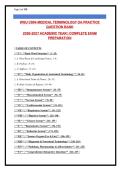
# TABLE OF CONTENTS
| **I** | **Basic Word Structure** | 1–25 |
| | A. Word Roots & Combining Forms | 1–8 |
| | B. Prefixes | 9–16 |
| | C. Suffixes | 17–25 |
| **II** | **Body Organization & Anatomical Terminology** | 26–40 |
| | A. Directional Terms & Planes | 26–33 |
| | B. Body Cavities & Regions | 34–40 |
| **III** | **Integumentary System** | 41–55 |
| **IV** | **Musculoskeletal System** | 56–75 |
| **V** | **Nervous System** | 76–90 |
| **VI** | **Cardiovascular System** | 91–110 |
| **VII** | **Respiratory System** | 111–125 |
| **VIII** | **Digestive System** | 126–140 |
| **IX** | **Urinary System** | 141–155 |
| **X** | **Reproductive System** | 156–170 |
| **XI** | **Endocrine System** | 171–185 |
| **XII** | **Sensory Organs (Eye & Ear)** | 186–195 |
| **XIII** | **Diagnostic & Procedural Terminology** | 196–210 |
| **XIV** | **Pathology, Pharmacology & Abbreviations** | 211–225 |
| **XV** | **Comprehensive/Integrative Questions** | 226–235 |
,Page 2 of 179
# SECTION I: BASIC WORD STRUCTURE
## A. Word Roots & Combining Forms
### Question 1
**The foundation of a medical term that contains the core meaning of the word is the:**
A. Combining form
B. Prefix
C. Root
D. Suffix
**Correct Answer: C. Root**
**Rationale:** The root is the fundamental element of a medical term and provides the core
meaning. For example, in the term *cardiomyopathy*, the root *cardi* means heart. The prefix
is added to the beginning of a word, the suffix is added to the end, and the combining form is the
root plus a combining vowel.
**Distractor Analysis:**
- **A. Combining form** – Incorrect. A combining form consists of a root plus a combining
vowel (e.g., *cardi/o*). While it contains the root, it is not the foundation itself.
- **B. Prefix** – Incorrect. A prefix is a word element attached to the beginning of a word to
modify its meaning; it is not the core.
- **D. Suffix** – Incorrect. A suffix is attached to the end of a word root and often indicates a
procedure, condition, disease, or part of speech.
---
,Page 3 of 179
### Question 2
**A combining vowel allows two or more of these to be connected as one word:**
A. Suffixes
B. Word elements
C. Prefixes
D. Diacritical marks
**Correct Answer: B. Word elements**
**Rationale:** A combining vowel (most commonly "o") is used to connect two or more word
elements (roots, prefixes, suffixes) to form a single medical term. For example, in
*gastroenteritis*, the combining vowel "o" connects *gastr* (stomach) and *enter* (intestine).
**Distractor Analysis:**
- **A. Suffixes** – Incorrect. Suffixes are attached to the end of word roots and do not require a
combining vowel when the suffix begins with a vowel.
- **C. Prefixes** – Incorrect. Prefixes are attached to the beginning of words and do not
typically involve combining vowels.
- **D. Diacritical marks** – Incorrect. Diacritical marks are symbols used to indicate
pronunciation, such as the macron (¯) for long vowel sounds.
---
### Question 3
**Which combining form means "kidney"?**
A. Cyst/o
B. Nephr/o
, Page 4 of 179
C. Hepat/o
D. Gastr/o
**Correct Answer: B. Nephr/o**
**Rationale:** *Nephr/o* is the combining form for kidney. *Ren/o* is an alternative
combining form for kidney. Understanding combining forms is essential for building and
decoding medical terminology.
**Distractor Analysis:**
- **A. Cyst/o** – Incorrect. *Cyst/o* refers to the bladder.
- **C. Hepat/o** – Incorrect. *Hepat/o* refers to the liver.
- **D. Gastr/o** – Incorrect. *Gastr/o* refers to the stomach.
---
### Question 4
**The combining form "hem/o" or "hemat/o" means:**
A. Water
B. Stone
C. Blood
D. Opening
**Correct Answer: C. Blood**
**Rationale:** *Hem/o* and *hemat/o* are combining forms that mean blood. These forms are
used in terms such as *hematology* (study of blood) and *hemorrhage* (excessive bleeding).
# TABLE OF CONTENTS
| **I** | **Basic Word Structure** | 1–25 |
| | A. Word Roots & Combining Forms | 1–8 |
| | B. Prefixes | 9–16 |
| | C. Suffixes | 17–25 |
| **II** | **Body Organization & Anatomical Terminology** | 26–40 |
| | A. Directional Terms & Planes | 26–33 |
| | B. Body Cavities & Regions | 34–40 |
| **III** | **Integumentary System** | 41–55 |
| **IV** | **Musculoskeletal System** | 56–75 |
| **V** | **Nervous System** | 76–90 |
| **VI** | **Cardiovascular System** | 91–110 |
| **VII** | **Respiratory System** | 111–125 |
| **VIII** | **Digestive System** | 126–140 |
| **IX** | **Urinary System** | 141–155 |
| **X** | **Reproductive System** | 156–170 |
| **XI** | **Endocrine System** | 171–185 |
| **XII** | **Sensory Organs (Eye & Ear)** | 186–195 |
| **XIII** | **Diagnostic & Procedural Terminology** | 196–210 |
| **XIV** | **Pathology, Pharmacology & Abbreviations** | 211–225 |
| **XV** | **Comprehensive/Integrative Questions** | 226–235 |
,Page 2 of 179
# SECTION I: BASIC WORD STRUCTURE
## A. Word Roots & Combining Forms
### Question 1
**The foundation of a medical term that contains the core meaning of the word is the:**
A. Combining form
B. Prefix
C. Root
D. Suffix
**Correct Answer: C. Root**
**Rationale:** The root is the fundamental element of a medical term and provides the core
meaning. For example, in the term *cardiomyopathy*, the root *cardi* means heart. The prefix
is added to the beginning of a word, the suffix is added to the end, and the combining form is the
root plus a combining vowel.
**Distractor Analysis:**
- **A. Combining form** – Incorrect. A combining form consists of a root plus a combining
vowel (e.g., *cardi/o*). While it contains the root, it is not the foundation itself.
- **B. Prefix** – Incorrect. A prefix is a word element attached to the beginning of a word to
modify its meaning; it is not the core.
- **D. Suffix** – Incorrect. A suffix is attached to the end of a word root and often indicates a
procedure, condition, disease, or part of speech.
---
,Page 3 of 179
### Question 2
**A combining vowel allows two or more of these to be connected as one word:**
A. Suffixes
B. Word elements
C. Prefixes
D. Diacritical marks
**Correct Answer: B. Word elements**
**Rationale:** A combining vowel (most commonly "o") is used to connect two or more word
elements (roots, prefixes, suffixes) to form a single medical term. For example, in
*gastroenteritis*, the combining vowel "o" connects *gastr* (stomach) and *enter* (intestine).
**Distractor Analysis:**
- **A. Suffixes** – Incorrect. Suffixes are attached to the end of word roots and do not require a
combining vowel when the suffix begins with a vowel.
- **C. Prefixes** – Incorrect. Prefixes are attached to the beginning of words and do not
typically involve combining vowels.
- **D. Diacritical marks** – Incorrect. Diacritical marks are symbols used to indicate
pronunciation, such as the macron (¯) for long vowel sounds.
---
### Question 3
**Which combining form means "kidney"?**
A. Cyst/o
B. Nephr/o
, Page 4 of 179
C. Hepat/o
D. Gastr/o
**Correct Answer: B. Nephr/o**
**Rationale:** *Nephr/o* is the combining form for kidney. *Ren/o* is an alternative
combining form for kidney. Understanding combining forms is essential for building and
decoding medical terminology.
**Distractor Analysis:**
- **A. Cyst/o** – Incorrect. *Cyst/o* refers to the bladder.
- **C. Hepat/o** – Incorrect. *Hepat/o* refers to the liver.
- **D. Gastr/o** – Incorrect. *Gastr/o* refers to the stomach.
---
### Question 4
**The combining form "hem/o" or "hemat/o" means:**
A. Water
B. Stone
C. Blood
D. Opening
**Correct Answer: C. Blood**
**Rationale:** *Hem/o* and *hemat/o* are combining forms that mean blood. These forms are
used in terms such as *hematology* (study of blood) and *hemorrhage* (excessive bleeding).


