

Page 1 of 185
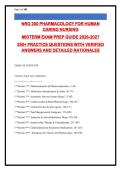
NRG 200 PHARMACOLOGY FOR HUMAN
CARING NURSING
MIDTERM EXAM PREP GUIDE 2026-2027
250+ PRACTICE QUESTIONS WITH VERIFIED
ANSWERS AND DETAILED RATIONALES
TABLE OF CONTENTS
| Section | Topic Area | Questions |
|---------|------------|-----------|
| **Section 1** | Pharmacokinetics & Pharmacodynamics | 1-40 |
| **Section 2** | Medication Administration & Safety | 41-70 |
| **Section 3** | Autonomic Nervous System Drugs | 71-105 |
| **Section 4** | Cardiovascular & Renal Pharmacology | 106-145 |
| **Section 5** | Central Nervous System Agents | 146-175 |
| **Section 6** | Pain Management & Analgesics | 176-200 |
| **Section 7** | Endocrine & Anti-inflammatory Drugs | 201-230 |
| **Section 8** | Antimicrobial Therapy & Chemotherapy | 231-260 |
| **Section 9** | Gastrointestinal & Respiratory Medications | 261-285 |
| **Section 10** | Emergency & Critical Care Pharmacology | 286-300 |
,Page 2 of 185
# SECTION 1: PHARMACOKINETICS & PHARMACODYNAMICS (Questions 1-40)
**Question 1**
The study of how a drug moves through the body, including absorption, distribution, metabolism,
and excretion, is known as:
A) Pharmacodynamics
B) Pharmacokinetics
C) Pharmacotherapeutics
D) Pharmacogenomics
**Correct Answer: B) Pharmacokinetics**
**Rationale:** Pharmacokinetics describes what the body does to the drug—its movement
through absorption, distribution, metabolism, and excretion (ADME). Pharmacodynamics, in
contrast, describes what the drug does to the body (mechanism of action).
---
**Question 2**
A nurse is administering a medication that is highly protein-bound (95% bound to plasma
proteins). Which factor could cause toxicity in this patient?
A) The patient has a high-protein diet
B) The patient is taking another highly protein-bound medication
C) The patient has increased gastric motility
D) The patient is well-hydrated
,Page 3 of 185
**Correct Answer: B) The patient is taking another highly protein-bound medication**
**Rationale:** When two highly protein-bound drugs are administered together, they compete
for binding sites on plasma proteins. This displaces the first drug, increasing the concentration of
free (unbound) active drug in the bloodstream, which can lead to toxicity. Only the unbound
fraction of a drug is pharmacologically active.
---
**Question 3**
What is the most important site of drug metabolism in the body?
A) Pancreas
B) Liver
C) Kidney
D) Brain
**Correct Answer: B) Liver**
**Rationale:** The liver is the primary site of drug metabolism, containing enzyme systems
(primarily the cytochrome P450 family) that transform drugs into more water-soluble forms for
excretion. This process can activate prodrugs or inactivate active drugs. Age-related decreases in
liver function may require dosage adjustments in older adults.
---
**Question 4**
A patient is receiving a medication with a half-life of 8 hours. The nurse understands that
approximately how long will it take for this drug to reach steady state?
, Page 4 of 185
A) 16 hours
B) 24 hours
C) 40 hours
D) 64 hours
**Correct Answer: C) 40 hours**
**Rationale:** Steady state is achieved after approximately 4-5 half-lives. With an 8-hour half-
life, steady state is reached in approximately 32-40 hours. Five half-lives (40 hours) represents
the time when drug administration and elimination are equal, and therapeutic drug levels are
consistently maintained.
---
**Question 5**
A patient is prescribed a medication that has a therapeutic index of 2. The nurse correctly
interprets this to mean:
A) The drug has a wide margin of safety
B) The drug has a narrow margin of safety and requires close monitoring
C) The drug is completely safe with no toxicity risk
D) The drug can be administered without monitoring serum levels
**Correct Answer: B) The drug has a narrow margin of safety and requires close monitoring**
**Rationale:** Therapeutic Index (TI) = TD50/ED50. A TI of 2 means the toxic dose is only
twice the effective dose—a very NARROW margin of safety. Drugs with narrow therapeutic
NRG 200 PHARMACOLOGY FOR HUMAN
CARING NURSING
MIDTERM EXAM PREP GUIDE 2026-2027
250+ PRACTICE QUESTIONS WITH VERIFIED
ANSWERS AND DETAILED RATIONALES
TABLE OF CONTENTS
| Section | Topic Area | Questions |
|---------|------------|-----------|
| **Section 1** | Pharmacokinetics & Pharmacodynamics | 1-40 |
| **Section 2** | Medication Administration & Safety | 41-70 |
| **Section 3** | Autonomic Nervous System Drugs | 71-105 |
| **Section 4** | Cardiovascular & Renal Pharmacology | 106-145 |
| **Section 5** | Central Nervous System Agents | 146-175 |
| **Section 6** | Pain Management & Analgesics | 176-200 |
| **Section 7** | Endocrine & Anti-inflammatory Drugs | 201-230 |
| **Section 8** | Antimicrobial Therapy & Chemotherapy | 231-260 |
| **Section 9** | Gastrointestinal & Respiratory Medications | 261-285 |
| **Section 10** | Emergency & Critical Care Pharmacology | 286-300 |
,Page 2 of 185
# SECTION 1: PHARMACOKINETICS & PHARMACODYNAMICS (Questions 1-40)
**Question 1**
The study of how a drug moves through the body, including absorption, distribution, metabolism,
and excretion, is known as:
A) Pharmacodynamics
B) Pharmacokinetics
C) Pharmacotherapeutics
D) Pharmacogenomics
**Correct Answer: B) Pharmacokinetics**
**Rationale:** Pharmacokinetics describes what the body does to the drug—its movement
through absorption, distribution, metabolism, and excretion (ADME). Pharmacodynamics, in
contrast, describes what the drug does to the body (mechanism of action).
---
**Question 2**
A nurse is administering a medication that is highly protein-bound (95% bound to plasma
proteins). Which factor could cause toxicity in this patient?
A) The patient has a high-protein diet
B) The patient is taking another highly protein-bound medication
C) The patient has increased gastric motility
D) The patient is well-hydrated
,Page 3 of 185
**Correct Answer: B) The patient is taking another highly protein-bound medication**
**Rationale:** When two highly protein-bound drugs are administered together, they compete
for binding sites on plasma proteins. This displaces the first drug, increasing the concentration of
free (unbound) active drug in the bloodstream, which can lead to toxicity. Only the unbound
fraction of a drug is pharmacologically active.
---
**Question 3**
What is the most important site of drug metabolism in the body?
A) Pancreas
B) Liver
C) Kidney
D) Brain
**Correct Answer: B) Liver**
**Rationale:** The liver is the primary site of drug metabolism, containing enzyme systems
(primarily the cytochrome P450 family) that transform drugs into more water-soluble forms for
excretion. This process can activate prodrugs or inactivate active drugs. Age-related decreases in
liver function may require dosage adjustments in older adults.
---
**Question 4**
A patient is receiving a medication with a half-life of 8 hours. The nurse understands that
approximately how long will it take for this drug to reach steady state?
, Page 4 of 185
A) 16 hours
B) 24 hours
C) 40 hours
D) 64 hours
**Correct Answer: C) 40 hours**
**Rationale:** Steady state is achieved after approximately 4-5 half-lives. With an 8-hour half-
life, steady state is reached in approximately 32-40 hours. Five half-lives (40 hours) represents
the time when drug administration and elimination are equal, and therapeutic drug levels are
consistently maintained.
---
**Question 5**
A patient is prescribed a medication that has a therapeutic index of 2. The nurse correctly
interprets this to mean:
A) The drug has a wide margin of safety
B) The drug has a narrow margin of safety and requires close monitoring
C) The drug is completely safe with no toxicity risk
D) The drug can be administered without monitoring serum levels
**Correct Answer: B) The drug has a narrow margin of safety and requires close monitoring**
**Rationale:** Therapeutic Index (TI) = TD50/ED50. A TI of 2 means the toxic dose is only
twice the effective dose—a very NARROW margin of safety. Drugs with narrow therapeutic


