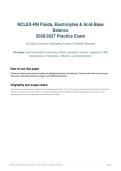
NCLEX-RN Fluids, Electrolytes & Acid-Base
Balance
2026/2027 Practice Exam
20 Original Questions, Highlighted Answers & Detailed Rationales
Coverage: fluid-volume deficit and excess, sodium, potassium, calcium, magnesium, ABG
interpretation, IV-fluid safety, infiltration, and fluid restriction.
How to use this paper
Choose the best answer before reading the highlighted answer and rationale. Extend review with current course
resources, laboratory reference ranges, and institutional policies.
Originality and scope notice
Every question and rationale was newly written for educational practice. This is not an actual, recalled, leaked, or official examination
and does not guarantee a score. NCLEX is a registered trademark of the National Council of State Boards of Nursing, Inc. This
independent resource is not affiliated with or endorsed by NCSBN.
Original educational practice material - not an official or recalled examination Page 1
, 1. Which assessment finding most strongly suggests fluid-volume deficit?
A. Bounding pulse
B. Orthostatic dizziness and concentrated urine
C. Crackles and jugular venous distention
D. Rapid weight gain
Answer: B
Rationale: Fluid-volume deficit commonly causes orthostatic symptoms, reduced urine output, concentrated urine,
tachycardia, and dry mucous membranes.
Original educational practice material - not an official or recalled examination Page 2
, 2. Which finding is most consistent with fluid-volume excess?
A. Flat neck veins
B. Sudden weight gain with bilateral crackles
C. Poor skin turgor only
D. Concentrated urine
Answer: B
Rationale: Rapid weight gain and crackles suggest retained fluid and pulmonary congestion.
Original educational practice material - not an official or recalled examination Page 3
Balance
2026/2027 Practice Exam
20 Original Questions, Highlighted Answers & Detailed Rationales
Coverage: fluid-volume deficit and excess, sodium, potassium, calcium, magnesium, ABG
interpretation, IV-fluid safety, infiltration, and fluid restriction.
How to use this paper
Choose the best answer before reading the highlighted answer and rationale. Extend review with current course
resources, laboratory reference ranges, and institutional policies.
Originality and scope notice
Every question and rationale was newly written for educational practice. This is not an actual, recalled, leaked, or official examination
and does not guarantee a score. NCLEX is a registered trademark of the National Council of State Boards of Nursing, Inc. This
independent resource is not affiliated with or endorsed by NCSBN.
Original educational practice material - not an official or recalled examination Page 1
, 1. Which assessment finding most strongly suggests fluid-volume deficit?
A. Bounding pulse
B. Orthostatic dizziness and concentrated urine
C. Crackles and jugular venous distention
D. Rapid weight gain
Answer: B
Rationale: Fluid-volume deficit commonly causes orthostatic symptoms, reduced urine output, concentrated urine,
tachycardia, and dry mucous membranes.
Original educational practice material - not an official or recalled examination Page 2
, 2. Which finding is most consistent with fluid-volume excess?
A. Flat neck veins
B. Sudden weight gain with bilateral crackles
C. Poor skin turgor only
D. Concentrated urine
Answer: B
Rationale: Rapid weight gain and crackles suggest retained fluid and pulmonary congestion.
Original educational practice material - not an official or recalled examination Page 3