

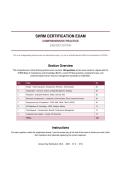
SHRM CERTIFICATION EXAM
COMPREHENSIVE PRACTICE
2026/2027 EDITION
This is an independent practice exam for educational study; it is not an official Elsevier HESI exit examination or NCLEX.
Section Overview
This comprehensive critical thinking practice exam contains 150 questions across seven sections, aligned with the
SHRM Body of Competency and Knowledge (BoCK), current HR best practices, employment laws, and
evidence-based human resource management standards for 2026/2027.
Sec Topic Qs
1 People - Talent Acquisition, Development, Retention, Total Rewards 25
2 Organization - Structure, Culture, Change Management, Strategy 20
3 Workplace - Employee Relations, Safety, Security, Risk 20
4 Behavioral Competencies - Leadership, Communication, Ethics, Business Acumen 20
5 Employment Law & Compliance - FLSA, ADA, FMLA, Title VII, EEOC 20
6 HR Operations & Technology - HRIS, Analytics, Metrics 15
7 Total Rewards - Compensation, Benefits, Performance Management 15
8 Integrated Case Studies - Complex HR Scenarios 15
TOTAL 150
Instructions
For each question, select the single best answer. Use the answer key at the end of the exam to check your work. Each
item includes a brief rationale explaining the correct response.
Answer Key Distribution: 38 A · 38 B · 37 C · 37 D
, Section 1: People - Talent Acquisition, Development, Retention, Engagement, and Total
Rewards
Q1: The process of attracting, screening, and selecting qualified candidates for a job is:
A. Succession planning
B. Performance management
C. Recruitment and selection [CORRECT]
D. Onboarding
Correct Answer: C
Rationale: Recruitment and selection is the process of attracting and selecting candidates. The other options describe different
processes.
Q2: A structured interview that asks every candidate the same questions is a:
A. Unstructured interview
B. Panel interview only
C. Stress interview
D. Structured interview [CORRECT]
Correct Answer: D
Rationale: A structured interview uses the same questions for all candidates, improving fairness. The other options are not as
standardized.
Q3: The purpose of onboarding is to:
A. Terminate employees
B. Conduct exit interviews
C. Integrate new employees into the organization and its culture [CORRECT]
D. Reduce pay
Correct Answer: C
Rationale: Onboarding integrates new employees into the organization. The other options are incorrect.
Q4: A succession plan identifies:
A. Candidates to terminate
B. Current salary levels
C. Potential candidates for key future positions [CORRECT]
D. Only entry-level roles
Correct Answer: C
Rationale: Succession planning identifies candidates for key future roles. The other options are incorrect.
Q5: Which is a common measure of employee turnover?
A. The number of hires
B. The training hours
C. The percentage of employees who leave over a period [CORRECT]
D. The salary budget
Correct Answer: C
Rationale: Turnover is the percentage of employees who leave over a period. The other options are not turnover.
Q6: A 'stay interview' is used to:
A. Conduct an exit interview
B. Discipline employees
C. Understand why employees remain and what might cause them to leave [CORRECT]
D. Set pay
Correct Answer: C
Rationale: A stay interview helps understand retention factors. The other options are incorrect.
Q7: Total rewards include:
A. Only salary
SHRM Certification Exam - 2026/2027 Page 2
, B. Compensation, benefits, work-life balance, and recognition [CORRECT]
C. Only benefits
D. Only bonuses
Correct Answer: B
Rationale: Total rewards encompass compensation, benefits, work-life, and recognition. The other options are incomplete.
Q8: Which is an example of a non-monetary reward?
A. Recognition and career development [CORRECT]
B. A salary increase
C. A cash bonus
D. A stock grant
Correct Answer: A
Rationale: Recognition and development are non-monetary rewards. The other options are monetary.
Q9: Employee engagement is best defined as:
A. The number of employees
B. The pay level
C. The level of commitment and involvement employees have toward their work [CORRECT]
D. The office size
Correct Answer: C
Rationale: Engagement is the commitment and involvement employees have. The other options are incorrect.
Q10: Which is an effective method to measure employee engagement?
A. Only exit interviews
B. Only pay scales
C. Employee engagement surveys [CORRECT]
D. Only headcount
Correct Answer: C
Rationale: Engagement surveys measure engagement. The other options are not engagement measures.
Q11: A 'learning management system' (LMS) is used to:
A. Recruit candidates
B. Set salaries
C. Deliver and track training and development programs [CORRECT]
D. Conduct discipline
Correct Answer: C
Rationale: An LMS delivers and tracks training/development. The other options are incorrect.
Q12: Career development planning helps employees:
A. Leave the company
B. Reduce hours
C. Avoid training
D. Progress toward their professional goals [CORRECT]
Correct Answer: D
Rationale: Career development supports professional growth. The other options are incorrect.
Q13: Which is an example of a development activity?
A. Mentoring and coaching [CORRECT]
B. A termination
C. A pay cut
D. A layoff
Correct Answer: A
Rationale: Mentoring and coaching are development activities. The other options are not development.
Q14: A talent acquisition strategy aligned with business goals should:
A. Target the skills needed to achieve the organization's objectives [CORRECT]
SHRM Certification Exam - 2026/2027 Page 3
COMPREHENSIVE PRACTICE
2026/2027 EDITION
This is an independent practice exam for educational study; it is not an official Elsevier HESI exit examination or NCLEX.
Section Overview
This comprehensive critical thinking practice exam contains 150 questions across seven sections, aligned with the
SHRM Body of Competency and Knowledge (BoCK), current HR best practices, employment laws, and
evidence-based human resource management standards for 2026/2027.
Sec Topic Qs
1 People - Talent Acquisition, Development, Retention, Total Rewards 25
2 Organization - Structure, Culture, Change Management, Strategy 20
3 Workplace - Employee Relations, Safety, Security, Risk 20
4 Behavioral Competencies - Leadership, Communication, Ethics, Business Acumen 20
5 Employment Law & Compliance - FLSA, ADA, FMLA, Title VII, EEOC 20
6 HR Operations & Technology - HRIS, Analytics, Metrics 15
7 Total Rewards - Compensation, Benefits, Performance Management 15
8 Integrated Case Studies - Complex HR Scenarios 15
TOTAL 150
Instructions
For each question, select the single best answer. Use the answer key at the end of the exam to check your work. Each
item includes a brief rationale explaining the correct response.
Answer Key Distribution: 38 A · 38 B · 37 C · 37 D
, Section 1: People - Talent Acquisition, Development, Retention, Engagement, and Total
Rewards
Q1: The process of attracting, screening, and selecting qualified candidates for a job is:
A. Succession planning
B. Performance management
C. Recruitment and selection [CORRECT]
D. Onboarding
Correct Answer: C
Rationale: Recruitment and selection is the process of attracting and selecting candidates. The other options describe different
processes.
Q2: A structured interview that asks every candidate the same questions is a:
A. Unstructured interview
B. Panel interview only
C. Stress interview
D. Structured interview [CORRECT]
Correct Answer: D
Rationale: A structured interview uses the same questions for all candidates, improving fairness. The other options are not as
standardized.
Q3: The purpose of onboarding is to:
A. Terminate employees
B. Conduct exit interviews
C. Integrate new employees into the organization and its culture [CORRECT]
D. Reduce pay
Correct Answer: C
Rationale: Onboarding integrates new employees into the organization. The other options are incorrect.
Q4: A succession plan identifies:
A. Candidates to terminate
B. Current salary levels
C. Potential candidates for key future positions [CORRECT]
D. Only entry-level roles
Correct Answer: C
Rationale: Succession planning identifies candidates for key future roles. The other options are incorrect.
Q5: Which is a common measure of employee turnover?
A. The number of hires
B. The training hours
C. The percentage of employees who leave over a period [CORRECT]
D. The salary budget
Correct Answer: C
Rationale: Turnover is the percentage of employees who leave over a period. The other options are not turnover.
Q6: A 'stay interview' is used to:
A. Conduct an exit interview
B. Discipline employees
C. Understand why employees remain and what might cause them to leave [CORRECT]
D. Set pay
Correct Answer: C
Rationale: A stay interview helps understand retention factors. The other options are incorrect.
Q7: Total rewards include:
A. Only salary
SHRM Certification Exam - 2026/2027 Page 2
, B. Compensation, benefits, work-life balance, and recognition [CORRECT]
C. Only benefits
D. Only bonuses
Correct Answer: B
Rationale: Total rewards encompass compensation, benefits, work-life, and recognition. The other options are incomplete.
Q8: Which is an example of a non-monetary reward?
A. Recognition and career development [CORRECT]
B. A salary increase
C. A cash bonus
D. A stock grant
Correct Answer: A
Rationale: Recognition and development are non-monetary rewards. The other options are monetary.
Q9: Employee engagement is best defined as:
A. The number of employees
B. The pay level
C. The level of commitment and involvement employees have toward their work [CORRECT]
D. The office size
Correct Answer: C
Rationale: Engagement is the commitment and involvement employees have. The other options are incorrect.
Q10: Which is an effective method to measure employee engagement?
A. Only exit interviews
B. Only pay scales
C. Employee engagement surveys [CORRECT]
D. Only headcount
Correct Answer: C
Rationale: Engagement surveys measure engagement. The other options are not engagement measures.
Q11: A 'learning management system' (LMS) is used to:
A. Recruit candidates
B. Set salaries
C. Deliver and track training and development programs [CORRECT]
D. Conduct discipline
Correct Answer: C
Rationale: An LMS delivers and tracks training/development. The other options are incorrect.
Q12: Career development planning helps employees:
A. Leave the company
B. Reduce hours
C. Avoid training
D. Progress toward their professional goals [CORRECT]
Correct Answer: D
Rationale: Career development supports professional growth. The other options are incorrect.
Q13: Which is an example of a development activity?
A. Mentoring and coaching [CORRECT]
B. A termination
C. A pay cut
D. A layoff
Correct Answer: A
Rationale: Mentoring and coaching are development activities. The other options are not development.
Q14: A talent acquisition strategy aligned with business goals should:
A. Target the skills needed to achieve the organization's objectives [CORRECT]
SHRM Certification Exam - 2026/2027 Page 3


