

ATI TEAS Science Exam Prep
Cellular functions Processes that include growth, metabolism, replication, protein synthesis, and
movement.
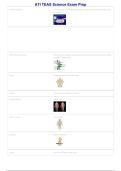
Directional terminology Words used to explain relationships of locations of anatomical elements (distal,
posterior, medial, etc.)
Distal Farther from the trunk of the body
Lateral Away from the midline of the body
dorsum of hand top of hand
dorsum of foot Top of foot
posterior Back of the body
medial Toward the midline of the body
, ATI TEAS Science Exam Prep
anterior Located towards the front of the body
inferior Lower on the body, farther from the head
Organ system A group of organs that work together in performing vital body functions.
Organelle A specialized part of a cell that has a specific function.
Image: Organelle
Organ A self-contained part of an organism that performs a specific function.
Reference planes Planes dividing the body to describe locations: sagittal, coronal, and
transverse.
Tissue A group of cells with similar structure that function together as a unit, but at a
lower level than organs.
, ATI TEAS Science Exam Prep
Alveoli Tiny air sacs in the lungs where exchange of oxygen and carbon dioxide takes
place.
Asthma A lung disease characterized by inflamed, narrowed airways and difficulty
breathing.
Bronchi The main passageways directly attached to the lungs.
Bronchioles Small passages in the lungs that connect bronchi to alveoli.
cystic fibrosis A genetic disorder that affects the lungs and other organs, characterized by
difficulty breathing, coughing up sputum, and lung infections.
perfusion The passage of fluid to an organ or a tissue.
pleura A membrane around the lungs and inside the chest cavity.
Surfactant a lipoprotein secreted by the alveoli that lowers the surface tension in the
alveoli, reduces the amount of pressure needed to inflate the alveoli, and
decreases the tendency of the alveoli to collapse.
Cellular functions Processes that include growth, metabolism, replication, protein synthesis, and
movement.
Directional terminology Words used to explain relationships of locations of anatomical elements (distal,
posterior, medial, etc.)
Distal Farther from the trunk of the body
Lateral Away from the midline of the body
dorsum of hand top of hand
dorsum of foot Top of foot
posterior Back of the body
medial Toward the midline of the body
, ATI TEAS Science Exam Prep
anterior Located towards the front of the body
inferior Lower on the body, farther from the head
Organ system A group of organs that work together in performing vital body functions.
Organelle A specialized part of a cell that has a specific function.
Image: Organelle
Organ A self-contained part of an organism that performs a specific function.
Reference planes Planes dividing the body to describe locations: sagittal, coronal, and
transverse.
Tissue A group of cells with similar structure that function together as a unit, but at a
lower level than organs.
, ATI TEAS Science Exam Prep
Alveoli Tiny air sacs in the lungs where exchange of oxygen and carbon dioxide takes
place.
Asthma A lung disease characterized by inflamed, narrowed airways and difficulty
breathing.
Bronchi The main passageways directly attached to the lungs.
Bronchioles Small passages in the lungs that connect bronchi to alveoli.
cystic fibrosis A genetic disorder that affects the lungs and other organs, characterized by
difficulty breathing, coughing up sputum, and lung infections.
perfusion The passage of fluid to an organ or a tissue.
pleura A membrane around the lungs and inside the chest cavity.
Surfactant a lipoprotein secreted by the alveoli that lowers the surface tension in the
alveoli, reduces the amount of pressure needed to inflate the alveoli, and
decreases the tendency of the alveoli to collapse.


