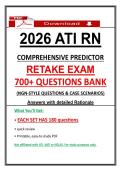
2026 ATI RN
COMPREHENSIVE PREDICTOR
RETAKE EXAM
700+ QUESTIONS BANK
(NGN-STYLE QUESTIONS & CASE SCENARIOS)
Answers with detailed Rationale
What You’ll Get:
• EACH SET HAS 180 questions
• quick review
• Printable, easy-to-study PDF
Not affiliated with ATI, VATI or NCLEX. For study purposes only.
,PREVIEW QUESTIONS BELOW
Get the Complete PDF After Purchase
"If you require further clarification or in need of any study
resources, feel free to Message me."
,Table of Contents
SET (1) .........................................................................2
SET (2) .....................................................................132
SET (3) .....................................................................207
SET (4) .....................................................................313
SET (1)
Question 1: IV Infusion Pump Safety
A nurse is preparing to initiate intravenous fluids via infusion pump for a client.
Which of the following actions should the nurse take?
A. Obtain a surge protector that can accommodate the pump and several other
appliances
B. Verify that the extension cord for the pump is ungrounded
C. Report the pump has a frayed cord and proceed with the infusion
D. Check the expiration date on the safety inspection sticker of the pump
Correct Answer: D
Rationale:
• D (Correct): Safety inspection stickers indicate the pump has been tested
and calibrated according to facility standards. Using equipment past its
inspection date risks inaccurate infusion rates and patient harm.
• A (Incorrect): Surge protectors are not recommended for medical equipment;
they can fail and interrupt critical therapy.
• B (Incorrect): Ungrounded cords are unsafe and violate electrical safety
standards; all medical equipment must be grounded.
, • C (Incorrect): A frayed cord is an electrical hazard; the pump must be
removed from service immediately, not used.
Key Concept: Medical equipment safety: Regular inspection, maintenance, and
immediate removal of damaged equipment are essential for patient safety. Never use
equipment with expired calibration or physical damage.
Question 2: Implanted Port Access
A nurse is caring for a client who has an implanted venous access port. Which of
the following should the nurse use to access the port?
A. A noncoring needle
B. An angiocatheter
C. A butterfly needle
D. A 25-gauge needle
Correct Answer: A
Rationale:
• A (Correct): A noncoring (Huber) needle has a deflected tip that pierces the
silicone septum of the port without cutting out a core of material. This
preserves the septum integrity for thousands of accesses.
• B (Incorrect): An angiocatheter is for peripheral IV insertion, not port access.
• C (Incorrect): A butterfly needle is for short-term peripheral access or scalp
veins in infants, not implanted ports.
• D (Incorrect): A standard 25-gauge needle cores the septum, causing leakage
and damage to the port.
Key Concept: Port-a-cath care: Use Huber needles only, assess for blood return
before each use, flush with heparin or saline per protocol after use, and rotate needle
insertion sites on the septum.
Question 3: Medication Discrepancy
COMPREHENSIVE PREDICTOR
RETAKE EXAM
700+ QUESTIONS BANK
(NGN-STYLE QUESTIONS & CASE SCENARIOS)
Answers with detailed Rationale
What You’ll Get:
• EACH SET HAS 180 questions
• quick review
• Printable, easy-to-study PDF
Not affiliated with ATI, VATI or NCLEX. For study purposes only.
,PREVIEW QUESTIONS BELOW
Get the Complete PDF After Purchase
"If you require further clarification or in need of any study
resources, feel free to Message me."
,Table of Contents
SET (1) .........................................................................2
SET (2) .....................................................................132
SET (3) .....................................................................207
SET (4) .....................................................................313
SET (1)
Question 1: IV Infusion Pump Safety
A nurse is preparing to initiate intravenous fluids via infusion pump for a client.
Which of the following actions should the nurse take?
A. Obtain a surge protector that can accommodate the pump and several other
appliances
B. Verify that the extension cord for the pump is ungrounded
C. Report the pump has a frayed cord and proceed with the infusion
D. Check the expiration date on the safety inspection sticker of the pump
Correct Answer: D
Rationale:
• D (Correct): Safety inspection stickers indicate the pump has been tested
and calibrated according to facility standards. Using equipment past its
inspection date risks inaccurate infusion rates and patient harm.
• A (Incorrect): Surge protectors are not recommended for medical equipment;
they can fail and interrupt critical therapy.
• B (Incorrect): Ungrounded cords are unsafe and violate electrical safety
standards; all medical equipment must be grounded.
, • C (Incorrect): A frayed cord is an electrical hazard; the pump must be
removed from service immediately, not used.
Key Concept: Medical equipment safety: Regular inspection, maintenance, and
immediate removal of damaged equipment are essential for patient safety. Never use
equipment with expired calibration or physical damage.
Question 2: Implanted Port Access
A nurse is caring for a client who has an implanted venous access port. Which of
the following should the nurse use to access the port?
A. A noncoring needle
B. An angiocatheter
C. A butterfly needle
D. A 25-gauge needle
Correct Answer: A
Rationale:
• A (Correct): A noncoring (Huber) needle has a deflected tip that pierces the
silicone septum of the port without cutting out a core of material. This
preserves the septum integrity for thousands of accesses.
• B (Incorrect): An angiocatheter is for peripheral IV insertion, not port access.
• C (Incorrect): A butterfly needle is for short-term peripheral access or scalp
veins in infants, not implanted ports.
• D (Incorrect): A standard 25-gauge needle cores the septum, causing leakage
and damage to the port.
Key Concept: Port-a-cath care: Use Huber needles only, assess for blood return
before each use, flush with heparin or saline per protocol after use, and rotate needle
insertion sites on the septum.
Question 3: Medication Discrepancy