
3.3 Transport in plants
Why do plants need a transport system?
Large plants have small SA:V ratio so need specialised exchange surfaces and
transport medium.
Each cell needs: oxygen, water, sugars, and mineral ions.
Plants not very active (respiration is low), so demand of oxygen is low (can use
diffusion).
Demand for water and sugars still high.
Water and mineral ions come from soil; sugars come from photosynthesis.
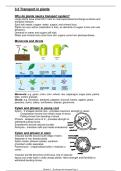
Monocots and dicots
Monocots: e.g. garlic, onion, corn, wheat, rice, asparagus, sugar cane, palms,
lilies, orchid, grasses.
Dicots: e.g. tomatoes, potatoes, peppers, broccoli, beans, apples, pears,
peaches, carrot, celery, sunflowers, daisies, geraniums.
Xylem and phloem in young root
Xylem - X shaped central core - provides maximum strength to resist:
- Compression forces from whole mass of shoot
- Pulling forces from bending of shoot.
Phloem - between arms of X - provides strength to
withstand pulling forces.
Endodermis around vascular bundle.
Pericycle - meristem cells just inside endodermis.
Xylem and phloem in stem
Vascular bundle around outer edge of stem.
Separate in non-woody plants.
Xylem inside, phloem outside, cambium
(meristem cells) separates.
Parenchyma - unspecialised cells in medulla or
cortex.
Vascular bundle becomes continuous ring of vascular
tissue just under bark in older woody plants. Have strength and flexibility to
withstand bending forces.
Module 3 - Exchange and transport Page 1
, Parenchyma - thin walls, unspecialised structure. Forms tissue of cortex and
pith.
Sclerenchyma - dead cells, thickened cell walls (lignin). Provides mechanical
strength and stiffness.
Collenchyma - elongated cells. Peripheral position. Provide support while plant
grows.
Xylem
Vessels to carry water and mineral ions.
Lignin impregnates walls of cells – strengthens
dead vessel walls. Makes them waterproof –
this kills cell.
End walls have disintegrated to leave hollow
tubes.
Living parenchyma cells act as packing
tissue to separate and support vessels.
- Made from dead cells aligned to form
continuous column.
- Tubes are narrow so column of water doesn't break and maintains effective
capillary action.
- Bordered pits allow water to move sideways from one vessel to another.
- Pattern of deposited lignin allows xylem to stretch as plant grows and
enables stem/ branch to bend.
Lignin
Strengthens cell wall and prevents collapsing.
Keeps vessel open even when water in short supply.
Lignin thickening causes patterns in cell wall – spiral, annular (rings) or reticulate
(a network of broken rings) – allows flexibility.
In some places lignification not complete, leaving gaps in cell wall, which form
bordered pits.
Bordered pits in 2 adjacent vessels allow movement of water between them.
Flow of water is unrestricted because:
- No cross walls
- No cell contents, nucleus, or cytoplasm
- Lignin thickening prevents wall from collapsing
Phloem
Used to transport assimilates (mainly sucrose and amino acids) – sucrose is
dissolved to form sap.
Phloem tissue consists of:
- Sieve tube elements:
○ Many individual sieve tube
elements aligned end to end
to form long sieve tubes.
○ Contain no nucleus and very
little cytoplasm, leaving space
for mass flow of sap to occur.
○ Ends of sieve tube elements
are perforated cross walls
called sieve plates.
○ Perforations in sieve plate
allow movement of sap from one element to next.
○ Sieve plate supports tube and keeps it open, and blocks tube after
injury or infection.
Module 3 - Exchange and transport Page 2
Why do plants need a transport system?
Large plants have small SA:V ratio so need specialised exchange surfaces and
transport medium.
Each cell needs: oxygen, water, sugars, and mineral ions.
Plants not very active (respiration is low), so demand of oxygen is low (can use
diffusion).
Demand for water and sugars still high.
Water and mineral ions come from soil; sugars come from photosynthesis.
Monocots and dicots
Monocots: e.g. garlic, onion, corn, wheat, rice, asparagus, sugar cane, palms,
lilies, orchid, grasses.
Dicots: e.g. tomatoes, potatoes, peppers, broccoli, beans, apples, pears,
peaches, carrot, celery, sunflowers, daisies, geraniums.
Xylem and phloem in young root
Xylem - X shaped central core - provides maximum strength to resist:
- Compression forces from whole mass of shoot
- Pulling forces from bending of shoot.
Phloem - between arms of X - provides strength to
withstand pulling forces.
Endodermis around vascular bundle.
Pericycle - meristem cells just inside endodermis.
Xylem and phloem in stem
Vascular bundle around outer edge of stem.
Separate in non-woody plants.
Xylem inside, phloem outside, cambium
(meristem cells) separates.
Parenchyma - unspecialised cells in medulla or
cortex.
Vascular bundle becomes continuous ring of vascular
tissue just under bark in older woody plants. Have strength and flexibility to
withstand bending forces.
Module 3 - Exchange and transport Page 1
, Parenchyma - thin walls, unspecialised structure. Forms tissue of cortex and
pith.
Sclerenchyma - dead cells, thickened cell walls (lignin). Provides mechanical
strength and stiffness.
Collenchyma - elongated cells. Peripheral position. Provide support while plant
grows.
Xylem
Vessels to carry water and mineral ions.
Lignin impregnates walls of cells – strengthens
dead vessel walls. Makes them waterproof –
this kills cell.
End walls have disintegrated to leave hollow
tubes.
Living parenchyma cells act as packing
tissue to separate and support vessels.
- Made from dead cells aligned to form
continuous column.
- Tubes are narrow so column of water doesn't break and maintains effective
capillary action.
- Bordered pits allow water to move sideways from one vessel to another.
- Pattern of deposited lignin allows xylem to stretch as plant grows and
enables stem/ branch to bend.
Lignin
Strengthens cell wall and prevents collapsing.
Keeps vessel open even when water in short supply.
Lignin thickening causes patterns in cell wall – spiral, annular (rings) or reticulate
(a network of broken rings) – allows flexibility.
In some places lignification not complete, leaving gaps in cell wall, which form
bordered pits.
Bordered pits in 2 adjacent vessels allow movement of water between them.
Flow of water is unrestricted because:
- No cross walls
- No cell contents, nucleus, or cytoplasm
- Lignin thickening prevents wall from collapsing
Phloem
Used to transport assimilates (mainly sucrose and amino acids) – sucrose is
dissolved to form sap.
Phloem tissue consists of:
- Sieve tube elements:
○ Many individual sieve tube
elements aligned end to end
to form long sieve tubes.
○ Contain no nucleus and very
little cytoplasm, leaving space
for mass flow of sap to occur.
○ Ends of sieve tube elements
are perforated cross walls
called sieve plates.
○ Perforations in sieve plate
allow movement of sap from one element to next.
○ Sieve plate supports tube and keeps it open, and blocks tube after
injury or infection.
Module 3 - Exchange and transport Page 2


