AMERICAN BOARD OF COLON
AND RECTAL SURGERY (ABCRS)
Comprehensive Board Review Question Bank & Explanatory Rationale
Guide
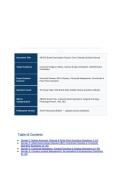
Document Title ABCRS Board Examination Practice Test & Detailed Solution Manual
Target Audience Colorectal Surgery Fellows, General Surgery Residents, ABCRS Board
Candidates
Exam Domains Anorectal Disease, IBD & Stomas, Colorectal Malignancies, Diverticular &
Covered Pelvic Floor Disorders
Question Count 40 Unique High-Yield Board-Style Multiple Choice Questions (MCQs)
SEO & ABCRS Exam Prep, Colorectal Board Questions, Surgical Oncology,
Categorization Proctology Review, TME, IBD
Publication Version 2026 Professional Edition — Updated Clinical Guidelines
Table of Contents
● Domain 1: Benign Anorectal, Perianal & Pelvic Floor Disorders (Questions 1–10)
● Domain 2: Inflammatory Bowel Disease (IBD), Diverticular Disease & Functional
Disorders (Questions 11–20)
● Domain 3: Colorectal Neoplasms, Surgical Oncology & Staging (Questions 21–30)
● Domain 4: Complex Surgical Management, Re-operations & Emergencies (Questions
31–40)
,Note: Each item includes a clinical scenario, four multiple-choice options, a clear answer
designation, and a highlighted green explanation detailing the physiological, surgical, and
evidence-based rationale.
Domain 1: Benign Anorectal, Perianal & Pelvic Floor
Disorders
Question 1
A 42-year-old male presents with severe, sharp anal pain during defecation followed by a
burning sensation lasting several hours. Physical examination reveals a mid-anal canal
tear in the posterior midline. Medical therapy with topical diltiazem for 8 weeks has failed.
What is the gold standard surgical intervention with the highest success rate?
A. Botulinum toxin injection into the internal anal sphincter
B. Fissurectomy with mucosal advancement flap
C. Lateral internal sphincterotomy (LIS)
D. Manual anal sphincter dilation (Lord's procedure)
CORRECT ANSWER: C — Lateral internal sphincterotomy (LIS)
Detailed Rationale:
Chronic anal fissure failing conservative and topical vasodilator therapy (e.g.,
diltiazem, nitroglycerin) is definitively managed with lateral internal sphincterotomy
(LIS). LIS directly addresses the primary underlying pathophysiology—hypertonicity
of the internal anal sphincter causing ischemic pain and non-healing. LIS
demonstrates healing rates exceeding 95%. Botulinum toxin has lower long-term
healing rates (60–70%) and higher recurrence. Manual anal dilation is obsolete due
to uncontrolled sphincter tearing and unacceptable rates of fecal incontinence.
Mucosal flaps are reserved for non-hypertonic fissures or patients with baseline
incontinence.
Question 2
A 35-year-old female presents with a complex transsphincteric fistula-in-ano involving the
lower 40% of the external anal sphincter. Endosonography confirms the tract crosses the
sphincter without significant secondary branching. Which sphincter-sparing surgical
technique is most appropriate to minimize fecal incontinence?
A. Primary high fistulotomy with marsupialization
, B. Ligation of the intersphincteric fistula tract (LIFT)
C. Cutting seton placement with weekly tightening
D. Cryoablation of the fistulous track
CORRECT ANSWER: B — Ligation of the intersphincteric fistula tract (LIFT)
Detailed Rationale:
The LIFT procedure involves entering the intersphincteric plane, identifying, ligating,
and dividing the fistula tract near the internal sphincter opening. It is an ideal
sphincter-sparing approach for transsphincteric fistulas because it completely avoids
division of the external anal sphincter mechanism, thereby maintaining baseline
continence. Primary fistulotomy in complex or high transsphincteric fistulas carries a
high risk of postoperative incontinence. Cutting setons cause significant pain and
incontinence from gradual sphincter division. LIFT yields healing rates between 70–
85% while preserving sphincter integrity.
Question 3
A 58-year-old male presents with acute, severe perianal pain and a tender, violaceous
mass at the anal verge noticed 24 hours ago. On examination, a 1.5 cm thrombosed
external hemorrhoid is identified. What is the most appropriate management?
A. In-office complete excisional hemorrhoidectomy under local anesthesia
B. Incision and drainage of the thrombus
C. Rubber band ligation of the external lesion
D. Topical hydrocortisone cream and sitz baths with deferred outpatient evaluation
CORRECT ANSWER: A — In-office complete excisional hemorrhoidectomy under local
anesthesia
Detailed Rationale:
For acute thrombosed external hemorrhoids presenting within 72 hours of symptom
onset, complete elliptical excision of the hemorrhoid and clot under local anesthesia
provides superior pain relief, lower recurrence rates, and faster resolution compared
to conservative therapy. Simple incision and drainage (clot evacuation) leaves skin
tags and is associated with a significantly higher rate of re-thrombosis and bleeding.
Rubber band ligation is strictly contraindicated for external hemorrhoids due to
somatic innervation, which causes excruciating pain.
Question 4
A 62-year-old female complains of fecal incontinence to liquid and solid stool following a
AND RECTAL SURGERY (ABCRS)
Comprehensive Board Review Question Bank & Explanatory Rationale
Guide
Document Title ABCRS Board Examination Practice Test & Detailed Solution Manual
Target Audience Colorectal Surgery Fellows, General Surgery Residents, ABCRS Board
Candidates
Exam Domains Anorectal Disease, IBD & Stomas, Colorectal Malignancies, Diverticular &
Covered Pelvic Floor Disorders
Question Count 40 Unique High-Yield Board-Style Multiple Choice Questions (MCQs)
SEO & ABCRS Exam Prep, Colorectal Board Questions, Surgical Oncology,
Categorization Proctology Review, TME, IBD
Publication Version 2026 Professional Edition — Updated Clinical Guidelines
Table of Contents
● Domain 1: Benign Anorectal, Perianal & Pelvic Floor Disorders (Questions 1–10)
● Domain 2: Inflammatory Bowel Disease (IBD), Diverticular Disease & Functional
Disorders (Questions 11–20)
● Domain 3: Colorectal Neoplasms, Surgical Oncology & Staging (Questions 21–30)
● Domain 4: Complex Surgical Management, Re-operations & Emergencies (Questions
31–40)
,Note: Each item includes a clinical scenario, four multiple-choice options, a clear answer
designation, and a highlighted green explanation detailing the physiological, surgical, and
evidence-based rationale.
Domain 1: Benign Anorectal, Perianal & Pelvic Floor
Disorders
Question 1
A 42-year-old male presents with severe, sharp anal pain during defecation followed by a
burning sensation lasting several hours. Physical examination reveals a mid-anal canal
tear in the posterior midline. Medical therapy with topical diltiazem for 8 weeks has failed.
What is the gold standard surgical intervention with the highest success rate?
A. Botulinum toxin injection into the internal anal sphincter
B. Fissurectomy with mucosal advancement flap
C. Lateral internal sphincterotomy (LIS)
D. Manual anal sphincter dilation (Lord's procedure)
CORRECT ANSWER: C — Lateral internal sphincterotomy (LIS)
Detailed Rationale:
Chronic anal fissure failing conservative and topical vasodilator therapy (e.g.,
diltiazem, nitroglycerin) is definitively managed with lateral internal sphincterotomy
(LIS). LIS directly addresses the primary underlying pathophysiology—hypertonicity
of the internal anal sphincter causing ischemic pain and non-healing. LIS
demonstrates healing rates exceeding 95%. Botulinum toxin has lower long-term
healing rates (60–70%) and higher recurrence. Manual anal dilation is obsolete due
to uncontrolled sphincter tearing and unacceptable rates of fecal incontinence.
Mucosal flaps are reserved for non-hypertonic fissures or patients with baseline
incontinence.
Question 2
A 35-year-old female presents with a complex transsphincteric fistula-in-ano involving the
lower 40% of the external anal sphincter. Endosonography confirms the tract crosses the
sphincter without significant secondary branching. Which sphincter-sparing surgical
technique is most appropriate to minimize fecal incontinence?
A. Primary high fistulotomy with marsupialization
, B. Ligation of the intersphincteric fistula tract (LIFT)
C. Cutting seton placement with weekly tightening
D. Cryoablation of the fistulous track
CORRECT ANSWER: B — Ligation of the intersphincteric fistula tract (LIFT)
Detailed Rationale:
The LIFT procedure involves entering the intersphincteric plane, identifying, ligating,
and dividing the fistula tract near the internal sphincter opening. It is an ideal
sphincter-sparing approach for transsphincteric fistulas because it completely avoids
division of the external anal sphincter mechanism, thereby maintaining baseline
continence. Primary fistulotomy in complex or high transsphincteric fistulas carries a
high risk of postoperative incontinence. Cutting setons cause significant pain and
incontinence from gradual sphincter division. LIFT yields healing rates between 70–
85% while preserving sphincter integrity.
Question 3
A 58-year-old male presents with acute, severe perianal pain and a tender, violaceous
mass at the anal verge noticed 24 hours ago. On examination, a 1.5 cm thrombosed
external hemorrhoid is identified. What is the most appropriate management?
A. In-office complete excisional hemorrhoidectomy under local anesthesia
B. Incision and drainage of the thrombus
C. Rubber band ligation of the external lesion
D. Topical hydrocortisone cream and sitz baths with deferred outpatient evaluation
CORRECT ANSWER: A — In-office complete excisional hemorrhoidectomy under local
anesthesia
Detailed Rationale:
For acute thrombosed external hemorrhoids presenting within 72 hours of symptom
onset, complete elliptical excision of the hemorrhoid and clot under local anesthesia
provides superior pain relief, lower recurrence rates, and faster resolution compared
to conservative therapy. Simple incision and drainage (clot evacuation) leaves skin
tags and is associated with a significantly higher rate of re-thrombosis and bleeding.
Rubber band ligation is strictly contraindicated for external hemorrhoids due to
somatic innervation, which causes excruciating pain.
Question 4
A 62-year-old female complains of fecal incontinence to liquid and solid stool following a