

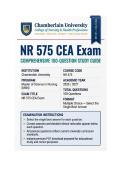
,NR 575 CEA Exam – Clinical Evaluation
Assessment – Q&A (2026) | Chamberlain
1. A 50-year-old patient presents with nonpitting periorbital edema, very dry
thinned hair, and loss of the lateral third of the eyebrows. The nurse
practitioner suspects which condition?
A) Addison's disease
B) Graves' disease
C) Severe hypothyroidism (myxedema)
D) Cushing's syndrome
Correct Answer: C) Severe hypothyroidism (myxedema)
Rationale: Myxedema presents with periorbital edema, coarse dry hair, and
Queen Anne's sign (loss of lateral eyebrow). These findings result from
decreased metabolic activity and mucopolysaccharide deposition. Addison's
causes hyperpigmentation, Graves' causes exophthalmos, Cushing's causes
moon face.
2. The nurse practitioner performs percussion of the thorax on a patient with a
new cough. What is the primary purpose of this technique?
A) Assess for cardiac enlargement
B) Identify if underlying tissues are air-filled, fluid-filled, or consolidated
C) Evaluate for rib fractures
D) Determine the heart's electrical axis
,Correct Answer: B) Identify if underlying tissues are air-filled, fluid-filled, or
consolidated
Rationale: Percussion produces sounds based on tissue density. Resonant note
indicates normal air-filled lung; dullness suggests fluid or consolidation;
hyperresonance indicates air trapping. It does not directly assess cardiac size,
fractures, or electrical activity.
3. A patient presents with weakness when shrugging the shoulders against
resistance. Which cranial nerve is most likely affected?
A) CN VII
B) CN IX
C) CN XI
D) CN XII
Correct Answer: C) CN XI
Rationale: The spinal accessory nerve (CN XI) innervates the trapezius and
sternocleidomastoid muscles. Weak shoulder shrug indicates CN XI dysfunction.
CN VII controls facial muscles, CN IX is glossopharyngeal, CN XII controls tongue
movement.
4. The correct sequence for performing an abdominal assessment is:
A) Inspection, auscultation, palpation, percussion
B) Inspection, auscultation, percussion, palpation
C) Percussion, auscultation, palpation, inspection
D) Auscultation, palpation, percussion, inspection
, Correct Answer: B) Inspection, auscultation, percussion, palpation
Rationale: Auscultation is performed before palpation and percussion because
these maneuvers can alter bowel sounds, leading to inaccurate findings.
Inspection always comes first. The sequence is inspection, auscultation,
percussion, palpation.
5. A 72-year-old patient develops sudden facial droop, right arm weakness, and
slurred speech that resolves completely within 20 minutes. What is the most
likely diagnosis?
A) Bell palsy
B) Transient ischemic attack (TIA)
C) Complex migraine
D) Focal seizure
Correct Answer: B) Transient ischemic attack (TIA)
Rationale: Transient focal neurological deficits that completely resolve within 24
hours, typically within minutes to an hour, are characteristic of TIA. This is a
warning sign for future stroke and requires urgent evaluation. Bell palsy
involves only facial nerve.
6. A highly sensitive diagnostic test is most useful for:
A) Confirming a diagnosis when positive
B) Ruling out a disease when negative
C) Increasing specificity
Assessment – Q&A (2026) | Chamberlain
1. A 50-year-old patient presents with nonpitting periorbital edema, very dry
thinned hair, and loss of the lateral third of the eyebrows. The nurse
practitioner suspects which condition?
A) Addison's disease
B) Graves' disease
C) Severe hypothyroidism (myxedema)
D) Cushing's syndrome
Correct Answer: C) Severe hypothyroidism (myxedema)
Rationale: Myxedema presents with periorbital edema, coarse dry hair, and
Queen Anne's sign (loss of lateral eyebrow). These findings result from
decreased metabolic activity and mucopolysaccharide deposition. Addison's
causes hyperpigmentation, Graves' causes exophthalmos, Cushing's causes
moon face.
2. The nurse practitioner performs percussion of the thorax on a patient with a
new cough. What is the primary purpose of this technique?
A) Assess for cardiac enlargement
B) Identify if underlying tissues are air-filled, fluid-filled, or consolidated
C) Evaluate for rib fractures
D) Determine the heart's electrical axis
,Correct Answer: B) Identify if underlying tissues are air-filled, fluid-filled, or
consolidated
Rationale: Percussion produces sounds based on tissue density. Resonant note
indicates normal air-filled lung; dullness suggests fluid or consolidation;
hyperresonance indicates air trapping. It does not directly assess cardiac size,
fractures, or electrical activity.
3. A patient presents with weakness when shrugging the shoulders against
resistance. Which cranial nerve is most likely affected?
A) CN VII
B) CN IX
C) CN XI
D) CN XII
Correct Answer: C) CN XI
Rationale: The spinal accessory nerve (CN XI) innervates the trapezius and
sternocleidomastoid muscles. Weak shoulder shrug indicates CN XI dysfunction.
CN VII controls facial muscles, CN IX is glossopharyngeal, CN XII controls tongue
movement.
4. The correct sequence for performing an abdominal assessment is:
A) Inspection, auscultation, palpation, percussion
B) Inspection, auscultation, percussion, palpation
C) Percussion, auscultation, palpation, inspection
D) Auscultation, palpation, percussion, inspection
, Correct Answer: B) Inspection, auscultation, percussion, palpation
Rationale: Auscultation is performed before palpation and percussion because
these maneuvers can alter bowel sounds, leading to inaccurate findings.
Inspection always comes first. The sequence is inspection, auscultation,
percussion, palpation.
5. A 72-year-old patient develops sudden facial droop, right arm weakness, and
slurred speech that resolves completely within 20 minutes. What is the most
likely diagnosis?
A) Bell palsy
B) Transient ischemic attack (TIA)
C) Complex migraine
D) Focal seizure
Correct Answer: B) Transient ischemic attack (TIA)
Rationale: Transient focal neurological deficits that completely resolve within 24
hours, typically within minutes to an hour, are characteristic of TIA. This is a
warning sign for future stroke and requires urgent evaluation. Bell palsy
involves only facial nerve.
6. A highly sensitive diagnostic test is most useful for:
A) Confirming a diagnosis when positive
B) Ruling out a disease when negative
C) Increasing specificity


