

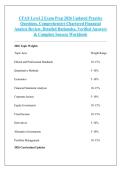
CFA® Level 2 Exam Prep 2026 Updated Practice
Questions, Comprehensive Chartered Financial
Analyst Review, Detailed Rationales, Verified Answers
& Complete Success Workbook
2026 Topic Weights
Topic Area Weight Range
Ethical and Professional Standards 10–15%
Quantitative Methods 5–10%
Economics 5–10%
Financial Statement Analysis 10–15%
Corporate Issuers 5–10%
Equity Investments 10–15%
Fixed Income 10–15%
Derivatives 5–10%
Alternative Investments 5–10%
Portfolio Management 10–15%
2026 Curriculum Updates
, • Minor change only: One Learning Outcome Statement (LOS) removed
from the Machine Learning module in Quantitative Methods (related to
neural networks and deep learning)
• Topic weight ranges are unchanged from 2025
• Overall curriculum remains highly consistent with 2025
VIGNETTE 1: ETHICS — GIPS & STANDARDS OF PROFESSIONAL
CONDUCT (Questions 1–5)
Vignette
Alex Chen, CFA, is a portfolio manager at Summit Asset Management. Summit is
preparing to claim compliance with the Global Investment Performance Standards
(GIPS) for the first time. Alex is tasked with reviewing Summit's performance
presentation policies. Summit has been in business since 2015 and has managed
discretionary portfolios since 2016. The firm's historical performance data from
2016–2019 was calculated using a different valuation methodology than its current
methodology. Alex is considering presenting only data from 2020 onward to avoid
the complexity of restating historical performance.
Separately, Alex manages the "Summit Growth Fund," a concentrated equity fund.
A prospective client asks Alex for the fund's track record. Alex provides a
performance summary that shows the fund's returns from 2020–2025. The
summary excludes 2018–2019 because the fund's performance during those years
was below the benchmark. Alex also includes a footnote stating that "past
performance is not indicative of future results."
Question 1
According to GIPS standards, what is the MINIMUM period of compliant
performance history Summit must present when initially claiming compliance?
A. Five years of compliant performance (2020–2024)
B. Ten years of compliant performance (2016–2025)
C. Five years of compliant performance, or since the firm's inception if less than
five years
D. Three years of compliant performance (2023–2025)
Correct Answer: C
,Rationale: Under GIPS, firms must present at least five years of compliant
performance history when initially claiming compliance. If the firm has been in
existence for less than five years, it must present performance since inception.
Summit has been in business since 2015, so it has more than five years of history.
However, the key issue is that the data from 2016–2019 was calculated using a
different methodology. Summit cannot simply exclude that period — it must either
restate the historical data using the current methodology or present the data as is
with appropriate disclosure. Option A presents only five years, which is the
minimum, but Summit must present compliant data for those five years. Since
Summit has been in existence since 2015, it must present at least 2020–2024.
Option B presents 10 years, which is the eventual requirement after building a
compliant track record, but not the initial minimum. Option C accurately states the
initial minimum. Option D (three years) is incorrect — GIPS requires five years
initially.
Question 2
What is Alex's MOST appropriate course of action regarding the 2016–2019
performance data?
A. Exclude the 2016–2019 data entirely and present only 2020–2025
B. Restate the 2016–2019 data using the current valuation methodology
C. Present the 2016–2019 data using the original methodology with clear
disclosure of the change
D. Present only 2020–2025 data but include a footnote explaining that earlier data
is unavailable
Correct Answer: B
Rationale: Under GIPS, firms must present performance data using consistent
methodologies throughout the compliant presentation period. If Summit claims
compliance for the full period, it must use the current valuation methodology for
all presented periods. If the historical data cannot be restated, the firm should
present the data using the original methodology with clear disclosure. However,
the best course of action is to restate the data to ensure consistency and compliance
with GIPS standards.
, Question 3
Did Alex violate any CFA Institute Standard of Professional Conduct by excluding
the 2018–2019 performance data from the prospective client presentation?
A. No, because the footnote adequately discloses the limitation
B. No, because the client only asked for the fund's track record from 2020 onward
C. Yes, because Alex selectively presented performance data that omitted poor-
performing periods
D. Yes, because Alex did not include a benchmark comparison
Correct Answer: C
Rationale: Under Standard III(D) — Performance Presentation, members must not
misstate performance or omit information that would make a presentation
misleading. By excluding the poor-performing 2018–2019 period, Alex is
presenting a misleading track record. The footnote about past performance is
standard disclosure but does not cure the selective omission. Standard III(D)
requires that performance presentations be fair, accurate, and complete. The
footnote (A) does not justify the omission. The client's request (B) does not excuse
the selective presentation.
Question 4
Which of the following is a requirement under Standard I(C) —
Misrepresentation?
A. Members must disclose all fees and expenses in performance presentations
B. Members must not knowingly make any misrepresentations relating to
investment analysis, recommendations, or actions
C. Members must include benchmark comparisons in all performance
presentations
D. Members must present performance net of all fees
Correct Answer: B
Rationale: Standard I(C) — Misrepresentation prohibits members from knowingly
making any misrepresentations relating to investment analysis, recommendations,
or actions. It covers oral and written communications, including performance
presentations. While fee disclosure (A) and benchmark comparisons (C) may be
Questions, Comprehensive Chartered Financial
Analyst Review, Detailed Rationales, Verified Answers
& Complete Success Workbook
2026 Topic Weights
Topic Area Weight Range
Ethical and Professional Standards 10–15%
Quantitative Methods 5–10%
Economics 5–10%
Financial Statement Analysis 10–15%
Corporate Issuers 5–10%
Equity Investments 10–15%
Fixed Income 10–15%
Derivatives 5–10%
Alternative Investments 5–10%
Portfolio Management 10–15%
2026 Curriculum Updates
, • Minor change only: One Learning Outcome Statement (LOS) removed
from the Machine Learning module in Quantitative Methods (related to
neural networks and deep learning)
• Topic weight ranges are unchanged from 2025
• Overall curriculum remains highly consistent with 2025
VIGNETTE 1: ETHICS — GIPS & STANDARDS OF PROFESSIONAL
CONDUCT (Questions 1–5)
Vignette
Alex Chen, CFA, is a portfolio manager at Summit Asset Management. Summit is
preparing to claim compliance with the Global Investment Performance Standards
(GIPS) for the first time. Alex is tasked with reviewing Summit's performance
presentation policies. Summit has been in business since 2015 and has managed
discretionary portfolios since 2016. The firm's historical performance data from
2016–2019 was calculated using a different valuation methodology than its current
methodology. Alex is considering presenting only data from 2020 onward to avoid
the complexity of restating historical performance.
Separately, Alex manages the "Summit Growth Fund," a concentrated equity fund.
A prospective client asks Alex for the fund's track record. Alex provides a
performance summary that shows the fund's returns from 2020–2025. The
summary excludes 2018–2019 because the fund's performance during those years
was below the benchmark. Alex also includes a footnote stating that "past
performance is not indicative of future results."
Question 1
According to GIPS standards, what is the MINIMUM period of compliant
performance history Summit must present when initially claiming compliance?
A. Five years of compliant performance (2020–2024)
B. Ten years of compliant performance (2016–2025)
C. Five years of compliant performance, or since the firm's inception if less than
five years
D. Three years of compliant performance (2023–2025)
Correct Answer: C
,Rationale: Under GIPS, firms must present at least five years of compliant
performance history when initially claiming compliance. If the firm has been in
existence for less than five years, it must present performance since inception.
Summit has been in business since 2015, so it has more than five years of history.
However, the key issue is that the data from 2016–2019 was calculated using a
different methodology. Summit cannot simply exclude that period — it must either
restate the historical data using the current methodology or present the data as is
with appropriate disclosure. Option A presents only five years, which is the
minimum, but Summit must present compliant data for those five years. Since
Summit has been in existence since 2015, it must present at least 2020–2024.
Option B presents 10 years, which is the eventual requirement after building a
compliant track record, but not the initial minimum. Option C accurately states the
initial minimum. Option D (three years) is incorrect — GIPS requires five years
initially.
Question 2
What is Alex's MOST appropriate course of action regarding the 2016–2019
performance data?
A. Exclude the 2016–2019 data entirely and present only 2020–2025
B. Restate the 2016–2019 data using the current valuation methodology
C. Present the 2016–2019 data using the original methodology with clear
disclosure of the change
D. Present only 2020–2025 data but include a footnote explaining that earlier data
is unavailable
Correct Answer: B
Rationale: Under GIPS, firms must present performance data using consistent
methodologies throughout the compliant presentation period. If Summit claims
compliance for the full period, it must use the current valuation methodology for
all presented periods. If the historical data cannot be restated, the firm should
present the data using the original methodology with clear disclosure. However,
the best course of action is to restate the data to ensure consistency and compliance
with GIPS standards.
, Question 3
Did Alex violate any CFA Institute Standard of Professional Conduct by excluding
the 2018–2019 performance data from the prospective client presentation?
A. No, because the footnote adequately discloses the limitation
B. No, because the client only asked for the fund's track record from 2020 onward
C. Yes, because Alex selectively presented performance data that omitted poor-
performing periods
D. Yes, because Alex did not include a benchmark comparison
Correct Answer: C
Rationale: Under Standard III(D) — Performance Presentation, members must not
misstate performance or omit information that would make a presentation
misleading. By excluding the poor-performing 2018–2019 period, Alex is
presenting a misleading track record. The footnote about past performance is
standard disclosure but does not cure the selective omission. Standard III(D)
requires that performance presentations be fair, accurate, and complete. The
footnote (A) does not justify the omission. The client's request (B) does not excuse
the selective presentation.
Question 4
Which of the following is a requirement under Standard I(C) —
Misrepresentation?
A. Members must disclose all fees and expenses in performance presentations
B. Members must not knowingly make any misrepresentations relating to
investment analysis, recommendations, or actions
C. Members must include benchmark comparisons in all performance
presentations
D. Members must present performance net of all fees
Correct Answer: B
Rationale: Standard I(C) — Misrepresentation prohibits members from knowingly
making any misrepresentations relating to investment analysis, recommendations,
or actions. It covers oral and written communications, including performance
presentations. While fee disclosure (A) and benchmark comparisons (C) may be


