
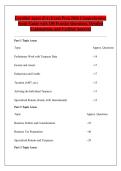
Enrolled Agent (EA) Exam Prep 2026 Comprehensive
Study Guide with 100 Practice Questions, Detailed
Explanations, and Verified Answers
Part 1 Topic Areas:
Topic Approx. Questions
Preliminary Work with Taxpayer Data ~14
Income and Assets ~17
Deductions and Credits ~17
Taxation (AMT, etc.) ~15
Advising the Individual Taxpayer ~11
Specialized Returns (Estate, Gift, International) ~12
Part 2 Topic Areas:
Topic Approx. Questions
Business Entities and Considerations ~25
Business Tax Preparation ~46
Specialized Returns and Taxpayers ~29
Part 3 Topic Areas:
,Topic Approx. Questions
Practices and Procedures (Circular 230, Ethics) ~26
Representation before the IRS ~25
Specific Types of Representation ~20
Completion of the Filing Process ~14
PART 1: INDIVIDUAL TAXATION (34 Questions)
Question 1
Which of the following individuals is NOT required to file a federal income tax
return for 2025?
A) A single individual under age 65 with gross income of $14,000
B) A married individual filing separately with gross income of $6,000
C) A single individual age 65 with gross income of $15,000
D) A married couple filing jointly, both under age 65, with gross income of
$28,000
Answer: B
Rationale: For 2025, a married individual filing separately must file a return if
gross income is at least **$5,000** (for 2025, this threshold is $5,000; for 2024 it
was $5,000). With $6,000, this individual exceeds the threshold and must file. A
single individual under 65 must file if gross income exceeds the standard deduction
of approximately $14,600 ($14,000 is below the threshold). A single individual age
65 has a higher standard deduction (approximately $16,550 for 2025), so $15,000
is below the filing requirement. A married couple filing jointly, both under 65,
must file if gross income exceeds $29,200 (for 2025); $28,000 is below the
threshold.
,Question 2
A taxpayer is unmarried, provides more than half the cost of maintaining a home
for a qualifying child, and is eligible for head of household status. Which of the
following is a requirement for the qualifying child?
A) The child must be under age 19 at the end of the tax year (or under age 24 and a
full-time student)
B) The child must have gross income of less than $4,700
C) The child must be a U.S. citizen
D) The child must live with the taxpayer for more than 9 months of the tax year
Answer: A
Rationale: A qualifying child for head of household purposes must be the
taxpayer's child, stepchild, foster child, sibling, or descendant; under age 19 at
year-end (or under 24 and a full-time student) ; and live with the taxpayer for
more than half the year. Option B describes the gross income test for a qualifying
relative. Option C is not a requirement—a qualifying child may be a resident alien.
Option D is incorrect—the requirement is more than half the year (6+ months), not
9 months.
Question 3
For the 2025 tax year, what is the maximum earned income credit (EIC)
percentage phaseout range for a taxpayer with three qualifying children?
A) 45%
B) 40%
C) 34%
D) 21%
Answer: A
Rationale: For 2025, the Earned Income Credit (EIC) phaseout percentage for
taxpayers with three or more qualifying children is 45% . The phaseout
percentage varies by the number of qualifying children: three or more = 45%, two
= 40%, one = 34%, zero = 21% (for 2025 figures).
, Question 4
A taxpayer received $5,000 in wages, $200 in interest income, and $8,000 in
Social Security benefits. The taxpayer is single and has no other income. What
amount of Social Security benefits is taxable?
A) $0
B) $4,000
C) $8,000
D) $3,000
Answer: A
Rationale: Social Security benefits become taxable when provisional income
(adjusted gross income + tax-exempt interest + 50% of Social Security benefits)
exceeds the base amount. For a single taxpayer, the base amount is $25,000.
Provisional income = $5,000 + $200 + (50% × $8,000) = $5,200 + $4,000 =
$9,200. Since $9,200 is below $25,000, none of the Social Security benefits are
taxable.
Question 5
A taxpayer sold a personal residence for $350,000. The taxpayer purchased the
home for $180,000 and lived in it for 3 years before selling. The taxpayer is single
and has no other home sales. What is the taxable gain?
A) $170,000
B) $0
C) $120,000
D) $50,000
Answer: B
Rationale: Under IRC §121, a single taxpayer may exclude up to **$250,000 of
gain** from the sale of a principal residence if they have owned and lived in the
residence for at least **2 of the 5 years** before the sale. The gain is $350,000 –
$180,000 = $170,000, which is below the $250,000 exclusion. Therefore, **the
entire gain is excluded**, and taxable gain is $0.
Study Guide with 100 Practice Questions, Detailed
Explanations, and Verified Answers
Part 1 Topic Areas:
Topic Approx. Questions
Preliminary Work with Taxpayer Data ~14
Income and Assets ~17
Deductions and Credits ~17
Taxation (AMT, etc.) ~15
Advising the Individual Taxpayer ~11
Specialized Returns (Estate, Gift, International) ~12
Part 2 Topic Areas:
Topic Approx. Questions
Business Entities and Considerations ~25
Business Tax Preparation ~46
Specialized Returns and Taxpayers ~29
Part 3 Topic Areas:
,Topic Approx. Questions
Practices and Procedures (Circular 230, Ethics) ~26
Representation before the IRS ~25
Specific Types of Representation ~20
Completion of the Filing Process ~14
PART 1: INDIVIDUAL TAXATION (34 Questions)
Question 1
Which of the following individuals is NOT required to file a federal income tax
return for 2025?
A) A single individual under age 65 with gross income of $14,000
B) A married individual filing separately with gross income of $6,000
C) A single individual age 65 with gross income of $15,000
D) A married couple filing jointly, both under age 65, with gross income of
$28,000
Answer: B
Rationale: For 2025, a married individual filing separately must file a return if
gross income is at least **$5,000** (for 2025, this threshold is $5,000; for 2024 it
was $5,000). With $6,000, this individual exceeds the threshold and must file. A
single individual under 65 must file if gross income exceeds the standard deduction
of approximately $14,600 ($14,000 is below the threshold). A single individual age
65 has a higher standard deduction (approximately $16,550 for 2025), so $15,000
is below the filing requirement. A married couple filing jointly, both under 65,
must file if gross income exceeds $29,200 (for 2025); $28,000 is below the
threshold.
,Question 2
A taxpayer is unmarried, provides more than half the cost of maintaining a home
for a qualifying child, and is eligible for head of household status. Which of the
following is a requirement for the qualifying child?
A) The child must be under age 19 at the end of the tax year (or under age 24 and a
full-time student)
B) The child must have gross income of less than $4,700
C) The child must be a U.S. citizen
D) The child must live with the taxpayer for more than 9 months of the tax year
Answer: A
Rationale: A qualifying child for head of household purposes must be the
taxpayer's child, stepchild, foster child, sibling, or descendant; under age 19 at
year-end (or under 24 and a full-time student) ; and live with the taxpayer for
more than half the year. Option B describes the gross income test for a qualifying
relative. Option C is not a requirement—a qualifying child may be a resident alien.
Option D is incorrect—the requirement is more than half the year (6+ months), not
9 months.
Question 3
For the 2025 tax year, what is the maximum earned income credit (EIC)
percentage phaseout range for a taxpayer with three qualifying children?
A) 45%
B) 40%
C) 34%
D) 21%
Answer: A
Rationale: For 2025, the Earned Income Credit (EIC) phaseout percentage for
taxpayers with three or more qualifying children is 45% . The phaseout
percentage varies by the number of qualifying children: three or more = 45%, two
= 40%, one = 34%, zero = 21% (for 2025 figures).
, Question 4
A taxpayer received $5,000 in wages, $200 in interest income, and $8,000 in
Social Security benefits. The taxpayer is single and has no other income. What
amount of Social Security benefits is taxable?
A) $0
B) $4,000
C) $8,000
D) $3,000
Answer: A
Rationale: Social Security benefits become taxable when provisional income
(adjusted gross income + tax-exempt interest + 50% of Social Security benefits)
exceeds the base amount. For a single taxpayer, the base amount is $25,000.
Provisional income = $5,000 + $200 + (50% × $8,000) = $5,200 + $4,000 =
$9,200. Since $9,200 is below $25,000, none of the Social Security benefits are
taxable.
Question 5
A taxpayer sold a personal residence for $350,000. The taxpayer purchased the
home for $180,000 and lived in it for 3 years before selling. The taxpayer is single
and has no other home sales. What is the taxable gain?
A) $170,000
B) $0
C) $120,000
D) $50,000
Answer: B
Rationale: Under IRC §121, a single taxpayer may exclude up to **$250,000 of
gain** from the sale of a principal residence if they have owned and lived in the
residence for at least **2 of the 5 years** before the sale. The gain is $350,000 –
$180,000 = $170,000, which is below the $250,000 exclusion. Therefore, **the
entire gain is excluded**, and taxable gain is $0.


