Exam for CMN 552: Module 1 Study Guide - Mood Disorders
, Premium Next-Gen Table of Contents
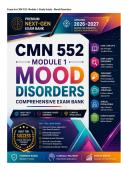
CMN 552 — Module 1: Mood Disorders
Comprehensive Exam Bank | Updated 2026–2027
Section Content Area
I Foundations & Classification of Mood Disorders
II Major Depressive Disorder
III Bipolar I & Bipolar II Disorders
IV Persistent Depressive & Cyclothymic Disorders
V Differential Diagnosis & Comorbidities
VI Psychopharmacology
VII Psychotherapy & Nonpharmacologic Management
VIII Special Populations & Clinical Considerations
IX Advanced Clinical Judgment & Case-Based Questions
X Comprehensive Module 1 Review
Premium Exam Features
• 300 comprehensive practice questions
• 10 high-yield content sections
• Advanced clinical judgment and case-based scenarios
• Differential diagnosis and comorbidity analysis
• Psychopharmacology and medication-management concepts
• Psychotherapy and nonpharmacologic approaches
• Special-population and clinical considerations
• Clinical Pearls
• Exam Strategy guidance
• Detailed answer rationales
, • Mixed and unpredictable A–D answer sequences
• Comprehensive cumulative Module 1 review
Foundations & Classification of Mood Disorders
Question 1
During an intake interview, a student says, “I've been sad since failing an important examination
three days ago.” Which additional information is most important before interpreting the
experience as a depressive disorder?
A. Whether the student normally earns high grades
B. Duration, severity, associated symptoms, functional impairment, and contextual proportionality
C. Whether another family member has ever failed an examination
D. Whether sadness is present at the exact same time each day
Correct Answer: B
Rationale: Sadness alone does not establish a mood disorder. Classification requires consideration of
symptom pattern, duration, severity, impairment, context, and exclusion of alternative explanations. A
transient emotional response to disappointment may differ substantially from a depressive syndrome.*
Clinical Pearl: A mood is a symptom; a mood disorder requires a clinically meaningful pattern.
Exam Strategy: When given one emotional symptom, look for the option that assesses the broader
syndrome.
Question 2
Which statement best distinguishes a mood from an emotion when conceptualizing mood
disorders?
A. Emotions always indicate psychopathology.
B. Mood and emotion are diagnostically identical concepts.
C. Mood refers only to observable behaviour.
D. Mood generally describes a more sustained emotional state, whereas emotions may be relatively brief
responses to particular events.
Correct Answer: D
Rationale: Mood generally refers to a more pervasive and sustained affective state, whereas emotions
often represent shorter responses associated with particular stimuli or circumstances. This distinction
helps clinicians characterize affective disturbances accurately.*
Clinical Pearl: Duration and pervasiveness help distinguish mood from momentary emotional
reactions.
Exam Strategy: Sustained background state → mood; shorter event-linked response → emotion.
Question 3
,A patient reports persistent low mood and loss of interest. Before assigning a primary depressive
diagnosis, which question represents the strongest differential-diagnostic reasoning?
A. Could substances, medications, medical conditions, bipolar-spectrum symptoms, or another disorder
better account for the presentation?
B. Does the patient prefer morning appointments?
C. Has the patient ever studied psychology?
D. Does the patient describe sadness using clinical terminology?
Correct Answer: A
Rationale: Classification should not stop after recognizing depressive symptoms. Clinicians must consider
alternative explanations, including bipolar-spectrum conditions, substances, medications, medical
disorders, bereavement-related context, and other psychiatric presentations.*
Clinical Pearl: Recognizing depression is not the same as establishing its diagnostic origin.
Exam Strategy: Before choosing a diagnosis, actively search for exclusionary or competing
explanations.
Question 4
A patient's mood symptoms occur exclusively during periods of substance exposure and closely
follow changes in use. What principle should guide classification?
A. Any depressive symptoms automatically indicate major depressive disorder.
B. Substance use is irrelevant once mood symptoms become severe.
C. The temporal relationship should be examined when considering a substance/medication-induced
mood presentation.
D. Mood disorders and substance effects can never resemble one another.
Correct Answer: C
Rationale: Temporal association between substance exposure, medication effects, and mood change is
diagnostically important. Classification requires determining whether the mood disturbance is primary
or better explained by substance- or medication-related effects.*
Clinical Pearl: Diagnostic timelines can reveal cause-related clues.
Exam Strategy: Symptoms tightly linked to exposure → examine substance/medication-induced
explanations.
Question 5
A person experiencing depression reports little pleasure from activities that were previously
highly rewarding. Which term most precisely describes this symptom?
A. Anhedonia
B. Grandiosity
C. Flight of ideas
D. Compulsion
Correct Answer: A
,Rationale: Anhedonia refers to markedly diminished interest or pleasure and represents a central feature
of depressive syndromes. It should be distinguished from anxiety-driven avoidance or inability to
participate for purely practical reasons.*
Clinical Pearl: Depression is not defined solely by sadness; loss of pleasure can be equally
important.
Exam Strategy: “Nothing feels enjoyable anymore” → anhedonia.
Question 6
A patient presents with a current depressive episode. Which historical finding would most
dramatically change the diagnostic framework?
A. Previous examination stress
B. A past episode meeting criteria for mania
C. Occasional ordinary sadness
D. Preference for sleeping late on weekends
Correct Answer: B
Rationale: A history of mania substantially changes classification because depressive episodes can occur
within bipolar disorders. Clinicians assessing depression should therefore investigate previous periods of
abnormal mood elevation, increased activity, and associated manic symptoms.*
Clinical Pearl: When assessing depression, always look backward for mania or hypomania.
Exam Strategy: Current depression + past mania → do not classify as straightforward unipolar
depression.
Question 7
Two patients report equally intense sadness. One continues functioning effectively, while the
other has stopped attending classes, withdrawn socially, and cannot complete ordinary
responsibilities. What does this comparison illustrate?
A. Functional impairment is irrelevant if symptoms are similar.
B. Diagnosis depends exclusively on symptom intensity.
C. Social withdrawal always establishes bipolar disorder.
D. Functional impairment provides important information about clinical significance and severity.
Correct Answer: D
Rationale: Psychological classification considers not only whether symptoms exist but also their impact
on occupational, academic, interpersonal, and other important areas of functioning.*
Clinical Pearl: Ask both “What symptoms exist?” and “What are those symptoms preventing the
person from doing?”
Exam Strategy: Similar symptoms + different functioning → impairment becomes a key
discriminator.
Question 8
,A patient alternates between episodes of depression and periods of markedly elevated mood,
reduced need for sleep, increased activity, and unusually expansive behaviour. Which broad
diagnostic category deserves particular consideration?
A. Anxiety disorders
B. Somatic symptom disorders
C. Bipolar and related disorders
D. Dissociative disorders
Correct Answer: C
Rationale: Episodes involving abnormal mood elevation and increased energy or activity, particularly
when combined with depressive episodes, raise consideration of bipolar-spectrum disorders.*
Clinical Pearl: Bipolar disorders involve more than “mood swings”; the nature and duration of
episodes matter.
Exam Strategy: Depression + distinct pathological elevation → think bipolar spectrum.
Question 9
Instead of asking, “Are you depressed?”, a clinician systematically examines mood, pleasure,
sleep, energy, cognition, appetite, psychomotor change, duration, impairment, and course. What
principle is illustrated?
A. Mood disorders are classified using syndromic patterns rather than a single symptom.
B. Every symptom carries identical diagnostic weight.
C. Diagnosis should be based on laboratory testing alone.
D. Functional information should be excluded.
Correct Answer: A
Rationale: Mood-disorder diagnosis depends on clinically meaningful clusters of symptoms occurring
with appropriate duration, severity, course, and functional consequences. Single symptoms generally lack
sufficient diagnostic specificity.*
Clinical Pearl: Syndrome > isolated symptom.
Exam Strategy: Broad symptom cluster assessment is stronger than a one-question diagnosis.
Question 10
A patient's depressive symptoms began after developing a medical condition known to affect
mood-regulating physiological processes. Which question becomes particularly important?
A. Whether depression is impossible when physical illness exists
B. Whether the mood disturbance may be attributable to the medical condition rather than automatically
classified as primary depression
C. Whether psychological symptoms should be ignored
D. Whether medical illnesses always produce mood disorders
Correct Answer: B
,Rationale: Medical conditions can sometimes produce clinically significant mood disturbances. The
clinician should evaluate timing, biological plausibility, course, and other evidence when determining
whether symptoms represent a primary or secondary mood condition.*
Clinical Pearl: Psychological symptoms can have important medical contributors.
Exam Strategy: New mood change + relevant medical illness → examine causal relationship.
Question 11
Which presentation most strongly suggests that ordinary mood variability has crossed into
clinically significant psychopathology?
A. Happiness after receiving good news
B. Brief disappointment following criticism
C. Persistent mood disturbance accompanied by substantial distress or impairment across important
areas of life
D. Temporary nervousness before an examination
Correct Answer: C
Rationale: Clinical significance depends on more than experiencing negative emotion. Persistence,
severity, dysfunction, distress, contextual appropriateness, and the overall syndrome help distinguish
disorder from ordinary emotional variation.*
Clinical Pearl: Psychopathology is not simply “having unpleasant emotions.”
Exam Strategy: Look for persistence + impairment/distress + syndrome-level disturbance.
Question 12
A patient currently appears depressed but describes a previous period of unusually elevated
mood and increased activity that lasted several days without the profound impairment
characteristic of full mania. Which possibility warrants investigation?
A. Hypomanic episode
B. Specific phobia
C. Dissociative amnesia
D. Obsessive-compulsive disorder
Correct Answer: A
Rationale: Hypomania involves a distinct period of abnormal mood elevation or irritability accompanied
by increased activity or energy and associated symptoms, but without the marked impairment or severity
required for mania.*
Clinical Pearl: Hypomania can be overlooked because patients may remember it as a period of
unusually high productivity.
Exam Strategy: Depression history + less severe elevated episode → investigate bipolar-spectrum
illness.
Question 13
,A clinician wants to determine whether a patient's apparent “mood swings” represent bipolar
disorder. Which approach is most useful?
A. Count how often mood changes within a single afternoon.
B. Assume any emotional variability is bipolarity.
C. Diagnose according to irritability alone.
D. Establish whether distinct episodes meet relevant symptom, duration, severity, and functional criteria.
Correct Answer: D
Rationale: Everyday mood variability should not be confused with bipolar episodes. Bipolar classification
requires careful characterization of distinct episodes, associated symptoms, duration, changes from
baseline, and functional consequences.*
Clinical Pearl: Mood swings ≠ automatically bipolar disorder.
Exam Strategy: Bipolar questions are usually about episodes, not ordinary moment-to-moment
emotional change.
Question 14
A person reports long-standing depressive symptoms that are less dramatic than a severe major
depressive episode but have remained chronically present. What dimension becomes particularly
important for classification?
A. Favourite coping strategy
B. Chronicity and longitudinal course
C. Whether symptoms began on a weekday
D. Number of previous therapists
Correct Answer: B
Rationale: Duration and longitudinal course help distinguish episodic from persistent depressive
presentations. Classification therefore requires understanding how symptoms unfold over time rather
than assessing only current intensity.*
Clinical Pearl: Mood disorders are disorders of course as well as symptoms.
Exam Strategy: Long-standing symptoms → pay close attention to chronicity.
Question 15
A patient's depressive presentation includes substantial anxiety symptoms. What is the strongest
classification principle?
A. Anxiety automatically rules out a mood disorder.
B. Only one symptom domain can be diagnosed at a time.
C. Evaluate the complete presentation because mood and anxiety symptoms may coexist and influence
severity and treatment.
D. Reclassify every anxious depression as bipolar disorder.
Correct Answer: C
,Rationale: Comorbidity and overlapping symptom dimensions are common in psychopathology.
Clinicians should characterize the full presentation rather than forcing all symptoms into a single
artificial category.*
Clinical Pearl: Diagnostic categories can coexist; patients do not necessarily fit into one isolated box.
Exam Strategy: Mixed symptom domains → evaluate comorbidity and specifiers rather than
assuming mutual exclusion.
Question 16
Why is longitudinal history especially important when evaluating someone presenting with
depression for the first time?
A. Current symptoms contain no useful information.
B. Previous episodes are relevant only in older adults.
C. Family history automatically determines diagnosis.
D. Earlier manic, hypomanic, depressive, substance-related, and treatment-response patterns can
substantially alter classification.
Correct Answer: D
Rationale: A cross-sectional interview captures only one point in time. Mood disorders are strongly
characterized by episodicity, recurrence, polarity, and longitudinal course.*
Clinical Pearl: Today's depression may be only one chapter in a much longer mood history.
Exam Strategy: Mood disorder classification → think timeline, not snapshot.
Question 17
A patient's mood symptoms do not fit neatly into the clinician's first diagnostic hypothesis. What
is the strongest response?
A. Force the presentation into the closest category.
B. Continue assessment, clarify missing criteria and competing explanations, and tolerate diagnostic
uncertainty when evidence remains incomplete.
C. Select a diagnosis based on the most dramatic symptom.
D. Avoid documenting uncertainty.
Correct Answer: B
Rationale: Responsible classification requires adequate evidence. When information is incomplete or
competing explanations remain plausible, further assessment is preferable to premature diagnostic
closure.*
Clinical Pearl: Diagnostic uncertainty can represent good clinical judgment when evidence is
genuinely incomplete.
Exam Strategy: Incomplete evidence → gather information rather than force certainty.
Question 18
, A patient describes an unusually energetic period with reduced sleep. Which additional feature
would most strongly help determine whether this represents pathological mood elevation rather
than ordinary enthusiasm?
A. Whether the episode represented a clear change from usual functioning and was accompanied by
characteristic manic or hypomanic features
B. Whether the patient enjoyed being productive
C. Whether the weather was pleasant
D. Whether friends also stayed awake late
Correct Answer: A
Rationale: Pathological mood elevation involves a distinct change from baseline accompanied by
characteristic cognitive, behavioural, mood, and activity changes. Reduced sleep alone is insufficient.*
Clinical Pearl: Mania and hypomania involve syndromic change from baseline, not simply high
energy.
Exam Strategy: One “manic-looking” symptom → search for the broader episode.
Question 19
Why might two individuals who both meet criteria for a depressive disorder nevertheless present
very differently?
A. Diagnostic categories require every patient to have identical symptoms.
B. Differences prove that one diagnosis must be wrong.
C. Mood disorders cannot involve individual variation.
D. Diagnostic syndromes can permit heterogeneity in symptom combinations, severity, course,
comorbidity, and contextual factors.
Correct Answer: D
Rationale: Individuals sharing the same categorical diagnosis may differ substantially in symptoms,
severity, episode pattern, associated features, functioning, and contributing factors. Classification
summarizes clinically meaningful patterns without making patients identical.*
Clinical Pearl: A diagnosis is a useful clinical category—not a complete description of a person.
Exam Strategy: Same diagnosis ≠ identical presentation.
Question 20
Which approach provides the strongest foundation for classifying a suspected mood disorder?
A. Diagnose from the patient's most noticeable symptom.
B. Use family history as the sole criterion.
C. Integrate symptom pattern, episode duration, severity, impairment, longitudinal course, differential
diagnosis, contextual factors, and relevant medical or substance influences.
D. Classify solely according to whether mood is positive or negative.
Correct Answer: C
, Premium Next-Gen Table of Contents
CMN 552 — Module 1: Mood Disorders
Comprehensive Exam Bank | Updated 2026–2027
Section Content Area
I Foundations & Classification of Mood Disorders
II Major Depressive Disorder
III Bipolar I & Bipolar II Disorders
IV Persistent Depressive & Cyclothymic Disorders
V Differential Diagnosis & Comorbidities
VI Psychopharmacology
VII Psychotherapy & Nonpharmacologic Management
VIII Special Populations & Clinical Considerations
IX Advanced Clinical Judgment & Case-Based Questions
X Comprehensive Module 1 Review
Premium Exam Features
• 300 comprehensive practice questions
• 10 high-yield content sections
• Advanced clinical judgment and case-based scenarios
• Differential diagnosis and comorbidity analysis
• Psychopharmacology and medication-management concepts
• Psychotherapy and nonpharmacologic approaches
• Special-population and clinical considerations
• Clinical Pearls
• Exam Strategy guidance
• Detailed answer rationales
, • Mixed and unpredictable A–D answer sequences
• Comprehensive cumulative Module 1 review
Foundations & Classification of Mood Disorders
Question 1
During an intake interview, a student says, “I've been sad since failing an important examination
three days ago.” Which additional information is most important before interpreting the
experience as a depressive disorder?
A. Whether the student normally earns high grades
B. Duration, severity, associated symptoms, functional impairment, and contextual proportionality
C. Whether another family member has ever failed an examination
D. Whether sadness is present at the exact same time each day
Correct Answer: B
Rationale: Sadness alone does not establish a mood disorder. Classification requires consideration of
symptom pattern, duration, severity, impairment, context, and exclusion of alternative explanations. A
transient emotional response to disappointment may differ substantially from a depressive syndrome.*
Clinical Pearl: A mood is a symptom; a mood disorder requires a clinically meaningful pattern.
Exam Strategy: When given one emotional symptom, look for the option that assesses the broader
syndrome.
Question 2
Which statement best distinguishes a mood from an emotion when conceptualizing mood
disorders?
A. Emotions always indicate psychopathology.
B. Mood and emotion are diagnostically identical concepts.
C. Mood refers only to observable behaviour.
D. Mood generally describes a more sustained emotional state, whereas emotions may be relatively brief
responses to particular events.
Correct Answer: D
Rationale: Mood generally refers to a more pervasive and sustained affective state, whereas emotions
often represent shorter responses associated with particular stimuli or circumstances. This distinction
helps clinicians characterize affective disturbances accurately.*
Clinical Pearl: Duration and pervasiveness help distinguish mood from momentary emotional
reactions.
Exam Strategy: Sustained background state → mood; shorter event-linked response → emotion.
Question 3
,A patient reports persistent low mood and loss of interest. Before assigning a primary depressive
diagnosis, which question represents the strongest differential-diagnostic reasoning?
A. Could substances, medications, medical conditions, bipolar-spectrum symptoms, or another disorder
better account for the presentation?
B. Does the patient prefer morning appointments?
C. Has the patient ever studied psychology?
D. Does the patient describe sadness using clinical terminology?
Correct Answer: A
Rationale: Classification should not stop after recognizing depressive symptoms. Clinicians must consider
alternative explanations, including bipolar-spectrum conditions, substances, medications, medical
disorders, bereavement-related context, and other psychiatric presentations.*
Clinical Pearl: Recognizing depression is not the same as establishing its diagnostic origin.
Exam Strategy: Before choosing a diagnosis, actively search for exclusionary or competing
explanations.
Question 4
A patient's mood symptoms occur exclusively during periods of substance exposure and closely
follow changes in use. What principle should guide classification?
A. Any depressive symptoms automatically indicate major depressive disorder.
B. Substance use is irrelevant once mood symptoms become severe.
C. The temporal relationship should be examined when considering a substance/medication-induced
mood presentation.
D. Mood disorders and substance effects can never resemble one another.
Correct Answer: C
Rationale: Temporal association between substance exposure, medication effects, and mood change is
diagnostically important. Classification requires determining whether the mood disturbance is primary
or better explained by substance- or medication-related effects.*
Clinical Pearl: Diagnostic timelines can reveal cause-related clues.
Exam Strategy: Symptoms tightly linked to exposure → examine substance/medication-induced
explanations.
Question 5
A person experiencing depression reports little pleasure from activities that were previously
highly rewarding. Which term most precisely describes this symptom?
A. Anhedonia
B. Grandiosity
C. Flight of ideas
D. Compulsion
Correct Answer: A
,Rationale: Anhedonia refers to markedly diminished interest or pleasure and represents a central feature
of depressive syndromes. It should be distinguished from anxiety-driven avoidance or inability to
participate for purely practical reasons.*
Clinical Pearl: Depression is not defined solely by sadness; loss of pleasure can be equally
important.
Exam Strategy: “Nothing feels enjoyable anymore” → anhedonia.
Question 6
A patient presents with a current depressive episode. Which historical finding would most
dramatically change the diagnostic framework?
A. Previous examination stress
B. A past episode meeting criteria for mania
C. Occasional ordinary sadness
D. Preference for sleeping late on weekends
Correct Answer: B
Rationale: A history of mania substantially changes classification because depressive episodes can occur
within bipolar disorders. Clinicians assessing depression should therefore investigate previous periods of
abnormal mood elevation, increased activity, and associated manic symptoms.*
Clinical Pearl: When assessing depression, always look backward for mania or hypomania.
Exam Strategy: Current depression + past mania → do not classify as straightforward unipolar
depression.
Question 7
Two patients report equally intense sadness. One continues functioning effectively, while the
other has stopped attending classes, withdrawn socially, and cannot complete ordinary
responsibilities. What does this comparison illustrate?
A. Functional impairment is irrelevant if symptoms are similar.
B. Diagnosis depends exclusively on symptom intensity.
C. Social withdrawal always establishes bipolar disorder.
D. Functional impairment provides important information about clinical significance and severity.
Correct Answer: D
Rationale: Psychological classification considers not only whether symptoms exist but also their impact
on occupational, academic, interpersonal, and other important areas of functioning.*
Clinical Pearl: Ask both “What symptoms exist?” and “What are those symptoms preventing the
person from doing?”
Exam Strategy: Similar symptoms + different functioning → impairment becomes a key
discriminator.
Question 8
,A patient alternates between episodes of depression and periods of markedly elevated mood,
reduced need for sleep, increased activity, and unusually expansive behaviour. Which broad
diagnostic category deserves particular consideration?
A. Anxiety disorders
B. Somatic symptom disorders
C. Bipolar and related disorders
D. Dissociative disorders
Correct Answer: C
Rationale: Episodes involving abnormal mood elevation and increased energy or activity, particularly
when combined with depressive episodes, raise consideration of bipolar-spectrum disorders.*
Clinical Pearl: Bipolar disorders involve more than “mood swings”; the nature and duration of
episodes matter.
Exam Strategy: Depression + distinct pathological elevation → think bipolar spectrum.
Question 9
Instead of asking, “Are you depressed?”, a clinician systematically examines mood, pleasure,
sleep, energy, cognition, appetite, psychomotor change, duration, impairment, and course. What
principle is illustrated?
A. Mood disorders are classified using syndromic patterns rather than a single symptom.
B. Every symptom carries identical diagnostic weight.
C. Diagnosis should be based on laboratory testing alone.
D. Functional information should be excluded.
Correct Answer: A
Rationale: Mood-disorder diagnosis depends on clinically meaningful clusters of symptoms occurring
with appropriate duration, severity, course, and functional consequences. Single symptoms generally lack
sufficient diagnostic specificity.*
Clinical Pearl: Syndrome > isolated symptom.
Exam Strategy: Broad symptom cluster assessment is stronger than a one-question diagnosis.
Question 10
A patient's depressive symptoms began after developing a medical condition known to affect
mood-regulating physiological processes. Which question becomes particularly important?
A. Whether depression is impossible when physical illness exists
B. Whether the mood disturbance may be attributable to the medical condition rather than automatically
classified as primary depression
C. Whether psychological symptoms should be ignored
D. Whether medical illnesses always produce mood disorders
Correct Answer: B
,Rationale: Medical conditions can sometimes produce clinically significant mood disturbances. The
clinician should evaluate timing, biological plausibility, course, and other evidence when determining
whether symptoms represent a primary or secondary mood condition.*
Clinical Pearl: Psychological symptoms can have important medical contributors.
Exam Strategy: New mood change + relevant medical illness → examine causal relationship.
Question 11
Which presentation most strongly suggests that ordinary mood variability has crossed into
clinically significant psychopathology?
A. Happiness after receiving good news
B. Brief disappointment following criticism
C. Persistent mood disturbance accompanied by substantial distress or impairment across important
areas of life
D. Temporary nervousness before an examination
Correct Answer: C
Rationale: Clinical significance depends on more than experiencing negative emotion. Persistence,
severity, dysfunction, distress, contextual appropriateness, and the overall syndrome help distinguish
disorder from ordinary emotional variation.*
Clinical Pearl: Psychopathology is not simply “having unpleasant emotions.”
Exam Strategy: Look for persistence + impairment/distress + syndrome-level disturbance.
Question 12
A patient currently appears depressed but describes a previous period of unusually elevated
mood and increased activity that lasted several days without the profound impairment
characteristic of full mania. Which possibility warrants investigation?
A. Hypomanic episode
B. Specific phobia
C. Dissociative amnesia
D. Obsessive-compulsive disorder
Correct Answer: A
Rationale: Hypomania involves a distinct period of abnormal mood elevation or irritability accompanied
by increased activity or energy and associated symptoms, but without the marked impairment or severity
required for mania.*
Clinical Pearl: Hypomania can be overlooked because patients may remember it as a period of
unusually high productivity.
Exam Strategy: Depression history + less severe elevated episode → investigate bipolar-spectrum
illness.
Question 13
,A clinician wants to determine whether a patient's apparent “mood swings” represent bipolar
disorder. Which approach is most useful?
A. Count how often mood changes within a single afternoon.
B. Assume any emotional variability is bipolarity.
C. Diagnose according to irritability alone.
D. Establish whether distinct episodes meet relevant symptom, duration, severity, and functional criteria.
Correct Answer: D
Rationale: Everyday mood variability should not be confused with bipolar episodes. Bipolar classification
requires careful characterization of distinct episodes, associated symptoms, duration, changes from
baseline, and functional consequences.*
Clinical Pearl: Mood swings ≠ automatically bipolar disorder.
Exam Strategy: Bipolar questions are usually about episodes, not ordinary moment-to-moment
emotional change.
Question 14
A person reports long-standing depressive symptoms that are less dramatic than a severe major
depressive episode but have remained chronically present. What dimension becomes particularly
important for classification?
A. Favourite coping strategy
B. Chronicity and longitudinal course
C. Whether symptoms began on a weekday
D. Number of previous therapists
Correct Answer: B
Rationale: Duration and longitudinal course help distinguish episodic from persistent depressive
presentations. Classification therefore requires understanding how symptoms unfold over time rather
than assessing only current intensity.*
Clinical Pearl: Mood disorders are disorders of course as well as symptoms.
Exam Strategy: Long-standing symptoms → pay close attention to chronicity.
Question 15
A patient's depressive presentation includes substantial anxiety symptoms. What is the strongest
classification principle?
A. Anxiety automatically rules out a mood disorder.
B. Only one symptom domain can be diagnosed at a time.
C. Evaluate the complete presentation because mood and anxiety symptoms may coexist and influence
severity and treatment.
D. Reclassify every anxious depression as bipolar disorder.
Correct Answer: C
,Rationale: Comorbidity and overlapping symptom dimensions are common in psychopathology.
Clinicians should characterize the full presentation rather than forcing all symptoms into a single
artificial category.*
Clinical Pearl: Diagnostic categories can coexist; patients do not necessarily fit into one isolated box.
Exam Strategy: Mixed symptom domains → evaluate comorbidity and specifiers rather than
assuming mutual exclusion.
Question 16
Why is longitudinal history especially important when evaluating someone presenting with
depression for the first time?
A. Current symptoms contain no useful information.
B. Previous episodes are relevant only in older adults.
C. Family history automatically determines diagnosis.
D. Earlier manic, hypomanic, depressive, substance-related, and treatment-response patterns can
substantially alter classification.
Correct Answer: D
Rationale: A cross-sectional interview captures only one point in time. Mood disorders are strongly
characterized by episodicity, recurrence, polarity, and longitudinal course.*
Clinical Pearl: Today's depression may be only one chapter in a much longer mood history.
Exam Strategy: Mood disorder classification → think timeline, not snapshot.
Question 17
A patient's mood symptoms do not fit neatly into the clinician's first diagnostic hypothesis. What
is the strongest response?
A. Force the presentation into the closest category.
B. Continue assessment, clarify missing criteria and competing explanations, and tolerate diagnostic
uncertainty when evidence remains incomplete.
C. Select a diagnosis based on the most dramatic symptom.
D. Avoid documenting uncertainty.
Correct Answer: B
Rationale: Responsible classification requires adequate evidence. When information is incomplete or
competing explanations remain plausible, further assessment is preferable to premature diagnostic
closure.*
Clinical Pearl: Diagnostic uncertainty can represent good clinical judgment when evidence is
genuinely incomplete.
Exam Strategy: Incomplete evidence → gather information rather than force certainty.
Question 18
, A patient describes an unusually energetic period with reduced sleep. Which additional feature
would most strongly help determine whether this represents pathological mood elevation rather
than ordinary enthusiasm?
A. Whether the episode represented a clear change from usual functioning and was accompanied by
characteristic manic or hypomanic features
B. Whether the patient enjoyed being productive
C. Whether the weather was pleasant
D. Whether friends also stayed awake late
Correct Answer: A
Rationale: Pathological mood elevation involves a distinct change from baseline accompanied by
characteristic cognitive, behavioural, mood, and activity changes. Reduced sleep alone is insufficient.*
Clinical Pearl: Mania and hypomania involve syndromic change from baseline, not simply high
energy.
Exam Strategy: One “manic-looking” symptom → search for the broader episode.
Question 19
Why might two individuals who both meet criteria for a depressive disorder nevertheless present
very differently?
A. Diagnostic categories require every patient to have identical symptoms.
B. Differences prove that one diagnosis must be wrong.
C. Mood disorders cannot involve individual variation.
D. Diagnostic syndromes can permit heterogeneity in symptom combinations, severity, course,
comorbidity, and contextual factors.
Correct Answer: D
Rationale: Individuals sharing the same categorical diagnosis may differ substantially in symptoms,
severity, episode pattern, associated features, functioning, and contributing factors. Classification
summarizes clinically meaningful patterns without making patients identical.*
Clinical Pearl: A diagnosis is a useful clinical category—not a complete description of a person.
Exam Strategy: Same diagnosis ≠ identical presentation.
Question 20
Which approach provides the strongest foundation for classifying a suspected mood disorder?
A. Diagnose from the patient's most noticeable symptom.
B. Use family history as the sole criterion.
C. Integrate symptom pattern, episode duration, severity, impairment, longitudinal course, differential
diagnosis, contextual factors, and relevant medical or substance influences.
D. Classify solely according to whether mood is positive or negative.
Correct Answer: C