
Page 1 of 112
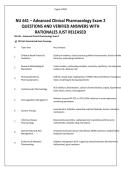
NU 641 – Advanced Clinical Pharmacology Exam 2
QUESTIONS AND VERIFIED ANSWERS WITH
RATIONALES JUST RELEASED
NU 641 – Advanced Clinical Pharmacology Exam 2
10-Point Summarized Exam Coverage
# Topic Area Key Concepts
Evidence-Based Practice & Quality of evidence; clinical practice guideline characteristics; levels of eviden
1
Guidelines hierarchy; study design limitations
Research Methodology & Cohort studies; confounding variables; sensitivity, specificity; risk interpretati
2
Biostatistics (relative risk, absolute risk)
Pharmacokinetics & Half-life, steady state, loading dose; CYP450 inducers/inhibitors; therapeutic
3
Pharmacodynamics index; renal/hepatic dosing adjustments
ACE inhibitors, beta-blockers, calcium channel blockers; angina, hypertension
4 Cardiovascular Pharmacology
heart failure; statins, anticoagulants
Warfarin reversal (4F-PCC vs. FFP); DOAC selection in renal impairment;
5 Anticoagulation Management
monitoring parameters
Loop diuretics, thiazides; sequential nephron blockade; diuretic resistance
6 Diuretic Therapy
mechanisms
Infectious Disease Beta-lactams (penicillins, cephalosporins); macrolides (azithromycin);
7
Pharmacology sulfonamides; antibiotic drug interactions
Gastrointestinal & Pain Antacids (aluminum/calcium side effects); GERD treatment; antidiarrheals;
8
Management headache classification
Endocrine & Metabolic Diabetes management (GLP-1 agonists); thyroid disorders (levothyroxine,
9
Pharmacology liothyronine); gout treatment
, Page 2 of 112
# Topic Area Key Concepts
Pediatric/elderly prescribing; renal impairment dosing; adverse drug reaction
10 Special Populations & Safety
factors; five rights of medication administration
1. The quality of evidence supporting a clinical recommendation depends primarily on which of the
following factors?
✅ The scientific soundness, number, and type of supporting studies and the consistency of supported
findings
❌ The strength of the correlations found in the studies alone
❌ The diversity of the studies and types of statistics used
❌ The p-values of the supporting findings
Rationale: Evidence quality is determined by the scientific rigor, quantity, and consistency of supporting
studies, not by any single metric .
2. Which of the following is an important feature of all evidence-based clinical practice guidelines?
✅ They should explicitly indicate the amount, level, and quality of evidence supporting each
recommendation
❌ They should link pathophysiology to clinical actions
, Page 3 of 112
❌ They should be based on conclusions from meta-analysis
❌ They should be based on randomized clinical trials
Rationale: Evidence-based guidelines must transparently indicate the quality and strength of evidence
behind each recommendation .
3. Which characteristic of a clinical practice guideline is the BEST indicator that the recommendations
are truly evidence-based?
✅ The evidence for each recommendation is summarized and referenced
❌ A computerized database search was conducted before the recommendations were developed
❌ The producers used a levels of evidence hierarchy to characterize supporting evidence
❌ The producers of the guideline state they are evidence-based
Rationale: The most reliable indicator is that each recommendation is supported by referenced,
summarized evidence .
4. In cohort studies, what is the main criterion used to form cohort groups?
✅ Exposure to risk factor
❌ Demographic characteristics
, Page 4 of 112
❌ Random assignment
❌ Theory-based assumptions
Rationale: Cohort groups are formed based on exposure status to the risk factor being studied .
5. What is the source of confounding variables in cohort studies?
✅ The fact that the two groups may be different in ways other than the risk factor of interest
❌ The researcher's decision regarding whom to ask to be in the study
❌ The use of retrospective methods rather than prospective methods
❌ The researcher's choice regarding the outcome of the study
Rationale: Confounding occurs when groups differ in other characteristics beyond the exposure being
studied .
6. A test with 100% sensitivity means that:
✅ The test identifies everyone with the disease but may mistakenly flag some healthy people as having
the disease
❌ The test identifies everyone with the disease and never flags any healthy people as having the
disease
NU 641 – Advanced Clinical Pharmacology Exam 2
QUESTIONS AND VERIFIED ANSWERS WITH
RATIONALES JUST RELEASED
NU 641 – Advanced Clinical Pharmacology Exam 2
10-Point Summarized Exam Coverage
# Topic Area Key Concepts
Evidence-Based Practice & Quality of evidence; clinical practice guideline characteristics; levels of eviden
1
Guidelines hierarchy; study design limitations
Research Methodology & Cohort studies; confounding variables; sensitivity, specificity; risk interpretati
2
Biostatistics (relative risk, absolute risk)
Pharmacokinetics & Half-life, steady state, loading dose; CYP450 inducers/inhibitors; therapeutic
3
Pharmacodynamics index; renal/hepatic dosing adjustments
ACE inhibitors, beta-blockers, calcium channel blockers; angina, hypertension
4 Cardiovascular Pharmacology
heart failure; statins, anticoagulants
Warfarin reversal (4F-PCC vs. FFP); DOAC selection in renal impairment;
5 Anticoagulation Management
monitoring parameters
Loop diuretics, thiazides; sequential nephron blockade; diuretic resistance
6 Diuretic Therapy
mechanisms
Infectious Disease Beta-lactams (penicillins, cephalosporins); macrolides (azithromycin);
7
Pharmacology sulfonamides; antibiotic drug interactions
Gastrointestinal & Pain Antacids (aluminum/calcium side effects); GERD treatment; antidiarrheals;
8
Management headache classification
Endocrine & Metabolic Diabetes management (GLP-1 agonists); thyroid disorders (levothyroxine,
9
Pharmacology liothyronine); gout treatment
, Page 2 of 112
# Topic Area Key Concepts
Pediatric/elderly prescribing; renal impairment dosing; adverse drug reaction
10 Special Populations & Safety
factors; five rights of medication administration
1. The quality of evidence supporting a clinical recommendation depends primarily on which of the
following factors?
✅ The scientific soundness, number, and type of supporting studies and the consistency of supported
findings
❌ The strength of the correlations found in the studies alone
❌ The diversity of the studies and types of statistics used
❌ The p-values of the supporting findings
Rationale: Evidence quality is determined by the scientific rigor, quantity, and consistency of supporting
studies, not by any single metric .
2. Which of the following is an important feature of all evidence-based clinical practice guidelines?
✅ They should explicitly indicate the amount, level, and quality of evidence supporting each
recommendation
❌ They should link pathophysiology to clinical actions
, Page 3 of 112
❌ They should be based on conclusions from meta-analysis
❌ They should be based on randomized clinical trials
Rationale: Evidence-based guidelines must transparently indicate the quality and strength of evidence
behind each recommendation .
3. Which characteristic of a clinical practice guideline is the BEST indicator that the recommendations
are truly evidence-based?
✅ The evidence for each recommendation is summarized and referenced
❌ A computerized database search was conducted before the recommendations were developed
❌ The producers used a levels of evidence hierarchy to characterize supporting evidence
❌ The producers of the guideline state they are evidence-based
Rationale: The most reliable indicator is that each recommendation is supported by referenced,
summarized evidence .
4. In cohort studies, what is the main criterion used to form cohort groups?
✅ Exposure to risk factor
❌ Demographic characteristics
, Page 4 of 112
❌ Random assignment
❌ Theory-based assumptions
Rationale: Cohort groups are formed based on exposure status to the risk factor being studied .
5. What is the source of confounding variables in cohort studies?
✅ The fact that the two groups may be different in ways other than the risk factor of interest
❌ The researcher's decision regarding whom to ask to be in the study
❌ The use of retrospective methods rather than prospective methods
❌ The researcher's choice regarding the outcome of the study
Rationale: Confounding occurs when groups differ in other characteristics beyond the exposure being
studied .
6. A test with 100% sensitivity means that:
✅ The test identifies everyone with the disease but may mistakenly flag some healthy people as having
the disease
❌ The test identifies everyone with the disease and never flags any healthy people as having the
disease



