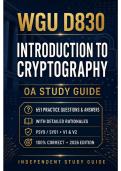
, WGU D830
Introduction to Cryptography
OA-Style Practice Assessment
76 Original Multiple-Choice Questions with Answers and Rationales
2026 Edition
Scenario-based review of foundations, symmetric and asymmetric cryptography,
hashing, PKI, protocols, lightweight cryptography, and post-quantum migration.
Academic integrity notice: This is independently authored practice material. It is not the live WGU OA, does not contain recalled or leaked
exam items, and is not endorsed by WGU. Course content and assessment specifications may change.
WGU D830 OA-Style Practice Assessment - Original Study Material Page 1
, How to Use This Assessment
Complete Part I without consulting the answer key. Choose one best answer for each item. Then score your
responses and review every rationale, including those you answered correctly.
Domain Questions Approx. share
Foundations and classical concepts 1-10 13%
Symmetric cryptography 11-24 18%
Asymmetric cryptography 25-35 15%
Hashing, MACs, and signatures 36-45 13%
PKI and key management 46-54 12%
Protocols and secure implementation 55-64 13%
Lightweight and post-quantum cryptography 65-76 16%
Suggested benchmark: 61/76 (about 80%) indicates strong readiness on this practice set. This benchmark is not WGU's official cut score.
WGU D830 OA-Style Practice Assessment - Original Study Material Page 2
, Part I - Practice Questions
1. Which statement best expresses Kerckhoffs's principle?
A. The algorithm must remain secret
B. Security should depend on secrecy of the key
C. Every cipher must use public keys
D. Long messages require longer algorithms
2. A Caesar cipher replaces each letter with another letter a fixed distance away. Which operation is
this?
A. Transposition
B. Substitution
C. Hashing
D. Key stretching
3. Which process rearranges plaintext symbols without replacing the symbols themselves?
A. Permutation/transposition
B. Substitution
C. Salting
D. Signing
4. In Shannon's terminology, what does confusion primarily obscure?
A. The relationship between the key and ciphertext
B. The length of the plaintext
C. The location of the recipient
D. The certificate expiration date
5. In Shannon's terminology, diffusion is intended to do what?
A. Hide the algorithm
B. Spread plaintext patterns across many ciphertext symbols
C. Exchange public keys
D. Compress the message
6. What is 29 mod 7?
A. 0
B. 1
C. 4
D. 7
7. Why is a one-time pad theoretically secure when used correctly?
A. It uses prime factorization
B. Its truly random key is as long as the message and never reused
C. It uses two public keys
D. It stores no ciphertext
WGU D830 OA-Style Practice Assessment - Original Study Material Page 3
Introduction to Cryptography
OA-Style Practice Assessment
76 Original Multiple-Choice Questions with Answers and Rationales
2026 Edition
Scenario-based review of foundations, symmetric and asymmetric cryptography,
hashing, PKI, protocols, lightweight cryptography, and post-quantum migration.
Academic integrity notice: This is independently authored practice material. It is not the live WGU OA, does not contain recalled or leaked
exam items, and is not endorsed by WGU. Course content and assessment specifications may change.
WGU D830 OA-Style Practice Assessment - Original Study Material Page 1
, How to Use This Assessment
Complete Part I without consulting the answer key. Choose one best answer for each item. Then score your
responses and review every rationale, including those you answered correctly.
Domain Questions Approx. share
Foundations and classical concepts 1-10 13%
Symmetric cryptography 11-24 18%
Asymmetric cryptography 25-35 15%
Hashing, MACs, and signatures 36-45 13%
PKI and key management 46-54 12%
Protocols and secure implementation 55-64 13%
Lightweight and post-quantum cryptography 65-76 16%
Suggested benchmark: 61/76 (about 80%) indicates strong readiness on this practice set. This benchmark is not WGU's official cut score.
WGU D830 OA-Style Practice Assessment - Original Study Material Page 2
, Part I - Practice Questions
1. Which statement best expresses Kerckhoffs's principle?
A. The algorithm must remain secret
B. Security should depend on secrecy of the key
C. Every cipher must use public keys
D. Long messages require longer algorithms
2. A Caesar cipher replaces each letter with another letter a fixed distance away. Which operation is
this?
A. Transposition
B. Substitution
C. Hashing
D. Key stretching
3. Which process rearranges plaintext symbols without replacing the symbols themselves?
A. Permutation/transposition
B. Substitution
C. Salting
D. Signing
4. In Shannon's terminology, what does confusion primarily obscure?
A. The relationship between the key and ciphertext
B. The length of the plaintext
C. The location of the recipient
D. The certificate expiration date
5. In Shannon's terminology, diffusion is intended to do what?
A. Hide the algorithm
B. Spread plaintext patterns across many ciphertext symbols
C. Exchange public keys
D. Compress the message
6. What is 29 mod 7?
A. 0
B. 1
C. 4
D. 7
7. Why is a one-time pad theoretically secure when used correctly?
A. It uses prime factorization
B. Its truly random key is as long as the message and never reused
C. It uses two public keys
D. It stores no ciphertext
WGU D830 OA-Style Practice Assessment - Original Study Material Page 3