

Written by students who passed Immediately available after payment Read online or as PDF Wrong document? Swap it for free 4.6 TrustPilot
logo-home
Document preview thumbnail
Preview 2 out of 9 pages
Exam (elaborations)

Topic 4: Thorax and Lungs quiz; NURS 6023-Advanced Assessment and Diagnostic Evaluation | 100% latest 2026- ASU.

Document preview thumbnail
Preview 2 out of 9 pages

Topic 4: Thorax and Lungs quiz; NURS 6023-Advanced Assessment and Diagnostic Evaluation | 100% latest 2026- ASU. A cardiologist diagnoses a patient with myocardial infarction. Which of the following best describes the pathophysiology of this condition? A 65-year-old man presents to clinic with a one-month history of episodic chest pain that typically lasts “5 to 10 minutes.” He localizes the pain to the sternal region. The pain usually arises after climbing the stairs or while doing yard work, and is occasionally accompanied by nausea and dyspnea. Which of the following is the most likely diagnosis? A 23-year-old previously healthy graduate student comes to the emergency department with a 1-hour history of shortness of breath, which came on suddenly while he was studying. He also notices sharp chest pain on the right side. He has smoked two packs of cigarettes per day for the last 10 years. On percussion, the physicians notice hyperresonance over the superior right lung field. There are decreased breath sounds superiorly on the right side. There are no wheezes, crackles, or rhonchi. Which of the following is the most likely diagnosis? A 51-year-old presents to pulmonology clinic with a two-week history of hemoptysis. With the gown lowered, the pulmonologist observes the chest to determine the respiratory rate. Where are the primary breathing centers located? A chest radiograph demonstrates fluid between the visceral and parietal pleura. Which of the following is the diagnosis? A clinical student performs a lung examination on a classmate. Which of the following is a correct way to perform lung auscultation? A 34-year-old woman complains of chronic cough, sneezing and nasal congestion. She denies recent fever, chills, weight loss, sputum production, dyspnea, chest pain, or heartburn. She has a history of eczema. She does not smoke. Vital signs are within normal limits. Her lungs are clear to auscultation bilaterally. Chest radiograph is unremarkable. Which of the following is the most likely diagnosis? A 39-year-old man presents to clinic with a two-day history of fever, chills, productive cough, and dyspnea. He has no history of serious illness. His temperature is 101.2°F. Other vital signs are within normal limits. Late inspiratory crackles are heard on auscultation over the left lower lung posteriorly. While auscultating this region, the medical provider instructs the patient to say “ee,” but it sounds like “aa.” Which of the following would most likely be appreciated on percussion of this region? A 62-year-old man presents to the emergency department with shortness of breath. Lung examination is notable for dullness over the right lower lung field posteriorly. Breath sounds are vesicular, except for in the right lower lung field posteriorly, in which they are bronchial. There are late inspiratory crackles over the right lower lung field posteriorly. Bronchophony is noted over the right lower lung field posteriorly. Which of the following is the most likely diagnosis? A cardiologist diagnoses a patient with angina pectoris. Which of the following best describes the pathophysiology of angina pectoris? A 16-year-old boy is brought to the emergency department after being involved in a motor vehicle collision. Chest radiograph is notable for displaced rib fracture and left apical pneumothorax. The physician decides to place a chest tube in the fourth intercostal space. How did the physician localize the fourth intercostal space? A 14-year-old high school student presents to clinic with a three-month history of periodic dyspnea when playing basketball. The dyspnea resolves shortly after resting. He has not had fever, chills, cough, sputum production, or chest pain. He has no history of serious illness. The physician suspects asthma. Which of the following would be most suggestive of asthma? A physician evaluates a 42-year-old woman with symptoms suggestive of pneumonia. The physicians ask the patient to say “ninety-nine” as he listens with the stethoscope. Which of the following is being evaluated? A 20-year-old soccer player presents to clinic with a one-day history of chest pain. When asked to localize the pain, he points to the following area: Which anatomic line transects the location of his pain? A medical student performs a lung examination on a classmate. She first inspects and palpates the anterior chest wall. Which structure is labeled A in the image provided? A medical student performs a lung examination on a classmate. She places her hands as in the picture below. What is being assessed? A 56-year-old woman with suspected chronic obstructive pulmonary disease (COPD) presents to clinic. During the examination, the medical provider asks the patient to say “ninety-nine” as she feels for palpable vibrations on the chest wall. Which of the following is being evaluated? A medical student performs a lung examination on a classmate. She places one hand on the sternum, the other hand on the thoracic spine and then squeezes the chest. What is the name of this technique? A 72-year-old woman comes to the emergency department with neck pain. The physician notes a contusion just lateral to the thyroid gland. Which of the following is the correct term to describe the anatomical location of the contusion? A medical student performs a lung examination on a classmate. She auscultates over the number region labeled “1.” Which lobe is being evaluated?

Content preview

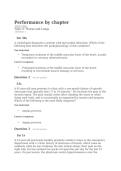
Performance by chapter
What's this?
Topic 4: Thorax and Lungs
Question 1

2m 36s
A cardiologist diagnoses a patient with myocardial infarction. Which of the
following best describes the pathophysiology of this condition?
You Selected:

 Temporary ischemia of the middle muscular layer of the heart, usually
secondary to coronary atherosclerosis.
Correct response:

 Prolonged ischemia of the middle muscular layer of the heart,
resulting in irreversible muscle damage or necrosis.

Question 2 See full question


52s
A 65-year-old man presents to clinic with a one-month history of episodic
chest pain that typically lasts “5 to 10 minutes.” He localizes the pain to the
sternal region. The pain usually arises after climbing the stairs or while
doing yard work, and is occasionally accompanied by nausea and dyspnea.
Which of the following is the most likely diagnosis?
You Selected:

 Angina pectoris.

Correct response:

 Angina pectoris.

Question 3 See full question


1m 1s
A 23-year-old previously healthy graduate student comes to the emergency
department with a 1-hour history of shortness of breath, which came on
suddenly while he was studying. He also notices sharp chest pain on the
right side. He has smoked two packs of cigarettes per day for the last 10
years. On percussion, the physicians notice hyperresonance over the

, superior right lung field. There are decreased breath sounds superiorly on
the right side. There are no wheezes, crackles, or rhonchi. Which of the
following is the most likely diagnosis?
You Selected:

 Pneumothorax.

Correct response:

 Pneumothorax.

Question 4 See full question


55s
A 51-year-old presents to pulmonology clinic with a two-week history of
hemoptysis. With the gown lowered, the pulmonoligist observes the chest to
determine the respiratory rate. Where are the primary breathing centers
located?
You Selected:

 Hypothalamus.

Correct response:

 Brainstem.

Question 5 See full question


12s
A chest radiograph demonstrates fluid between the visceral and parietal
pleura. Which of the following is the diagnosis?
You Selected:

 Pleural effusion.

Correct response:

 Pleural effusion.

Question 6 See full question


2m 19s

Document information

Uploaded on
August 10, 2026
Number of pages
9
Written in
2025/2026
Type
Exam (elaborations)
Contains
Questions & answers
$16.54

Wrong document? Swap it for free Within 14 days of purchase and before downloading, you can choose a different document. You can simply spend the amount again.
Written by students who passed
Immediately available after payment
Read online or as PDF

Seller avatar
Reputation scores are based on the amount of documents a seller has sold for a fee and the reviews they have received for those documents. There are three levels: Bronze, Silver and Gold. The better the reputation, the more your can rely on the quality of the sellers work.
MindCraft
3.8
(47)
Sold
368
Followers
7
Items
2790
Last sold
2 hours ago


Why students choose Stuvia

Created by fellow students, verified by reviews

Quality you can trust: written by students who passed their tests and reviewed by others who've used these notes.

Didn't get what you expected? Choose another document

No worries! You can instantly pick a different document that better fits what you're looking for.

Pay as you like, start learning right away

No subscription, no commitments. Pay the way you're used to via credit card and download your PDF document instantly.

Student with book image

“Bought, downloaded, and aced it. It really can be that simple.”

Alisha Student

Working on your references?

Create accurate citations in APA, MLA and Harvard with our free citation generator.

Working on your references?

Frequently asked questions

