

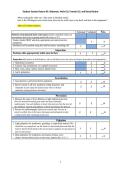
Student System Return #3: Abdomen, Male GU, Female GU, and Rectal Rubric
When starting the video say: “My name is [Student name],
here is the 360-degree scan of the room, here are the walls, here is my desk, and here is the equipment”.
Show all of these surfaces.
Performed Verbalized Points
Performs environmental check with camera (videos submitted without an
environment check prior to getting started will receive a “0”)
Washes hands FIRST and dons appropriate personal protective
1 /1
equipment.
Introduces self to patient using first and last name, including role. 1 /1
Inspection
Positions table appropriately (table must be flat). 1 1 /2
Inspection (Ask patient to hold hands at side or fold them across the chest and inspect from above and tangentially.)
1. Abdominal symmetry 1 /1
2. Contour: flat, protuberant, or scaphoid (concave) 1 /1
3. Skin: scars, striae, rashes, lesions, dilated veins 1 /1
4. Aortic pulsations 1 1 /2
Auscultation
1. Auscultation is performed before palpation. 2 2 __/4
2. Bowel sounds in all four quadrants noting frequency and
2 2 __/4
character (Listen along the midclavicular lines in the four
quadrants, pausing between locations.)
Percussion
1. Measure the span of liver dullness at right midclavicular line
(Percuss downward starting just under the breast along the
midclavicular line until dullness is heard, then percuss from the level of 2 2 __/4
the umbilicus upward until dullness is heard and measure the span of
2. Percuss for splenomegaly (Splenic percussion sign: Percuss at
anterior axillary line at the lowest interspace and ask patient to take 2 2 /4
a deep breath while continuing to percuss.)
Palpation
1. Light palpation for tenderness, guarding, or superficial masses (This
should be very superficial; use the hand in a horizontal plane and slide the
hand or barely lift the hand to the next location to palpate moving slowly in 2 2 /4
four or nine areas.)
2. Deep palpation for tenderness and masses (Palpate much 2 2 __/4
deeper moving slowly in four or nine areas; depress skin ~2–3”.)
1
, 3. Palpate liver edge, spleen, and kidneys for enlargement, tenderness
Liver: Place left hand posteriorly around the 11th and 12th ribs and press up
toward the ceiling. Palpate downward and upward [not in a scooping
fashion] with right hand, starting from the level of the umbilicus until the
lowest rib. Ask the patient to take a deep breath and try to feel the liver
edge as it moves under the fingertips. The hooking technique may be 4 4 /8
helpful in patients who are obese.
Spleen: Reach over and use left hand to press the left lower rib cage upward
while using right hand, starting well below the left costal margin to press
upward. Ask the patient to take a deep breath and try to feel the spleen
edge.
Kidneys: Palpate along the midclavicular line at the level of the liver edge or
costal margin bilaterally.
Special Techniques
1. Costovertebral angle (CVA) tenderness (Use fist percussion to make
a firm strike against the hand that is laying over the CVA bilaterally 2 2 __/4
– see page 644)
2. McBurney’s point (Assess for McBurney’s point. Palpating 2 inches from
the anterior superior iliac spine from the process to the umbilicus – see 2 2 __/4
page 647)
3. Rovsing sign (Assess for Rovsing sign [right-sided pain during left-
sided pressure] by pressing deeply and evenly in the LLQ – see page
648) 2 2 __/4
4. Cholecystitis (Assess for Murphy sign by palpating the liver edge
and asking patient to take a deep breath. Watch for a sharp pain 2 2 __/4
that stops inspiration – see page 648)
MALE GENITALIA
Dons appropriate personal protective equipment. _/1
1
Inspection (Standing)
1. Skin/hair: lesions, infestations, excoriations 1 _/1
2. Penis: lesions, deformities 1 _/1
3. Glans: lesions, inflammation 1 _/1
4. Meatus (Open between thumb and index finger.): hypospadias, 1 _/1
discharge, lesions
5. Scrotum: skin, contour (Elevate to view posterior surface.) 1 _/1
Palpation
1. Inguinal nodes: size, consistency, tenderness 1 _/1
2. Penis: tenderness, nodules or masses, induration 1 _/1
3. Scrotum: nodules or masses, edema 1 _/1
4. Testes: size, shape, consistency, tenderness, masses, nodules
(Palpate between thumb and first two fingers.) 1 _/1
2
When starting the video say: “My name is [Student name],
here is the 360-degree scan of the room, here are the walls, here is my desk, and here is the equipment”.
Show all of these surfaces.
Performed Verbalized Points
Performs environmental check with camera (videos submitted without an
environment check prior to getting started will receive a “0”)
Washes hands FIRST and dons appropriate personal protective
1 /1
equipment.
Introduces self to patient using first and last name, including role. 1 /1
Inspection
Positions table appropriately (table must be flat). 1 1 /2
Inspection (Ask patient to hold hands at side or fold them across the chest and inspect from above and tangentially.)
1. Abdominal symmetry 1 /1
2. Contour: flat, protuberant, or scaphoid (concave) 1 /1
3. Skin: scars, striae, rashes, lesions, dilated veins 1 /1
4. Aortic pulsations 1 1 /2
Auscultation
1. Auscultation is performed before palpation. 2 2 __/4
2. Bowel sounds in all four quadrants noting frequency and
2 2 __/4
character (Listen along the midclavicular lines in the four
quadrants, pausing between locations.)
Percussion
1. Measure the span of liver dullness at right midclavicular line
(Percuss downward starting just under the breast along the
midclavicular line until dullness is heard, then percuss from the level of 2 2 __/4
the umbilicus upward until dullness is heard and measure the span of
2. Percuss for splenomegaly (Splenic percussion sign: Percuss at
anterior axillary line at the lowest interspace and ask patient to take 2 2 /4
a deep breath while continuing to percuss.)
Palpation
1. Light palpation for tenderness, guarding, or superficial masses (This
should be very superficial; use the hand in a horizontal plane and slide the
hand or barely lift the hand to the next location to palpate moving slowly in 2 2 /4
four or nine areas.)
2. Deep palpation for tenderness and masses (Palpate much 2 2 __/4
deeper moving slowly in four or nine areas; depress skin ~2–3”.)
1
, 3. Palpate liver edge, spleen, and kidneys for enlargement, tenderness
Liver: Place left hand posteriorly around the 11th and 12th ribs and press up
toward the ceiling. Palpate downward and upward [not in a scooping
fashion] with right hand, starting from the level of the umbilicus until the
lowest rib. Ask the patient to take a deep breath and try to feel the liver
edge as it moves under the fingertips. The hooking technique may be 4 4 /8
helpful in patients who are obese.
Spleen: Reach over and use left hand to press the left lower rib cage upward
while using right hand, starting well below the left costal margin to press
upward. Ask the patient to take a deep breath and try to feel the spleen
edge.
Kidneys: Palpate along the midclavicular line at the level of the liver edge or
costal margin bilaterally.
Special Techniques
1. Costovertebral angle (CVA) tenderness (Use fist percussion to make
a firm strike against the hand that is laying over the CVA bilaterally 2 2 __/4
– see page 644)
2. McBurney’s point (Assess for McBurney’s point. Palpating 2 inches from
the anterior superior iliac spine from the process to the umbilicus – see 2 2 __/4
page 647)
3. Rovsing sign (Assess for Rovsing sign [right-sided pain during left-
sided pressure] by pressing deeply and evenly in the LLQ – see page
648) 2 2 __/4
4. Cholecystitis (Assess for Murphy sign by palpating the liver edge
and asking patient to take a deep breath. Watch for a sharp pain 2 2 __/4
that stops inspiration – see page 648)
MALE GENITALIA
Dons appropriate personal protective equipment. _/1
1
Inspection (Standing)
1. Skin/hair: lesions, infestations, excoriations 1 _/1
2. Penis: lesions, deformities 1 _/1
3. Glans: lesions, inflammation 1 _/1
4. Meatus (Open between thumb and index finger.): hypospadias, 1 _/1
discharge, lesions
5. Scrotum: skin, contour (Elevate to view posterior surface.) 1 _/1
Palpation
1. Inguinal nodes: size, consistency, tenderness 1 _/1
2. Penis: tenderness, nodules or masses, induration 1 _/1
3. Scrotum: nodules or masses, edema 1 _/1
4. Testes: size, shape, consistency, tenderness, masses, nodules
(Palpate between thumb and first two fingers.) 1 _/1
2


