
SOCIOLOGY 101 FINAL PAPER EXAMPREP
COMPLETE QUESTIONS AND ANSWERS
VIEW AHEAD STUDY SHEET
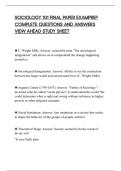
◉ C. Wright Mills. Answer: coined the term "The sociological
imagination" and allows us to comprehend the change happening
around us.
◉ Sociological Imagination. Answer: Ability to see the connection
between the larger world and our personal lives (C. Wright Mills)
◉ Auguste Comte (1798-1857). Answer: "Father of Sociology" -
invented what he called "social physics" to understand the world. We
could determine what is right and wrong without reference to higher
powers or other religious concepts.
◉ Social Institution. Answer: Any institution in a society that works
to shape the behavior of the groups of people within it
◉ Theoretical Stage. Answer: Society seemed to be the result of
divine will
"It was God's plan
,◉ Metaphysical Stage. Answer: human behavior governed by natural,
biological instincts
◉ Scientific Stage. Answer: develop a social physics to understand
human behavior
◉ Harriet Martineau (1802-1876). Answer: In 1853 she translated
Auguste Comte's work from French to English. *one of the earliest
feminist social scientists
◉ Karl Marx (1818-83). Answer: founder of "Marxism" the
ideological alternative to capitalism
◉ Max Weber (1864-1920). Answer: first to use sociological
imagination. created Verstehen ("understanding"). To truly understand
why people act the way they do, a sociologist must understand the
meanings people attach to their actions.
◉ Emile Durkheim (1858-1917). Answer: studied suicide and showed
how individual acts are conditioned by social forces.
◉ Anomie. Answer: too little social regulation; normlessness
◉ Georg Simmel. Answer: Established a sociology of numbers, how
people conduct themselves differently depending how many people
are involved
, ◉ Sociology "cousins". Answer: Psychology, anthropology, History,
political science
◉ Symbolic Interactionism. Answer: A micro-level theory in which
shared means and assumptions form the basic motivations behind
people's actions
◉ Quantitative Methods. Answer: uses statistical analysis to examine
numerical data
(data that can be converted to numerical form)
◉ Qualitative methods. Answer: methods that attempt to collect
information about the social world that cannot be readily converted to
numeric form.
◉ Sociology. Answer: The study of human society. The general goal
of sociology is to allow us to see how our individual lives are
intimately related to the social forces that exist beyond us
◉ Deductive approach. Answer: a research approach that starts with a
theory, forms a hypothesis, makes empirical observations, and then
analyzes the data to confirm, reject, or modify the original theory
◉ Inductive approach. Answer: a research approach that starts with
empirical observations and then works to form a theory.
COMPLETE QUESTIONS AND ANSWERS
VIEW AHEAD STUDY SHEET
◉ C. Wright Mills. Answer: coined the term "The sociological
imagination" and allows us to comprehend the change happening
around us.
◉ Sociological Imagination. Answer: Ability to see the connection
between the larger world and our personal lives (C. Wright Mills)
◉ Auguste Comte (1798-1857). Answer: "Father of Sociology" -
invented what he called "social physics" to understand the world. We
could determine what is right and wrong without reference to higher
powers or other religious concepts.
◉ Social Institution. Answer: Any institution in a society that works
to shape the behavior of the groups of people within it
◉ Theoretical Stage. Answer: Society seemed to be the result of
divine will
"It was God's plan
,◉ Metaphysical Stage. Answer: human behavior governed by natural,
biological instincts
◉ Scientific Stage. Answer: develop a social physics to understand
human behavior
◉ Harriet Martineau (1802-1876). Answer: In 1853 she translated
Auguste Comte's work from French to English. *one of the earliest
feminist social scientists
◉ Karl Marx (1818-83). Answer: founder of "Marxism" the
ideological alternative to capitalism
◉ Max Weber (1864-1920). Answer: first to use sociological
imagination. created Verstehen ("understanding"). To truly understand
why people act the way they do, a sociologist must understand the
meanings people attach to their actions.
◉ Emile Durkheim (1858-1917). Answer: studied suicide and showed
how individual acts are conditioned by social forces.
◉ Anomie. Answer: too little social regulation; normlessness
◉ Georg Simmel. Answer: Established a sociology of numbers, how
people conduct themselves differently depending how many people
are involved
, ◉ Sociology "cousins". Answer: Psychology, anthropology, History,
political science
◉ Symbolic Interactionism. Answer: A micro-level theory in which
shared means and assumptions form the basic motivations behind
people's actions
◉ Quantitative Methods. Answer: uses statistical analysis to examine
numerical data
(data that can be converted to numerical form)
◉ Qualitative methods. Answer: methods that attempt to collect
information about the social world that cannot be readily converted to
numeric form.
◉ Sociology. Answer: The study of human society. The general goal
of sociology is to allow us to see how our individual lives are
intimately related to the social forces that exist beyond us
◉ Deductive approach. Answer: a research approach that starts with a
theory, forms a hypothesis, makes empirical observations, and then
analyzes the data to confirm, reject, or modify the original theory
◉ Inductive approach. Answer: a research approach that starts with
empirical observations and then works to form a theory.


