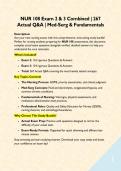
NUR 108 Exam 2 & 3 Combined | 267
Actual Q&A | Med-Surg & Fundamentals
Description:
Ace your next nursing exams with this comprehensive, time-saving study bundle!
Perfect for nursing students preparing for NUR 108 assessments, this document
compiles actual exam questions alongside verified, detailed answers to help you
understand the core rationales.
What’s Included?
• Exam 2: 133 rigorous Questions & Answers
• Exam 3: 134 rigorous Questions & Answers
• Total: 267 Actual Q&A covering the most heavily tested concepts.
Key Topics Covered:
• The Nursing Process: ADPIE, priority assessments, and clinical judgment.
• Med-Surg Concepts: Fluid and electrolytes, oxygenation/hypoxia, and
common chronic conditions.
• Fundamentals of Nursing: Vital signs, physical assessments, and
medication administration best practices.
• Professional Roles: Quality and Safety Education for Nurses (QSEN),
nursing theories, and ethical/legal boundaries.
Why Choose This Study Bundle?
• Actual Exam Prep: Practice with questions designed to mirror the
difficulty of your actual tests.
• Exam-Ready Format: Organized for quick skimming and efficient last-
minute reviews.
Stop stressing and start studying smarter. Download your copy today and boost
your confidence on exam day!
1
,Exam 2
Q1. Explain how erosion of the gastrointestinal mucosal layer in peptic ulcer
disease produces typical symptoms such as abdominal pain and gastrointestinal
bleeding. [Short Answer]
Answer: Erosion of the protective mucosal layer removes the barrier that shields
underlying tissue from acid and digestive enzymes, so those substances inflame and
damage deeper layers, producing gnawing or burning abdominal pain; if the erosion
reaches blood vessels it causes bleeding, which can appear as bright red emesis or black,
tarry stools.
Explanation: A complete answer links the pathological lesion (mucosal erosion) to symptoms:
loss of mucosal protection allows acid to directly injure tissue, causing inflammation and pain,
and deeper erosion into vessels produces GI bleeding. Use the clinical manifestations (type and
timing of pain, and signs of bleeding) to illustrate how tissue damage creates these findings.
Q2. Which instruction about sucralfate (Carafate) is consistent with the source
material? [Multiple Choice]
A) Sucralfate is an antibiotic used to eradicate H. pylori
B) Sucralfate increases gastric acid secretion and should be avoided in PUD
C) Sucralfate is a thick, gel-like mucosal protectant that promotes healing without
changing gastric acid and should be taken on an empty stomach before meals
D) Sucralfate works by neutralizing gastric acid and should be taken with meals
Answer: Sucralfate is a thick, gel-like mucosal protectant that promotes healing without
changing gastric acid and should be taken on an empty stomach before meals
Explanation: Sucralfate forms a protective coating over ulcers to promote healing and does not
alter gastric acid levels; it is taken on an empty stomach before meals. It does not neutralize acid
chemically (that's antacids), it is not an antibiotic, and it does not increase acid secretion—thus
the distractors are incorrect.
Q3. Which statement about omeprazole is correct according to the provided
information? [Multiple Choice]
2
, A) Usual dose is 20 mg for gastric ulcer and 40 mg for GERD
B) Omeprazole is routinely given IV and may be crushed for easier swallowing
C) Omeprazole is given by mouth; usual dose 20 mg daily for GERD and 40 mg for a
gastric ulcer; do not crush or chew
D) Omeprazole heals H. pylori infection when used alone
Answer: Omeprazole is given by mouth; usual dose 20 mg daily for GERD and 40 mg for
a gastric ulcer; do not crush or chew
Explanation: The source states omeprazole is given PO (by mouth), typically 20 mg daily for
GERD and 40 mg for gastric ulcers, and it should not be crushed or chewed. It is not described as
routinely given IV or crushable. The second distractor reverses the dosages. The third distractor is
incorrect because antibiotics together with a PPI are used to eradicate H. pylori; omeprazole
alone does not eradicate the bacteria.
Q4. Which set of findings is most characteristic of a duodenal ulcer rather than a
gastric ulcer? [Multiple Choice]
A) gnawing or burning upper abdominal pain after meal and possible bright red blood
in emesis or black tarry stools
B) right lower quadrant pain with rebound tenderness
C) loss of appetite, weight loss, vomiting, and pain relieved by food
D) pain that is always relieved without vomiting and no bleeding
Answer: gnawing or burning upper abdominal pain after meal and possible bright red
blood in emesis or black tarry stools
Explanation: Duodenal ulcers commonly present with gnawing or burning epigastric pain after
meals and can lead to bleeding evident as hematemesis or melena. Gastric ulcers more often
cause anorexia, weight loss, vomiting, and pain that may be relieved by food; therefore the
second option describes gastric ulcers, not duodenal. The third option is vague and unlike the
specific GI bleeding signs; the fourth option describes signs of possible appendicitis rather than
peptic ulcer disease.
Q5. Which patient teaching is recommended for someone with GERD? [Multiple
Choice]
A) do not eat 3 hrs prior to bed
B) eat large, high-fat meals before lying down
C) smoke tobacco to reduce stress after meals
3
, D) lie flat immediately after eating
Answer: do not eat 3 hrs prior to bed
Explanation: Avoiding eating for 3 hours before bed reduces the chance of gastric contents
moving up into the esophagus during sleep, which helps control GERD. Smoking, eating large
high-fat meals before lying down, and lying flat after eating all worsen reflux risk; they are
specifically contraindicated in the source recommendations (avoid tobacco, avoid fatty foods,
elevate head of bed).
Q6. Which of the following statements about Helicobacter pylori is accurate
according to the source? [Multiple Choice]
A) It cannot survive acidic surroundings and does not adhere to mucosa
B) It is gram-negative, adapts by neutralizing its acidic surroundings and adhering to GI
mucosa, and is strongly associated with gastric cancer
C) It is an enveloped virus associated with duodenal obstruction
D) It is gram-positive and rarely associated with gastric cancer
Answer: It is gram-negative, adapts by neutralizing its acidic surroundings and adhering
to GI mucosa, and is strongly associated with gastric cancer
Explanation: The source describes H. pylori as gram-negative, able to neutralize acidic
environments and adhere to GI mucosa, and strongly associated with gastric cancer. The first
distractor incorrectly swaps gram classification and association. The second incorrectly states it
cannot survive acid or adhere, which contradicts the bacterium's adaptive traits. The third
distractor misidentifies H. pylori as a virus and invents an association not present in the source.
Q7. Which regimen is listed as the preferred treatment for H. pylori infection?
[Multiple Choice]
A) PPI + 2 antibiotics such as omeprazole with clarithromycin and amoxicillin
B) PPI alone without antibiotics
C) antacids plus H2 receptor antagonists only
D) sucralfate alone taken 4 times daily
Answer: PPI + 2 antibiotics such as omeprazole with clarithromycin and amoxicillin
Explanation: The preferred H. pylori treatment in the source is combination therapy: a proton
pump inhibitor plus two antibiotics (example: omeprazole, clarithromycin, amoxicillin). A PPI
alone or antacids/H2 blockers without antibiotics would not eradicate H. pylori. Sucralfate is a
mucosal protectant used to coat ulcers but does not serve as antibiotic therapy for H. pylori.
4
Actual Q&A | Med-Surg & Fundamentals
Description:
Ace your next nursing exams with this comprehensive, time-saving study bundle!
Perfect for nursing students preparing for NUR 108 assessments, this document
compiles actual exam questions alongside verified, detailed answers to help you
understand the core rationales.
What’s Included?
• Exam 2: 133 rigorous Questions & Answers
• Exam 3: 134 rigorous Questions & Answers
• Total: 267 Actual Q&A covering the most heavily tested concepts.
Key Topics Covered:
• The Nursing Process: ADPIE, priority assessments, and clinical judgment.
• Med-Surg Concepts: Fluid and electrolytes, oxygenation/hypoxia, and
common chronic conditions.
• Fundamentals of Nursing: Vital signs, physical assessments, and
medication administration best practices.
• Professional Roles: Quality and Safety Education for Nurses (QSEN),
nursing theories, and ethical/legal boundaries.
Why Choose This Study Bundle?
• Actual Exam Prep: Practice with questions designed to mirror the
difficulty of your actual tests.
• Exam-Ready Format: Organized for quick skimming and efficient last-
minute reviews.
Stop stressing and start studying smarter. Download your copy today and boost
your confidence on exam day!
1
,Exam 2
Q1. Explain how erosion of the gastrointestinal mucosal layer in peptic ulcer
disease produces typical symptoms such as abdominal pain and gastrointestinal
bleeding. [Short Answer]
Answer: Erosion of the protective mucosal layer removes the barrier that shields
underlying tissue from acid and digestive enzymes, so those substances inflame and
damage deeper layers, producing gnawing or burning abdominal pain; if the erosion
reaches blood vessels it causes bleeding, which can appear as bright red emesis or black,
tarry stools.
Explanation: A complete answer links the pathological lesion (mucosal erosion) to symptoms:
loss of mucosal protection allows acid to directly injure tissue, causing inflammation and pain,
and deeper erosion into vessels produces GI bleeding. Use the clinical manifestations (type and
timing of pain, and signs of bleeding) to illustrate how tissue damage creates these findings.
Q2. Which instruction about sucralfate (Carafate) is consistent with the source
material? [Multiple Choice]
A) Sucralfate is an antibiotic used to eradicate H. pylori
B) Sucralfate increases gastric acid secretion and should be avoided in PUD
C) Sucralfate is a thick, gel-like mucosal protectant that promotes healing without
changing gastric acid and should be taken on an empty stomach before meals
D) Sucralfate works by neutralizing gastric acid and should be taken with meals
Answer: Sucralfate is a thick, gel-like mucosal protectant that promotes healing without
changing gastric acid and should be taken on an empty stomach before meals
Explanation: Sucralfate forms a protective coating over ulcers to promote healing and does not
alter gastric acid levels; it is taken on an empty stomach before meals. It does not neutralize acid
chemically (that's antacids), it is not an antibiotic, and it does not increase acid secretion—thus
the distractors are incorrect.
Q3. Which statement about omeprazole is correct according to the provided
information? [Multiple Choice]
2
, A) Usual dose is 20 mg for gastric ulcer and 40 mg for GERD
B) Omeprazole is routinely given IV and may be crushed for easier swallowing
C) Omeprazole is given by mouth; usual dose 20 mg daily for GERD and 40 mg for a
gastric ulcer; do not crush or chew
D) Omeprazole heals H. pylori infection when used alone
Answer: Omeprazole is given by mouth; usual dose 20 mg daily for GERD and 40 mg for
a gastric ulcer; do not crush or chew
Explanation: The source states omeprazole is given PO (by mouth), typically 20 mg daily for
GERD and 40 mg for gastric ulcers, and it should not be crushed or chewed. It is not described as
routinely given IV or crushable. The second distractor reverses the dosages. The third distractor is
incorrect because antibiotics together with a PPI are used to eradicate H. pylori; omeprazole
alone does not eradicate the bacteria.
Q4. Which set of findings is most characteristic of a duodenal ulcer rather than a
gastric ulcer? [Multiple Choice]
A) gnawing or burning upper abdominal pain after meal and possible bright red blood
in emesis or black tarry stools
B) right lower quadrant pain with rebound tenderness
C) loss of appetite, weight loss, vomiting, and pain relieved by food
D) pain that is always relieved without vomiting and no bleeding
Answer: gnawing or burning upper abdominal pain after meal and possible bright red
blood in emesis or black tarry stools
Explanation: Duodenal ulcers commonly present with gnawing or burning epigastric pain after
meals and can lead to bleeding evident as hematemesis or melena. Gastric ulcers more often
cause anorexia, weight loss, vomiting, and pain that may be relieved by food; therefore the
second option describes gastric ulcers, not duodenal. The third option is vague and unlike the
specific GI bleeding signs; the fourth option describes signs of possible appendicitis rather than
peptic ulcer disease.
Q5. Which patient teaching is recommended for someone with GERD? [Multiple
Choice]
A) do not eat 3 hrs prior to bed
B) eat large, high-fat meals before lying down
C) smoke tobacco to reduce stress after meals
3
, D) lie flat immediately after eating
Answer: do not eat 3 hrs prior to bed
Explanation: Avoiding eating for 3 hours before bed reduces the chance of gastric contents
moving up into the esophagus during sleep, which helps control GERD. Smoking, eating large
high-fat meals before lying down, and lying flat after eating all worsen reflux risk; they are
specifically contraindicated in the source recommendations (avoid tobacco, avoid fatty foods,
elevate head of bed).
Q6. Which of the following statements about Helicobacter pylori is accurate
according to the source? [Multiple Choice]
A) It cannot survive acidic surroundings and does not adhere to mucosa
B) It is gram-negative, adapts by neutralizing its acidic surroundings and adhering to GI
mucosa, and is strongly associated with gastric cancer
C) It is an enveloped virus associated with duodenal obstruction
D) It is gram-positive and rarely associated with gastric cancer
Answer: It is gram-negative, adapts by neutralizing its acidic surroundings and adhering
to GI mucosa, and is strongly associated with gastric cancer
Explanation: The source describes H. pylori as gram-negative, able to neutralize acidic
environments and adhere to GI mucosa, and strongly associated with gastric cancer. The first
distractor incorrectly swaps gram classification and association. The second incorrectly states it
cannot survive acid or adhere, which contradicts the bacterium's adaptive traits. The third
distractor misidentifies H. pylori as a virus and invents an association not present in the source.
Q7. Which regimen is listed as the preferred treatment for H. pylori infection?
[Multiple Choice]
A) PPI + 2 antibiotics such as omeprazole with clarithromycin and amoxicillin
B) PPI alone without antibiotics
C) antacids plus H2 receptor antagonists only
D) sucralfate alone taken 4 times daily
Answer: PPI + 2 antibiotics such as omeprazole with clarithromycin and amoxicillin
Explanation: The preferred H. pylori treatment in the source is combination therapy: a proton
pump inhibitor plus two antibiotics (example: omeprazole, clarithromycin, amoxicillin). A PPI
alone or antacids/H2 blockers without antibiotics would not eradicate H. pylori. Sucralfate is a
mucosal protectant used to coat ulcers but does not serve as antibiotic therapy for H. pylori.
4