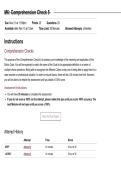
M6: Comprehension Check 5
Due Nov 21 at 11:59pm Points 35 Questions 29
Available after Nov 15 at 12am Time Limit 30 Minutes Allowed Attempts Unlimited
Instructions
Comprehension Checks
The purpose of the Comprehension Checks is to assess your knowledge of the meaning and application of the
Ethics Code. You will be expected to match the name of the Code to its appropriate definition in a series of
multiple choice questions. Being able to recognize the different Codes is step one in being able to apply them to a
case scenario or professional situation. In order to ensure fluency, there will be a 30 minute time limit. However,
you will be able to be retake the assessment until you obtain a 100% score.
Assessment Instructions
You will have 30 minutes to complete this assessment.
If you do not score a 100% on this attempt, please retake this quiz until you score 100% accuracy. The
next Module will not open until you score a 100%.
Take the Quiz Again
Attempt History
Attempt Time Score
KEPT Attempt 2 14 minutes 35 out of 35
LATEST Attempt 2 14 minutes 35 out of 35
, Attempt Time Score
Attempt 1 28 minutes 31.29 out of 35
Correct answers are hidden.
Score for this attempt: 35 out of 35
Submitted Nov 15 at 11:53pm
This attempt took 14 minutes.
Question 1 pts
For the following code, please select the accurate description:
Code 5.01: Protecting the Rights of Clients, Stakeholders, Supervisees, and Trainees
Standard compels behavior analysts to at least attempt to correct exaggerations or misstatements made
by others.
Standard allowing testimonials from former or current clients so long as their use is not designed to obtain
new clients.
Standard requiring that behavior analysts be knowledgeable about and comply with laws related to use of
intellectual property, including copyrighted and trademarked material.
,Standard which states that behavior analysts will not ask current clients for testimonials in order to obtain
new clients.
Standard which requires behavior analysts to include a specific disclaimer on websites and marketing
materials stating that any nonbehavioral service is not a behavioral service.
Standard that prohibits behaviors analysts from posting about clients or stakeholders to their personal
social media accounts; it also requires that if client information is to be used on company websites or
social media, informed consent must have been obtained along with a disclaimer indicating such. This
standard also requires efforts be made to reduce potential sharing or misuse of client information shared.
Standard that prohibits publicly sharing information about clients through digital content unless informed
consent has been obtained and confidentiality has been protected. Informed consent in this standard must
include information about the intended purpose and audience with whom the information will be shared,
as well as the risks and any benefits to the client or stakeholder.
Standard which requires that behavior analysts not to a) exaggerate the impact of their work or our
science, b) misrepresent their credential status, c) give advice in a public setting and d) give advice to
non-clients.
Standard stating that behavior analysts may seek to obtain new clients by using testimonials from former
clients, as long as they identify whether the testimonial was solicited or unsolicited.
, Standard which requires behavior analysts to protect their clients, supervisees, and/or trainees
confidential information, similar to that of attorney-client privilege or doctor-patient confidentiality.
Standard which compels behavior analysts to protect their clients’, stakeholders, supervisees, and/or
trainees’ privacy as required by law.
Question 2 pts
For the following code, please select the accurate description:
Code 5.02: Confidentiality in Public Statements
Standard requiring that behavior analysts be knowledgeable about and comply with laws related to use of
intellectual property, including copyrighted and trademarked material.
Standard compels behavior analysts to at least attempt to correct exaggerations or misstatements made
by others.
Due Nov 21 at 11:59pm Points 35 Questions 29
Available after Nov 15 at 12am Time Limit 30 Minutes Allowed Attempts Unlimited
Instructions
Comprehension Checks
The purpose of the Comprehension Checks is to assess your knowledge of the meaning and application of the
Ethics Code. You will be expected to match the name of the Code to its appropriate definition in a series of
multiple choice questions. Being able to recognize the different Codes is step one in being able to apply them to a
case scenario or professional situation. In order to ensure fluency, there will be a 30 minute time limit. However,
you will be able to be retake the assessment until you obtain a 100% score.
Assessment Instructions
You will have 30 minutes to complete this assessment.
If you do not score a 100% on this attempt, please retake this quiz until you score 100% accuracy. The
next Module will not open until you score a 100%.
Take the Quiz Again
Attempt History
Attempt Time Score
KEPT Attempt 2 14 minutes 35 out of 35
LATEST Attempt 2 14 minutes 35 out of 35
, Attempt Time Score
Attempt 1 28 minutes 31.29 out of 35
Correct answers are hidden.
Score for this attempt: 35 out of 35
Submitted Nov 15 at 11:53pm
This attempt took 14 minutes.
Question 1 pts
For the following code, please select the accurate description:
Code 5.01: Protecting the Rights of Clients, Stakeholders, Supervisees, and Trainees
Standard compels behavior analysts to at least attempt to correct exaggerations or misstatements made
by others.
Standard allowing testimonials from former or current clients so long as their use is not designed to obtain
new clients.
Standard requiring that behavior analysts be knowledgeable about and comply with laws related to use of
intellectual property, including copyrighted and trademarked material.
,Standard which states that behavior analysts will not ask current clients for testimonials in order to obtain
new clients.
Standard which requires behavior analysts to include a specific disclaimer on websites and marketing
materials stating that any nonbehavioral service is not a behavioral service.
Standard that prohibits behaviors analysts from posting about clients or stakeholders to their personal
social media accounts; it also requires that if client information is to be used on company websites or
social media, informed consent must have been obtained along with a disclaimer indicating such. This
standard also requires efforts be made to reduce potential sharing or misuse of client information shared.
Standard that prohibits publicly sharing information about clients through digital content unless informed
consent has been obtained and confidentiality has been protected. Informed consent in this standard must
include information about the intended purpose and audience with whom the information will be shared,
as well as the risks and any benefits to the client or stakeholder.
Standard which requires that behavior analysts not to a) exaggerate the impact of their work or our
science, b) misrepresent their credential status, c) give advice in a public setting and d) give advice to
non-clients.
Standard stating that behavior analysts may seek to obtain new clients by using testimonials from former
clients, as long as they identify whether the testimonial was solicited or unsolicited.
, Standard which requires behavior analysts to protect their clients, supervisees, and/or trainees
confidential information, similar to that of attorney-client privilege or doctor-patient confidentiality.
Standard which compels behavior analysts to protect their clients’, stakeholders, supervisees, and/or
trainees’ privacy as required by law.
Question 2 pts
For the following code, please select the accurate description:
Code 5.02: Confidentiality in Public Statements
Standard requiring that behavior analysts be knowledgeable about and comply with laws related to use of
intellectual property, including copyrighted and trademarked material.
Standard compels behavior analysts to at least attempt to correct exaggerations or misstatements made
by others.