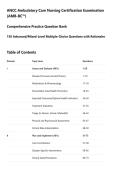
ANCC Ambulatory Care Nursing Certification Examination
(AMB-BC™)
Comprehensive Practice Question Bank
150 Advanced/Mixed-Level Multiple-Choice Questions with Rationales
Table of Contents
Domain Topic Area Questions
I Assess and Evaluate (40%) 1–50
Disease Processes (Acute/Chronic) 1–10
Medications & Pharmacology 11–18
Preventative Care/Health Promotion 19–25
Expected Outcomes/Optimal Health Indicators 26–30
Treatment Evaluation 31–35
Triage (In-Person, Virtual, Telehealth) 36–42
Physical and Psychosocial Assessment 43–47
Clinical Data Interpretation 48–50
II Plan and Implement (18%) 51–73
Care Coordination 51–58
Disease-Specific Interventions 59–65
Clinical Tasks/Procedures 66–73
,Domain Topic Area Questions
III Professional Role (22%) 74–101
Scope and Standards of Practice 74–80
Professional Development 81–85
Fiscal Health/Reimbursement 86–89
Patient/Family/Staff Advocacy 90–93
Leadership/Risk Management 94–97
Safety and Security 98–101
IV Education (19%) 102–125
Modes of Educational Delivery 102–107
Diverse Populations 108–113
Communication Barriers 114–118
Professional Communication 119–125
V Mixed/Integrated Scenarios 126–150
DOMAIN I: ASSESS AND EVALUATE (40%)
A. Disease Processes (Acute, Chronic)
• Question 1
A 58-year-old male with a history of type 2 diabetes mellitus and hypertension presents to the
ambulatory care clinic with complaints of progressive shortness of breath, orthopnea, and bilateral
lower extremity edema that has worsened over the past week. His morning blood glucose readings
have been consistently elevated despite adherence to his metformin and insulin regimen. Which
assessment finding is most concerning for the ambulatory care nurse to address immediately?
, A. Fasting blood glucose of 168 mg/dL
B. Weight gain of 4 pounds since last visit
C. Jugular venous distention observed during examination
D. Hemoglobin A1c of 8.2%
•• C. Jugular venous distention observed during examination
Rationale: Jugular venous distention (JVD) is a key clinical sign of right-sided heart failure and elevated
central venous pressure, indicating significant fluid overload and worsening cardiac function. In a
patient with diabetes and hypertension who presents with progressive shortness of breath and edema,
JVD suggests acute decompensated heart failure requiring immediate intervention. While elevated
blood glucose (168 mg/dL), weight gain (4 pounds), and elevated A1c (8.2%) are all concerning
findings that require management, JVD represents an acute, potentially life-threatening hemodynamic
change that must be addressed emergently. The ambulatory care nurse should prioritize this finding
and escalate care appropriately.
• Question 2
A 72-year-old female patient with a history of chronic obstructive pulmonary disease (COPD) presents
for a routine follow-up. She reports increased dyspnea on exertion, a productive cough with yellow
sputum, and fatigue over the past three days. Her oxygen saturation is 90% on room air, respiratory
rate is 24 breaths per minute, and she uses accessory muscles to breathe. Which action should the
ambulatory care nurse take first?
A. Administer prescribed albuterol nebulizer treatment
B. Obtain a sputum culture and sensitivity
C. Assess the patient's peak expiratory flow rate
D. Notify the provider immediately of acute exacerbation findings
•• D. Notify the provider immediately of acute exacerbation findings
Rationale: The patient is demonstrating signs of an acute COPD exacerbation, including increased
dyspnea, productive cough with changed sputum character, hypoxia (SpO2 90%), tachypnea, and
accessory muscle use. These findings indicate a clinical deterioration that requires immediate provider
notification and potential escalation of care. While administering albuterol, obtaining sputum culture,
and assessing peak flow are appropriate interventions, they should occur after or in conjunction with
notifying the provider of the acute change in status. The ambulatory care nurse must recognize that
this patient may require corticosteroids, antibiotics, or even hospitalization.
• Question 3
A 45-year-old patient with a new diagnosis of rheumatoid arthritis is being seen in the ambulatory
rheumatology clinic. The nurse is conducting an initial comprehensive assessment. Which finding is
most consistent with the pathophysiology of rheumatoid arthritis?
A. Asymmetric joint involvement primarily affecting the lumbar spine
B. Symmetric polyarthritis affecting small joints of the hands and feet
C. Morning stiffness lasting less than 15 minutes
, D. Elevated serum uric acid levels
•• B. Symmetric polyarthritis affecting small joints of the hands and feet
Rationale: Rheumatoid arthritis (RA) is a chronic systemic autoimmune disease characterized by
symmetric polyarthritis that typically affects the small joints of the hands, wrists, and feet. Morning
stiffness lasting more than 30–60 minutes is a hallmark feature. Asymmetric joint involvement is more
characteristic of osteoarthritis, and elevated uric acid is associated with gout. The ambulatory care
nurse's understanding of disease processes is essential for accurate assessment and patient education.
• Question 4
A 68-year-old male with heart failure with reduced ejection fraction (HFrEF) is seen in the ambulatory
cardiology clinic. He reports increasing fatigue, weight gain of 5 pounds over the past week, and ankle
swelling. His medications include lisinopril, carvedilol, and furosemide. Which laboratory value should
the ambulatory care nurse prioritize for review?
A. Serum potassium
B. Serum creatinine
C. B-type natriuretic peptide (BNP)
D. Complete blood count
•• C. B-type natriuretic peptide (BNP)
Rationale: BNP is a neurohormone secreted by the cardiac ventricles in response to increased wall
tension and volume overload. In a patient with worsening heart failure symptoms (fatigue, weight gain,
edema), BNP levels provide objective evidence of heart failure exacerbation and guide management
decisions. While potassium and creatinine are important to monitor (especially with diuretic and ACE
inhibitor therapy), BNP is the most specific indicator of the patient's current heart failure status and
helps differentiate cardiac from non-cardiac causes of dyspnea and edema.
• Question 5
A 55-year-old female with a history of asthma presents to the ambulatory care clinic with complaints
of chest tightness, wheezing, and cough that have been worsening over the past two weeks. She
reports using her albuterol inhaler 3–4 times daily. Which assessment finding indicates poor asthma
control and the need for treatment optimization?
A. Peak expiratory flow rate of 85% of personal best
B. Use of rescue inhaler more than twice per week
C. Nighttime awakenings due to asthma symptoms once per month
D. Forced expiratory volume in 1 second (FEV1) of 80% predicted
•• B. Use of rescue inhaler more than twice per week
Rationale: According to asthma management guidelines, the use of short-acting beta-agonists (rescue
inhalers) more than twice per week indicates poor asthma control. Other indicators of poor control
include nighttime awakenings more than twice per month, peak flow or FEV1 less than 80% of
(AMB-BC™)
Comprehensive Practice Question Bank
150 Advanced/Mixed-Level Multiple-Choice Questions with Rationales
Table of Contents
Domain Topic Area Questions
I Assess and Evaluate (40%) 1–50
Disease Processes (Acute/Chronic) 1–10
Medications & Pharmacology 11–18
Preventative Care/Health Promotion 19–25
Expected Outcomes/Optimal Health Indicators 26–30
Treatment Evaluation 31–35
Triage (In-Person, Virtual, Telehealth) 36–42
Physical and Psychosocial Assessment 43–47
Clinical Data Interpretation 48–50
II Plan and Implement (18%) 51–73
Care Coordination 51–58
Disease-Specific Interventions 59–65
Clinical Tasks/Procedures 66–73
,Domain Topic Area Questions
III Professional Role (22%) 74–101
Scope and Standards of Practice 74–80
Professional Development 81–85
Fiscal Health/Reimbursement 86–89
Patient/Family/Staff Advocacy 90–93
Leadership/Risk Management 94–97
Safety and Security 98–101
IV Education (19%) 102–125
Modes of Educational Delivery 102–107
Diverse Populations 108–113
Communication Barriers 114–118
Professional Communication 119–125
V Mixed/Integrated Scenarios 126–150
DOMAIN I: ASSESS AND EVALUATE (40%)
A. Disease Processes (Acute, Chronic)
• Question 1
A 58-year-old male with a history of type 2 diabetes mellitus and hypertension presents to the
ambulatory care clinic with complaints of progressive shortness of breath, orthopnea, and bilateral
lower extremity edema that has worsened over the past week. His morning blood glucose readings
have been consistently elevated despite adherence to his metformin and insulin regimen. Which
assessment finding is most concerning for the ambulatory care nurse to address immediately?
, A. Fasting blood glucose of 168 mg/dL
B. Weight gain of 4 pounds since last visit
C. Jugular venous distention observed during examination
D. Hemoglobin A1c of 8.2%
•• C. Jugular venous distention observed during examination
Rationale: Jugular venous distention (JVD) is a key clinical sign of right-sided heart failure and elevated
central venous pressure, indicating significant fluid overload and worsening cardiac function. In a
patient with diabetes and hypertension who presents with progressive shortness of breath and edema,
JVD suggests acute decompensated heart failure requiring immediate intervention. While elevated
blood glucose (168 mg/dL), weight gain (4 pounds), and elevated A1c (8.2%) are all concerning
findings that require management, JVD represents an acute, potentially life-threatening hemodynamic
change that must be addressed emergently. The ambulatory care nurse should prioritize this finding
and escalate care appropriately.
• Question 2
A 72-year-old female patient with a history of chronic obstructive pulmonary disease (COPD) presents
for a routine follow-up. She reports increased dyspnea on exertion, a productive cough with yellow
sputum, and fatigue over the past three days. Her oxygen saturation is 90% on room air, respiratory
rate is 24 breaths per minute, and she uses accessory muscles to breathe. Which action should the
ambulatory care nurse take first?
A. Administer prescribed albuterol nebulizer treatment
B. Obtain a sputum culture and sensitivity
C. Assess the patient's peak expiratory flow rate
D. Notify the provider immediately of acute exacerbation findings
•• D. Notify the provider immediately of acute exacerbation findings
Rationale: The patient is demonstrating signs of an acute COPD exacerbation, including increased
dyspnea, productive cough with changed sputum character, hypoxia (SpO2 90%), tachypnea, and
accessory muscle use. These findings indicate a clinical deterioration that requires immediate provider
notification and potential escalation of care. While administering albuterol, obtaining sputum culture,
and assessing peak flow are appropriate interventions, they should occur after or in conjunction with
notifying the provider of the acute change in status. The ambulatory care nurse must recognize that
this patient may require corticosteroids, antibiotics, or even hospitalization.
• Question 3
A 45-year-old patient with a new diagnosis of rheumatoid arthritis is being seen in the ambulatory
rheumatology clinic. The nurse is conducting an initial comprehensive assessment. Which finding is
most consistent with the pathophysiology of rheumatoid arthritis?
A. Asymmetric joint involvement primarily affecting the lumbar spine
B. Symmetric polyarthritis affecting small joints of the hands and feet
C. Morning stiffness lasting less than 15 minutes
, D. Elevated serum uric acid levels
•• B. Symmetric polyarthritis affecting small joints of the hands and feet
Rationale: Rheumatoid arthritis (RA) is a chronic systemic autoimmune disease characterized by
symmetric polyarthritis that typically affects the small joints of the hands, wrists, and feet. Morning
stiffness lasting more than 30–60 minutes is a hallmark feature. Asymmetric joint involvement is more
characteristic of osteoarthritis, and elevated uric acid is associated with gout. The ambulatory care
nurse's understanding of disease processes is essential for accurate assessment and patient education.
• Question 4
A 68-year-old male with heart failure with reduced ejection fraction (HFrEF) is seen in the ambulatory
cardiology clinic. He reports increasing fatigue, weight gain of 5 pounds over the past week, and ankle
swelling. His medications include lisinopril, carvedilol, and furosemide. Which laboratory value should
the ambulatory care nurse prioritize for review?
A. Serum potassium
B. Serum creatinine
C. B-type natriuretic peptide (BNP)
D. Complete blood count
•• C. B-type natriuretic peptide (BNP)
Rationale: BNP is a neurohormone secreted by the cardiac ventricles in response to increased wall
tension and volume overload. In a patient with worsening heart failure symptoms (fatigue, weight gain,
edema), BNP levels provide objective evidence of heart failure exacerbation and guide management
decisions. While potassium and creatinine are important to monitor (especially with diuretic and ACE
inhibitor therapy), BNP is the most specific indicator of the patient's current heart failure status and
helps differentiate cardiac from non-cardiac causes of dyspnea and edema.
• Question 5
A 55-year-old female with a history of asthma presents to the ambulatory care clinic with complaints
of chest tightness, wheezing, and cough that have been worsening over the past two weeks. She
reports using her albuterol inhaler 3–4 times daily. Which assessment finding indicates poor asthma
control and the need for treatment optimization?
A. Peak expiratory flow rate of 85% of personal best
B. Use of rescue inhaler more than twice per week
C. Nighttime awakenings due to asthma symptoms once per month
D. Forced expiratory volume in 1 second (FEV1) of 80% predicted
•• B. Use of rescue inhaler more than twice per week
Rationale: According to asthma management guidelines, the use of short-acting beta-agonists (rescue
inhalers) more than twice per week indicates poor asthma control. Other indicators of poor control
include nighttime awakenings more than twice per month, peak flow or FEV1 less than 80% of