
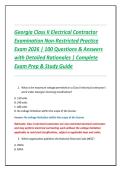
Georgia Class II Electrical Contractor
Examination Non-Restricted Practice
Exam 2026 | 100 Questions & Answers
with Detailed Rationales | Complete
Exam Prep & Study Guide
1. What is the maximum voltage permitted on a Class II electrical contractor's
work under Georgia's licensing classification?
A. 120 volts
B. 240 volts
C. 480 volts
D. No voltage limitation within the scope of the license
Answer: No voltage limitation within the scope of the license
Rationale: Class II electrical contractors are non-restricted electrical contractors
and may perform electrical contracting work without the voltage limitation
applicable to restricted classifications, subject to applicable laws and codes.
2. Which organization publishes the National Electrical Code (NEC)?
A. OSHA
B. NFPA
,C. ICC
D. ANSI
Answer: NFPA
Rationale: The National Fire Protection Association (NFPA) publishes NFPA 70,
the National Electrical Code.
3. What is the primary purpose of the NEC?
A. To establish electrical utility rates
B. To provide minimum safety requirements for electrical installations
C. To establish contractor profit margins
D. To regulate electrical apprenticeships
Answer: To provide minimum safety requirements for electrical installations
Rationale: The NEC establishes requirements intended to safeguard people and
property from hazards arising from electrical installations.
4. What is the unit used to measure electrical current?
A. Volt
B. Ohm
C. Ampere
D. Watt
Answer: Ampere
Rationale: An ampere, or amp, is the unit used to measure electric current.
5. What is the unit of electrical resistance?
A. Volt
B. Ohm
C. Watt
D. Ampere
Answer: Ohm
,Rationale: Resistance to electrical current is measured in ohms (Ω).
6. What formula represents Ohm's Law?
A. P = VI
B. V = IR
C. P = I²R
D. E = mc²
Answer: V = IR
Rationale: Ohm's Law states that voltage equals current multiplied by
resistance.
7. A 120-volt circuit supplies 10 amperes. What is its approximate power?
A. 12 watts
B. 120 watts
C. 1,200 watts
D. 12,000 watts
Answer: 1,200 watts
Rationale: Power is calculated as P = V × I, so 120 × 10 = 1,200 watts.
8. What is the primary function of a circuit breaker?
A. Increase voltage
B. Limit normal voltage
C. Interrupt current during an overcurrent condition
D. Improve power factor
Answer: Interrupt current during an overcurrent condition
Rationale: Circuit breakers open a circuit when current exceeds the device's
permitted rating or when another qualifying fault condition occurs.
9. What is the purpose of a grounding electrode system?
, A. To increase circuit voltage
B. To connect the electrical system to earth
C. To replace overcurrent protection
D. To eliminate all electrical resistance
Answer: To connect the electrical system to earth
Rationale: Grounding electrode systems connect the electrical system to earth
and help stabilize voltage to ground and provide a path for certain fault and
transient conditions.
10.What is the primary purpose of equipment grounding conductors?
A. Carry normal load current
B. Provide a low-impedance fault-current path
C. Increase circuit voltage
D. Reduce conductor size
Answer: Provide a low-impedance fault-current path
Rationale: Equipment grounding conductors provide a path for fault current so
that overcurrent protective devices can operate promptly.
11.Which conductor normally carries current back to the source in a grounded
single-phase circuit?
A. Equipment grounding conductor
B. Grounding electrode conductor
C. Neutral conductor
D. Bonding jumper
Answer: Neutral conductor
Rationale: The grounded conductor, commonly called the neutral, normally
carries return current in a single-phase line-to-neutral circuit.
12.What is the purpose of bonding?


