

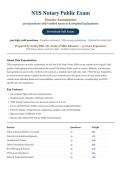
NYS Notary Public Exam
Practice Examination
300 Questions with Verified Answers & Detailed Explanations
Download Full Exam
300 high-yield questions · Complete rationales · Why wrong explanations · Updated for 2026/2027
Prepared by NotaryPRO, JD, Notary Public Educator – 15 Years Experience
NYS Notary Exam: 100% Pass Rate | Verified: 2026/2027 Academic Year
About This Examination
This comprehensive practice examination for the New York State Notary Public exam contains 300 original, high-
quality, challenging questions that mirror the actual NYS Notary Public exam in content, difficulty, and structure.
Each question is paired with a verified correct answer, a detailed expert rationale, and a "Why Wrong" breakdown
for every incorrect option. Updated for the 2026/2027 academic year, this guide covers all core notary public
content areas including duties and responsibilities, notarial acts, official documents, recordkeeping, and NYS-
specific laws and regulations.
Key Features
300 original, high-yield exam-style questions
Detailed expert rationales with legal references
"Why Wrong" sections for every incorrect option (A, B, C, D)
Covers all NYS Notary Public content areas with accurate weight distribution
Tests knowledge, comprehension, application, analysis, and critical thinking
Balanced range of difficulty levels
Based on the official NYS Notary Public exam blueprint
Section Questions Weight
Duties & Responsibilities of a Notary 45 15%
Notarial Acts & Acknowledgments 50 17%
Jurisdiction & Powers 35 12%
Official Documents & Records 45 15%
Recordkeeping & Journal 35 12%
NYS Laws & Regulations 45 15%
Ethics & Professional Conduct 45 14%
, Duties & Responsibilities (51 questions)
1. A notary public is asked to notarize a document for a signer who is not present. The
signer's spouse brings the document and asks the notary to "just put the seal on it." What is
the notary's correct response?
A. Refuse to notarize because the signer must appear personally
B. Notarize the document because the spouse has power of attorney
C. Notarize the document if the spouse can identify the signer
D. Notarize the document and note that the signer was not present
✓ Correct answer: A. Refuse to notarize because the signer must appear personally
Rationale: Under NYS law, a notary public must require the personal appearance of the signer before
performing a notarial act. The signer must personally appear and acknowledge the signature or
swear/affirm to the contents. The spouse cannot substitute for the signer. This is a fundamental duty
to prevent fraud and protect the integrity of notarial acts.
Why the others are wrong:
B: A power of attorney does not allow the spouse to appear in place of the signer for a notarial act.
C: Even with proper identification of the signer, the signer must be physically present.
D: Notarizing and noting the signer was not present would be a violation of NYS notary law.
Reference: NYS Department of State Notary Public License Law · NYS Executive Law Article 6 · NYS Notary Public Handbook.
2. A notary public is asked to perform a notarization for a close family member. What is the
notary's best course of action?
A. Refuse to notarize because of conflict of interest
B. Proceed with the notarization if proper procedures are followed
C. Ask another notary to perform the notarization
D. Proceed only if the family member is not a beneficiary
✓ Correct answer: B. Proceed with the notarization if proper procedures are followed
Rationale: NYS law does not prohibit notarizing for family members, provided there is no financial or
beneficial interest in the transaction. The notary must still follow all proper procedures and maintain
impartiality. The key is to ensure the notary has no direct financial interest in the document being
notarized. Notarizing for a family member is permissible if the notary remains neutral.
Why the others are wrong:
A: There is no automatic prohibition on notarizing for family members.
C: Asking another notary is not required if there is no conflict of interest.
D: The notary can proceed even if the family member is a beneficiary, as long as the notary has no direct financial
interest.
Reference: NYS Department of State Notary Public License Law · NYS Executive Law Article 6 · NYS Notary Public Handbook.
,3. A notary public witnesses a document signing where the signer appears confused and does
not seem to understand the document. What is the notary's obligation?
A. Refuse to notarize if the signer lacks capacity
B. Notarize the document if the signer has identification
C. Notarize the document and note the signer's confusion
D. Ask the signer to read the document aloud before signing
✓ Correct answer: A. Refuse to notarize if the signer lacks capacity
Rationale: A notary public has a duty to ensure the signer has the capacity to understand the document
being signed. If the signer appears confused or lacks capacity, the notary should refuse to notarize.
This protects the signer and upholds the integrity of the notarial act. The notary is not required to ask
the signer to read the document aloud, but must ensure understanding.
Why the others are wrong:
B: Identification alone does not ensure the signer has capacity to understand.
C: Notarizing despite confusion would be a breach of duty.
D: Asking the signer to read the document aloud is not sufficient to ensure capacity.
Reference: NYS Department of State Notary Public License Law · NYS Executive Law Article 6 · NYS Notary Public Handbook.
4. Which of the following is a notary public NOT authorized to do?
A. Administer oaths and affirmations
B. Take acknowledgments
C. Issue subpoenas
D. Witness signatures
✓ Correct answer: C. Issue subpoenas
Rationale: A notary public is not authorized to issue subpoenas. This is a function of a court clerk,
attorney, or other authorized official. Notaries are authorized to administer oaths and affirmations,
take acknowledgments, and witness signatures. These are the core functions of a notary public in NYS.
Why the others are wrong:
A: Administering oaths and affirmations is a core notary function.
B: Taking acknowledgments is a core notary function.
D: Witnessing signatures is a core notary function.
Reference: NYS Department of State Notary Public License Law · NYS Executive Law Article 6 · NYS Notary Public Handbook.
5. A notary public is asked to notarize a document that is written in a foreign language. What
should the notary do?
A. Refuse to notarize if the notary cannot read the document
B. Notarize the document as long as the signer understands it
C. Notarize the document if an interpreter is present
D. Refuse to notarize unless the document is translated
✓ Correct answer: B. Notarize the document as long as the signer understands it
Rationale: A notary may notarize a document in a foreign language as long as the signer appears
personally and understands the document. The notary does not need to understand the language of
the document; the notary is certifying the signer's acknowledgment or oath, not the content. However,
the notary should ensure the signer understands what they are signing.
Why the others are wrong:
A: The notary does not need to read or understand the document language.
C: An interpreter is not required but may be used if needed for understanding.
D: The document does not need to be translated for the notary to perform the notarial act.
Reference: NYS Department of State Notary Public License Law · NYS Executive Law Article 6 · NYS Notary Public Handbook.
, 6. A notary public is asked to perform a notarization for a person who is physically unable to
sign their name. What should the notary do?
A. Allow the signer to make a mark (e.g., "X") with two witnesses
B. Refuse to notarize because the signer cannot sign
C. Have the signer's spouse sign on their behalf
D. Notarize the document if the signer can acknowledge their signature
✓ Correct answer: A. Allow the signer to make a mark (e.g., "X") with two witnesses
Rationale: NYS law allows a signer who is unable to sign to make a mark (such as an "X") in the
presence of two witnesses who also sign. The notary must still verify the signer's identity and ensure
the signer understands the document. The witnesses must also be identified by the notary. This
ensures the signer's intent is documented while accommodating physical limitations.
Why the others are wrong:
B: The notary should accommodate a signer with physical limitations.
C: The spouse cannot sign on behalf of the signer unless authorized by power of attorney.
D: The signer must execute the document, either by signature or mark.
Reference: NYS Department of State Notary Public License Law · NYS Executive Law Article 6 · NYS Notary Public Handbook.
7. What is the maximum fee a notary public in NYS may charge for administering an oath?
A. $2.00 per oath
B. $5.00 per oath
C. $10.00 per oath
D. $15.00 per oath
✓ Correct answer: A. $2.00 per oath
Rationale: Under NYS law, the maximum fee a notary public may charge for administering an oath or
affirmation is $2.00 per person. This is set by statute and applies to all notaries in the state. The fee for
taking an acknowledgment is also $2.00. These fees are maximums; a notary may charge less, but
cannot exceed these amounts. Any additional travel or service fees must be agreed upon in advance
and are separate.
Why the others are wrong:
B: $5.00 is the maximum for depositions, not oaths.
C: $10.00 exceeds the statutory maximum for oaths.
D: $15.00 exceeds the statutory maximum.
Reference: NYS Department of State Notary Public License Law · NYS Executive Law Article 6 · NYS Notary Public Handbook.
Practice Examination
300 Questions with Verified Answers & Detailed Explanations
Download Full Exam
300 high-yield questions · Complete rationales · Why wrong explanations · Updated for 2026/2027
Prepared by NotaryPRO, JD, Notary Public Educator – 15 Years Experience
NYS Notary Exam: 100% Pass Rate | Verified: 2026/2027 Academic Year
About This Examination
This comprehensive practice examination for the New York State Notary Public exam contains 300 original, high-
quality, challenging questions that mirror the actual NYS Notary Public exam in content, difficulty, and structure.
Each question is paired with a verified correct answer, a detailed expert rationale, and a "Why Wrong" breakdown
for every incorrect option. Updated for the 2026/2027 academic year, this guide covers all core notary public
content areas including duties and responsibilities, notarial acts, official documents, recordkeeping, and NYS-
specific laws and regulations.
Key Features
300 original, high-yield exam-style questions
Detailed expert rationales with legal references
"Why Wrong" sections for every incorrect option (A, B, C, D)
Covers all NYS Notary Public content areas with accurate weight distribution
Tests knowledge, comprehension, application, analysis, and critical thinking
Balanced range of difficulty levels
Based on the official NYS Notary Public exam blueprint
Section Questions Weight
Duties & Responsibilities of a Notary 45 15%
Notarial Acts & Acknowledgments 50 17%
Jurisdiction & Powers 35 12%
Official Documents & Records 45 15%
Recordkeeping & Journal 35 12%
NYS Laws & Regulations 45 15%
Ethics & Professional Conduct 45 14%
, Duties & Responsibilities (51 questions)
1. A notary public is asked to notarize a document for a signer who is not present. The
signer's spouse brings the document and asks the notary to "just put the seal on it." What is
the notary's correct response?
A. Refuse to notarize because the signer must appear personally
B. Notarize the document because the spouse has power of attorney
C. Notarize the document if the spouse can identify the signer
D. Notarize the document and note that the signer was not present
✓ Correct answer: A. Refuse to notarize because the signer must appear personally
Rationale: Under NYS law, a notary public must require the personal appearance of the signer before
performing a notarial act. The signer must personally appear and acknowledge the signature or
swear/affirm to the contents. The spouse cannot substitute for the signer. This is a fundamental duty
to prevent fraud and protect the integrity of notarial acts.
Why the others are wrong:
B: A power of attorney does not allow the spouse to appear in place of the signer for a notarial act.
C: Even with proper identification of the signer, the signer must be physically present.
D: Notarizing and noting the signer was not present would be a violation of NYS notary law.
Reference: NYS Department of State Notary Public License Law · NYS Executive Law Article 6 · NYS Notary Public Handbook.
2. A notary public is asked to perform a notarization for a close family member. What is the
notary's best course of action?
A. Refuse to notarize because of conflict of interest
B. Proceed with the notarization if proper procedures are followed
C. Ask another notary to perform the notarization
D. Proceed only if the family member is not a beneficiary
✓ Correct answer: B. Proceed with the notarization if proper procedures are followed
Rationale: NYS law does not prohibit notarizing for family members, provided there is no financial or
beneficial interest in the transaction. The notary must still follow all proper procedures and maintain
impartiality. The key is to ensure the notary has no direct financial interest in the document being
notarized. Notarizing for a family member is permissible if the notary remains neutral.
Why the others are wrong:
A: There is no automatic prohibition on notarizing for family members.
C: Asking another notary is not required if there is no conflict of interest.
D: The notary can proceed even if the family member is a beneficiary, as long as the notary has no direct financial
interest.
Reference: NYS Department of State Notary Public License Law · NYS Executive Law Article 6 · NYS Notary Public Handbook.
,3. A notary public witnesses a document signing where the signer appears confused and does
not seem to understand the document. What is the notary's obligation?
A. Refuse to notarize if the signer lacks capacity
B. Notarize the document if the signer has identification
C. Notarize the document and note the signer's confusion
D. Ask the signer to read the document aloud before signing
✓ Correct answer: A. Refuse to notarize if the signer lacks capacity
Rationale: A notary public has a duty to ensure the signer has the capacity to understand the document
being signed. If the signer appears confused or lacks capacity, the notary should refuse to notarize.
This protects the signer and upholds the integrity of the notarial act. The notary is not required to ask
the signer to read the document aloud, but must ensure understanding.
Why the others are wrong:
B: Identification alone does not ensure the signer has capacity to understand.
C: Notarizing despite confusion would be a breach of duty.
D: Asking the signer to read the document aloud is not sufficient to ensure capacity.
Reference: NYS Department of State Notary Public License Law · NYS Executive Law Article 6 · NYS Notary Public Handbook.
4. Which of the following is a notary public NOT authorized to do?
A. Administer oaths and affirmations
B. Take acknowledgments
C. Issue subpoenas
D. Witness signatures
✓ Correct answer: C. Issue subpoenas
Rationale: A notary public is not authorized to issue subpoenas. This is a function of a court clerk,
attorney, or other authorized official. Notaries are authorized to administer oaths and affirmations,
take acknowledgments, and witness signatures. These are the core functions of a notary public in NYS.
Why the others are wrong:
A: Administering oaths and affirmations is a core notary function.
B: Taking acknowledgments is a core notary function.
D: Witnessing signatures is a core notary function.
Reference: NYS Department of State Notary Public License Law · NYS Executive Law Article 6 · NYS Notary Public Handbook.
5. A notary public is asked to notarize a document that is written in a foreign language. What
should the notary do?
A. Refuse to notarize if the notary cannot read the document
B. Notarize the document as long as the signer understands it
C. Notarize the document if an interpreter is present
D. Refuse to notarize unless the document is translated
✓ Correct answer: B. Notarize the document as long as the signer understands it
Rationale: A notary may notarize a document in a foreign language as long as the signer appears
personally and understands the document. The notary does not need to understand the language of
the document; the notary is certifying the signer's acknowledgment or oath, not the content. However,
the notary should ensure the signer understands what they are signing.
Why the others are wrong:
A: The notary does not need to read or understand the document language.
C: An interpreter is not required but may be used if needed for understanding.
D: The document does not need to be translated for the notary to perform the notarial act.
Reference: NYS Department of State Notary Public License Law · NYS Executive Law Article 6 · NYS Notary Public Handbook.
, 6. A notary public is asked to perform a notarization for a person who is physically unable to
sign their name. What should the notary do?
A. Allow the signer to make a mark (e.g., "X") with two witnesses
B. Refuse to notarize because the signer cannot sign
C. Have the signer's spouse sign on their behalf
D. Notarize the document if the signer can acknowledge their signature
✓ Correct answer: A. Allow the signer to make a mark (e.g., "X") with two witnesses
Rationale: NYS law allows a signer who is unable to sign to make a mark (such as an "X") in the
presence of two witnesses who also sign. The notary must still verify the signer's identity and ensure
the signer understands the document. The witnesses must also be identified by the notary. This
ensures the signer's intent is documented while accommodating physical limitations.
Why the others are wrong:
B: The notary should accommodate a signer with physical limitations.
C: The spouse cannot sign on behalf of the signer unless authorized by power of attorney.
D: The signer must execute the document, either by signature or mark.
Reference: NYS Department of State Notary Public License Law · NYS Executive Law Article 6 · NYS Notary Public Handbook.
7. What is the maximum fee a notary public in NYS may charge for administering an oath?
A. $2.00 per oath
B. $5.00 per oath
C. $10.00 per oath
D. $15.00 per oath
✓ Correct answer: A. $2.00 per oath
Rationale: Under NYS law, the maximum fee a notary public may charge for administering an oath or
affirmation is $2.00 per person. This is set by statute and applies to all notaries in the state. The fee for
taking an acknowledgment is also $2.00. These fees are maximums; a notary may charge less, but
cannot exceed these amounts. Any additional travel or service fees must be agreed upon in advance
and are separate.
Why the others are wrong:
B: $5.00 is the maximum for depositions, not oaths.
C: $10.00 exceeds the statutory maximum for oaths.
D: $15.00 exceeds the statutory maximum.
Reference: NYS Department of State Notary Public License Law · NYS Executive Law Article 6 · NYS Notary Public Handbook.


