

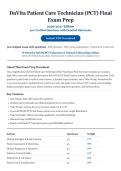
DaVita Patient Care Technician (PCT) Final
Exam Prep
2026/2027 Edition
300 Verified Questions with Detailed Rationales
Instant PDF Download
300 original exam-style questions · Full rationales · Why wrong explanations · Updated for 2026/2027
Written by DaVita PCT Educators & Dialysis Clinical Specialists
DaVita PCT Final Exam: High-Yield Content | Verified: 2026/2027 Academic Year
About This Exam Prep Document
This comprehensive DaVita Patient Care Technician (PCT) Final Exam Prep Document contains 300 original,
high-yield, exam-style questions that mirror the DaVita PCT Final Exam in content, difficulty, and structure. Each
question is paired with a verified correct answer, a detailed expert rationale, and a "Why Wrong" breakdown for
every incorrect option. Updated for the 2026/2027 cycle, this guide covers all core PCT content areas including
dialysis principles, patient care, safety, infection control, equipment operation, and DaVita policies.
Key Features
300 original, high-yield exam-style questions
Detailed expert rationales and clinical implications for each question
"Why Wrong" sections for every incorrect option (A, B, C, D)
Covers all DaVita PCT Final Exam content areas with accurate weight distribution
Tests knowledge, clinical reasoning, application, and critical thinking
Balanced range of difficulty levels
Based on DaVita PCT Training Program and CMS ESRD guidelines
Section Questions Weight
Dialysis Principles & Renal Anatomy 50 17%
Patient Assessment & Monitoring 55 18%
Dialysis Equipment & Operation 50 17%
Infection Control & Safety 50 17%
Medications & Lab Values 45 15%
Patient Care & Complications 50 16%
,Dialysis Principles & Renal Anatomy (55 questions)
1. The primary function of the dialysis machine during hemodialysis is to:
A. Remove waste products and excess fluid from the blood
B. Add medications to the blood
C. Filter the blood through a semipermeable membrane
D. Monitor blood pressure and heart rate
✓ Correct answer: A. Remove waste products and excess fluid from the blood
Rationale: The primary function of the dialysis machine is to remove waste products (urea,
creatinine) and excess fluid from the blood. This is achieved through diffusion and ultrafiltration. The
machine pumps blood through the dialyzer and returns it to the patient.
Why the others are wrong:
B: Medications are not typically added by the dialysis machine; they are administered separately.
C: Filtration is one mechanism but the overall function is waste and fluid removal.
D: Monitoring is a secondary function; the primary is dialysis treatment.
Reference: DaVita PCT Training Manual · CMS ESRD Conditions for Coverage · KDOQI Guidelines · OSHA.
2. The normal glomerular filtration rate (GFR) in a healthy adult is approximately:
A. 120 mL/min/1.73 m²
B. 60 mL/min/1.73 m²
C. 90 mL/min/1.73 m²
D. 30 mL/min/1.73 m²
✓ Correct answer: A. 120 mL/min/1.73 m²
Rationale: A normal GFR is approximately 120 mL/min/1.73 m². When GFR falls below 15
mL/min/1.73 m², the patient requires dialysis. Understanding normal GFR values is essential for
assessing renal function and determining when dialysis is needed.
Why the others are wrong:
B: 60 mL/min indicates moderate kidney disease, not normal.
C: 90 mL/min is below normal and indicates mild kidney disease.
D: 30 mL/min indicates severe kidney disease requiring treatment.
Reference: DaVita PCT Training Manual · CMS ESRD Conditions for Coverage · KDOQI Guidelines · OSHA.
,3. What is the primary electrolyte imbalance that can occur in a hemodialysis patient and
requires careful monitoring?
A. Hyperkalemia (elevated potassium)
B. Hyponatremia (low sodium)
C. Hypercalcemia (elevated calcium)
D. Hypomagnesemia (low magnesium)
✓ Correct answer: A. Hyperkalemia (elevated potassium)
Rationale: Hyperkalemia is the most serious electrolyte imbalance in dialysis patients, as it can lead
to life-threatening cardiac arrhythmias. Dialysis patients are at risk due to decreased renal excretion of
potassium. Monitoring potassium levels is a critical aspect of dialysis care.
Why the others are wrong:
B: Hyponatremia can occur but is less common and less immediately life-threatening.
C: Hypercalcemia is less common in dialysis patients; hypocalcemia is more common.
D: Hypomagnesemia can occur but is not the primary electrolyte concern.
Reference: DaVita PCT Training Manual · CMS ESRD Conditions for Coverage · KDOQI Guidelines · OSHA.
4. The dialysate solution in hemodialysis is designed to:
A. Balance electrolytes and remove waste products from the blood
B. Add nutrients to the blood
C. Maintain body temperature during dialysis
D. Prevent blood clotting in the machine
✓ Correct answer: A. Balance electrolytes and remove waste products from the blood
Rationale: Dialysate is a solution that contains electrolytes at concentrations similar to normal
blood. During dialysis, waste products diffuse from the blood into the dialysate, and electrolytes are
balanced. This is the mechanism for both waste removal and electrolyte correction.
Why the others are wrong:
B: Nutrients are not added to the blood via dialysate.
C: Temperature is controlled by the machine, not the dialysate itself.
D: Anticoagulants are used to prevent clotting; dialysate does not prevent clotting.
Reference: DaVita PCT Training Manual · CMS ESRD Conditions for Coverage · KDOQI Guidelines · OSHA.
, 5. Which of the following is the most common cause of end-stage renal disease (ESRD) in
the United States?
A. Diabetes mellitus
B. Hypertension
C. Glomerulonephritis
D. Polycystic kidney disease
✓ Correct answer: A. Diabetes mellitus
Rationale: Diabetes mellitus is the leading cause of ESRD in the United States, accounting for
approximately 40-45% of cases. Hypertension is the second leading cause. Understanding the causes
of ESRD helps PCTs understand the patient population and their specific needs.
Why the others are wrong:
B: Hypertension is the second leading cause, not the most common.
C: Glomerulonephritis is a cause but less common than diabetes.
D: Polycystic kidney disease is a genetic cause and less common.
Reference: DaVita PCT Training Manual · CMS ESRD Conditions for Coverage · KDOQI Guidelines · OSHA.
6. The term "ultrafiltration" in hemodialysis refers to:
A. The removal of excess fluid from the blood through pressure gradient across the membrane
B. The removal of waste products through diffusion
C. The addition of electrolytes to the blood
D. The warming of blood before returning to the patient
✓ Correct answer: A. The removal of excess fluid from the blood through pressure gradient
across the membrane
Rationale: Ultrafiltration is the process of removing excess fluid from the blood during dialysis. This
is achieved through a pressure gradient across the semipermeable membrane, pulling fluid from the
blood into the dialysate. This is a key component of achieving the patient's target weight.
Why the others are wrong:
B: Diffusion is the mechanism for waste removal, not ultrafiltration.
C: Electrolyte addition is part of dialysate function, not ultrafiltration.
D: Warming is a function of the dialysis machine, not ultrafiltration.
Reference: DaVita PCT Training Manual · CMS ESRD Conditions for Coverage · KDOQI Guidelines · OSHA.
Exam Prep
2026/2027 Edition
300 Verified Questions with Detailed Rationales
Instant PDF Download
300 original exam-style questions · Full rationales · Why wrong explanations · Updated for 2026/2027
Written by DaVita PCT Educators & Dialysis Clinical Specialists
DaVita PCT Final Exam: High-Yield Content | Verified: 2026/2027 Academic Year
About This Exam Prep Document
This comprehensive DaVita Patient Care Technician (PCT) Final Exam Prep Document contains 300 original,
high-yield, exam-style questions that mirror the DaVita PCT Final Exam in content, difficulty, and structure. Each
question is paired with a verified correct answer, a detailed expert rationale, and a "Why Wrong" breakdown for
every incorrect option. Updated for the 2026/2027 cycle, this guide covers all core PCT content areas including
dialysis principles, patient care, safety, infection control, equipment operation, and DaVita policies.
Key Features
300 original, high-yield exam-style questions
Detailed expert rationales and clinical implications for each question
"Why Wrong" sections for every incorrect option (A, B, C, D)
Covers all DaVita PCT Final Exam content areas with accurate weight distribution
Tests knowledge, clinical reasoning, application, and critical thinking
Balanced range of difficulty levels
Based on DaVita PCT Training Program and CMS ESRD guidelines
Section Questions Weight
Dialysis Principles & Renal Anatomy 50 17%
Patient Assessment & Monitoring 55 18%
Dialysis Equipment & Operation 50 17%
Infection Control & Safety 50 17%
Medications & Lab Values 45 15%
Patient Care & Complications 50 16%
,Dialysis Principles & Renal Anatomy (55 questions)
1. The primary function of the dialysis machine during hemodialysis is to:
A. Remove waste products and excess fluid from the blood
B. Add medications to the blood
C. Filter the blood through a semipermeable membrane
D. Monitor blood pressure and heart rate
✓ Correct answer: A. Remove waste products and excess fluid from the blood
Rationale: The primary function of the dialysis machine is to remove waste products (urea,
creatinine) and excess fluid from the blood. This is achieved through diffusion and ultrafiltration. The
machine pumps blood through the dialyzer and returns it to the patient.
Why the others are wrong:
B: Medications are not typically added by the dialysis machine; they are administered separately.
C: Filtration is one mechanism but the overall function is waste and fluid removal.
D: Monitoring is a secondary function; the primary is dialysis treatment.
Reference: DaVita PCT Training Manual · CMS ESRD Conditions for Coverage · KDOQI Guidelines · OSHA.
2. The normal glomerular filtration rate (GFR) in a healthy adult is approximately:
A. 120 mL/min/1.73 m²
B. 60 mL/min/1.73 m²
C. 90 mL/min/1.73 m²
D. 30 mL/min/1.73 m²
✓ Correct answer: A. 120 mL/min/1.73 m²
Rationale: A normal GFR is approximately 120 mL/min/1.73 m². When GFR falls below 15
mL/min/1.73 m², the patient requires dialysis. Understanding normal GFR values is essential for
assessing renal function and determining when dialysis is needed.
Why the others are wrong:
B: 60 mL/min indicates moderate kidney disease, not normal.
C: 90 mL/min is below normal and indicates mild kidney disease.
D: 30 mL/min indicates severe kidney disease requiring treatment.
Reference: DaVita PCT Training Manual · CMS ESRD Conditions for Coverage · KDOQI Guidelines · OSHA.
,3. What is the primary electrolyte imbalance that can occur in a hemodialysis patient and
requires careful monitoring?
A. Hyperkalemia (elevated potassium)
B. Hyponatremia (low sodium)
C. Hypercalcemia (elevated calcium)
D. Hypomagnesemia (low magnesium)
✓ Correct answer: A. Hyperkalemia (elevated potassium)
Rationale: Hyperkalemia is the most serious electrolyte imbalance in dialysis patients, as it can lead
to life-threatening cardiac arrhythmias. Dialysis patients are at risk due to decreased renal excretion of
potassium. Monitoring potassium levels is a critical aspect of dialysis care.
Why the others are wrong:
B: Hyponatremia can occur but is less common and less immediately life-threatening.
C: Hypercalcemia is less common in dialysis patients; hypocalcemia is more common.
D: Hypomagnesemia can occur but is not the primary electrolyte concern.
Reference: DaVita PCT Training Manual · CMS ESRD Conditions for Coverage · KDOQI Guidelines · OSHA.
4. The dialysate solution in hemodialysis is designed to:
A. Balance electrolytes and remove waste products from the blood
B. Add nutrients to the blood
C. Maintain body temperature during dialysis
D. Prevent blood clotting in the machine
✓ Correct answer: A. Balance electrolytes and remove waste products from the blood
Rationale: Dialysate is a solution that contains electrolytes at concentrations similar to normal
blood. During dialysis, waste products diffuse from the blood into the dialysate, and electrolytes are
balanced. This is the mechanism for both waste removal and electrolyte correction.
Why the others are wrong:
B: Nutrients are not added to the blood via dialysate.
C: Temperature is controlled by the machine, not the dialysate itself.
D: Anticoagulants are used to prevent clotting; dialysate does not prevent clotting.
Reference: DaVita PCT Training Manual · CMS ESRD Conditions for Coverage · KDOQI Guidelines · OSHA.
, 5. Which of the following is the most common cause of end-stage renal disease (ESRD) in
the United States?
A. Diabetes mellitus
B. Hypertension
C. Glomerulonephritis
D. Polycystic kidney disease
✓ Correct answer: A. Diabetes mellitus
Rationale: Diabetes mellitus is the leading cause of ESRD in the United States, accounting for
approximately 40-45% of cases. Hypertension is the second leading cause. Understanding the causes
of ESRD helps PCTs understand the patient population and their specific needs.
Why the others are wrong:
B: Hypertension is the second leading cause, not the most common.
C: Glomerulonephritis is a cause but less common than diabetes.
D: Polycystic kidney disease is a genetic cause and less common.
Reference: DaVita PCT Training Manual · CMS ESRD Conditions for Coverage · KDOQI Guidelines · OSHA.
6. The term "ultrafiltration" in hemodialysis refers to:
A. The removal of excess fluid from the blood through pressure gradient across the membrane
B. The removal of waste products through diffusion
C. The addition of electrolytes to the blood
D. The warming of blood before returning to the patient
✓ Correct answer: A. The removal of excess fluid from the blood through pressure gradient
across the membrane
Rationale: Ultrafiltration is the process of removing excess fluid from the blood during dialysis. This
is achieved through a pressure gradient across the semipermeable membrane, pulling fluid from the
blood into the dialysate. This is a key component of achieving the patient's target weight.
Why the others are wrong:
B: Diffusion is the mechanism for waste removal, not ultrafiltration.
C: Electrolyte addition is part of dialysate function, not ultrafiltration.
D: Warming is a function of the dialysis machine, not ultrafiltration.
Reference: DaVita PCT Training Manual · CMS ESRD Conditions for Coverage · KDOQI Guidelines · OSHA.


