

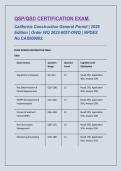
QSP/QSD CERTIFICATION EXAM.
California Construction General Permit | 2026
Edition | Order WQ 2022-0057-DWQ | NPDES
No.CAS000002.
EXAM DOMAIN DISTRIBUTION TABLE
Table
Exam Domain Question Question Cognitive Level
Range Count Distribution
Regulatory Framework Q1–Q15 15 Recall 40%, Application
40%, Analysis 20%
Risk Determination & Q16–Q30 15 Recall 20%, Application
Permit Requirements 50%, Analysis 30%
SWPPP Development & Q31–Q45 15 Recall 30%, Application
Implementation 50%, Analysis 20%
Erosion & Sediment Q46–Q65 20 Recall 25%, Application
Control BMPs 55%, Analysis 20%
Non-Stormwater Q66–Q75 10 Recall 30%, Application
Management 50%, Analysis 20%
Monitoring & Sampling Q76–Q90 15 Recall 25%, Application
50%, Analysis 25%
, Exam Domain Question Question Cognitive Level
Range Count Distribution
Inspections & Reporting Q91–Q105 15 Recall 20%, Application
55%, Analysis 25%
Rainfall & Compliance Q106–Q115 10 Recall 30%, Application
50%, Analysis 20%
Non-Structural BMPs & Q116–Q125 10 Recall 35%, Application
Housekeeping 45%, Analysis 20%
Integrated Scenarios & Q126–Q140 15 Recall 0%, Application
Case Studies 60%, Analysis 40%
TOTAL Q1–Q140 140 Recall 25%, Application
55%, Analysis 20%
DOMAIN 1: REGULATORY FRAMEWORK (Q1–Q15)
Q1: Under the federal Clean Water Act, which section authorizes the NPDES program to
regulate stormwater discharges from construction activities?
A. Section 303(d) — Impaired waters listing
B. Section 402 — National Pollutant Discharge Elimination System [CORRECT]
C. Section 401 — Water quality certification
D. Section 319 — Nonpoint source management
Correct Answer: B
Rationale: Section 402 of the Clean Water Act establishes the NPDES program, which provides
the federal authority under which California's Construction General Permit is issued. The State
Water Board exercises delegated authority from U.S. EPA to administer NPDES permits
statewide.
Q2: Which California state law establishes the nine Regional Water Quality Control Boards and
grants them authority to enforce stormwater discharge prohibitions?
,A. California Government Code
B. Porter-Cologne Water Quality Control Act [CORRECT]
C. California Environmental Quality Act (CEQA)
D. California Water Code Section 1000
Correct Answer: B
Rationale: The Porter-Cologne Water Quality Control Act creates the Regional Water Quality
Control Boards and empowers them to enforce waste discharge requirements, including
stormwater prohibitions under the Construction General Permit. CGP Section I references this
authority.
Q3: A construction project disturbs 0.75 acres of soil as part of a common plan of development
that ultimately disturbs 3.5 acres. Under the 2022 CGP, is this project subject to permit
coverage?
A. No, because the individual project disturbs less than one acre
B. Yes, because it is part of a common plan of development exceeding one acre [CORRECT]
C. No, unless the project is located within an MS4 permit area
D. Yes, but only if the project discharges directly to a 303(d) listed water body
Correct Answer: B
Rationale: CGP Section II.A and Attachment B define qualifying construction activity as any
project disturbing one or more acres, or less than one acre if part of a larger common plan of
development exceeding one acre. The 0.75-acre project is subject to the CGP.
Q4: What is the NPDES permit number assigned to California's statewide Construction General
Permit (Order WQ 2022-0057-DWQ)?
A. CAS000001
B. CAS000002 [CORRECT]
C. CA0000002
D. NPDES-CA-2022-0057
Correct Answer: B
Rationale: The 2022 CGP is issued under NPDES Permit No. CAS000002, as stated in the permit
title page and Section I. This number must be referenced on all NOI filings and public notices.
Q5: Under the 2022 CGP, which entity serves as the primary administrator for QSD and QSP
certification examinations and training program oversight?
A. State Water Resources Control Board
B. California Stormwater Quality Association (CASQA) [CORRECT]
C. Regional Water Quality Control Boards
D. California Department of Public Health
, Correct Answer: B
Rationale: CASQA administers the QSD/QSP training and certification program under contract
with the State Water Board. CGP Section XI and Attachment B define QSD/QSP qualifications
and continuing education requirements administered through CASQA.
Q6: A receiving water body has an adopted Total Maximum Daily Load (TMDL) for sediment.
Under the 2022 CGP, where are the TMDL-specific implementation requirements for
construction dischargers found?
A. Attachment A — Permit Registration Documents
B. Attachment H — TMDL Implementation Requirements [CORRECT]
C. Attachment D — Traditional Project Requirements
D. Attachment F — Active Treatment Systems
Correct Answer: B
Rationale: CGP Attachment H contains TMDL-specific requirements, including additional BMPs,
numeric action levels, and modeling requirements for Responsible Dischargers. Section IV.D.4
requires compliance with applicable TMDL implementation provisions.
Q7: Which of the following construction activities is explicitly EXEMPT from coverage under the
2022 CGP?
A. A 2-acre commercial development
B. A 1.5-acre residential subdivision
C. Routine road maintenance that does not expose underlying soil or erodible subgrade
[CORRECT]
D. A 0.8-acre project separated by more than one mile from other development
Correct Answer: C
Rationale: CGP Section II.B and the 2023 CASQA BMP Handbook specify that routine road
maintenance not exposing underlying soil or erodible subgrade is exempt. Projects exposing ≥1
acre of subgrade are subject to the CGP.
Q8: The 2022 CGP became effective on September 1, 2023, with a transition period for projects
enrolled under the 2009 CGP. What was the final deadline for all 2009 CGP projects to transition
or terminate?
A. December 31, 2024
B. August 31, 2025 [CORRECT]
C. September 1, 2025
D. January 1, 2026
Correct Answer: B
Rationale: The 2022 CGP transition period allowed 2009 CGP projects to continue until August
California Construction General Permit | 2026
Edition | Order WQ 2022-0057-DWQ | NPDES
No.CAS000002.
EXAM DOMAIN DISTRIBUTION TABLE
Table
Exam Domain Question Question Cognitive Level
Range Count Distribution
Regulatory Framework Q1–Q15 15 Recall 40%, Application
40%, Analysis 20%
Risk Determination & Q16–Q30 15 Recall 20%, Application
Permit Requirements 50%, Analysis 30%
SWPPP Development & Q31–Q45 15 Recall 30%, Application
Implementation 50%, Analysis 20%
Erosion & Sediment Q46–Q65 20 Recall 25%, Application
Control BMPs 55%, Analysis 20%
Non-Stormwater Q66–Q75 10 Recall 30%, Application
Management 50%, Analysis 20%
Monitoring & Sampling Q76–Q90 15 Recall 25%, Application
50%, Analysis 25%
, Exam Domain Question Question Cognitive Level
Range Count Distribution
Inspections & Reporting Q91–Q105 15 Recall 20%, Application
55%, Analysis 25%
Rainfall & Compliance Q106–Q115 10 Recall 30%, Application
50%, Analysis 20%
Non-Structural BMPs & Q116–Q125 10 Recall 35%, Application
Housekeeping 45%, Analysis 20%
Integrated Scenarios & Q126–Q140 15 Recall 0%, Application
Case Studies 60%, Analysis 40%
TOTAL Q1–Q140 140 Recall 25%, Application
55%, Analysis 20%
DOMAIN 1: REGULATORY FRAMEWORK (Q1–Q15)
Q1: Under the federal Clean Water Act, which section authorizes the NPDES program to
regulate stormwater discharges from construction activities?
A. Section 303(d) — Impaired waters listing
B. Section 402 — National Pollutant Discharge Elimination System [CORRECT]
C. Section 401 — Water quality certification
D. Section 319 — Nonpoint source management
Correct Answer: B
Rationale: Section 402 of the Clean Water Act establishes the NPDES program, which provides
the federal authority under which California's Construction General Permit is issued. The State
Water Board exercises delegated authority from U.S. EPA to administer NPDES permits
statewide.
Q2: Which California state law establishes the nine Regional Water Quality Control Boards and
grants them authority to enforce stormwater discharge prohibitions?
,A. California Government Code
B. Porter-Cologne Water Quality Control Act [CORRECT]
C. California Environmental Quality Act (CEQA)
D. California Water Code Section 1000
Correct Answer: B
Rationale: The Porter-Cologne Water Quality Control Act creates the Regional Water Quality
Control Boards and empowers them to enforce waste discharge requirements, including
stormwater prohibitions under the Construction General Permit. CGP Section I references this
authority.
Q3: A construction project disturbs 0.75 acres of soil as part of a common plan of development
that ultimately disturbs 3.5 acres. Under the 2022 CGP, is this project subject to permit
coverage?
A. No, because the individual project disturbs less than one acre
B. Yes, because it is part of a common plan of development exceeding one acre [CORRECT]
C. No, unless the project is located within an MS4 permit area
D. Yes, but only if the project discharges directly to a 303(d) listed water body
Correct Answer: B
Rationale: CGP Section II.A and Attachment B define qualifying construction activity as any
project disturbing one or more acres, or less than one acre if part of a larger common plan of
development exceeding one acre. The 0.75-acre project is subject to the CGP.
Q4: What is the NPDES permit number assigned to California's statewide Construction General
Permit (Order WQ 2022-0057-DWQ)?
A. CAS000001
B. CAS000002 [CORRECT]
C. CA0000002
D. NPDES-CA-2022-0057
Correct Answer: B
Rationale: The 2022 CGP is issued under NPDES Permit No. CAS000002, as stated in the permit
title page and Section I. This number must be referenced on all NOI filings and public notices.
Q5: Under the 2022 CGP, which entity serves as the primary administrator for QSD and QSP
certification examinations and training program oversight?
A. State Water Resources Control Board
B. California Stormwater Quality Association (CASQA) [CORRECT]
C. Regional Water Quality Control Boards
D. California Department of Public Health
, Correct Answer: B
Rationale: CASQA administers the QSD/QSP training and certification program under contract
with the State Water Board. CGP Section XI and Attachment B define QSD/QSP qualifications
and continuing education requirements administered through CASQA.
Q6: A receiving water body has an adopted Total Maximum Daily Load (TMDL) for sediment.
Under the 2022 CGP, where are the TMDL-specific implementation requirements for
construction dischargers found?
A. Attachment A — Permit Registration Documents
B. Attachment H — TMDL Implementation Requirements [CORRECT]
C. Attachment D — Traditional Project Requirements
D. Attachment F — Active Treatment Systems
Correct Answer: B
Rationale: CGP Attachment H contains TMDL-specific requirements, including additional BMPs,
numeric action levels, and modeling requirements for Responsible Dischargers. Section IV.D.4
requires compliance with applicable TMDL implementation provisions.
Q7: Which of the following construction activities is explicitly EXEMPT from coverage under the
2022 CGP?
A. A 2-acre commercial development
B. A 1.5-acre residential subdivision
C. Routine road maintenance that does not expose underlying soil or erodible subgrade
[CORRECT]
D. A 0.8-acre project separated by more than one mile from other development
Correct Answer: C
Rationale: CGP Section II.B and the 2023 CASQA BMP Handbook specify that routine road
maintenance not exposing underlying soil or erodible subgrade is exempt. Projects exposing ≥1
acre of subgrade are subject to the CGP.
Q8: The 2022 CGP became effective on September 1, 2023, with a transition period for projects
enrolled under the 2009 CGP. What was the final deadline for all 2009 CGP projects to transition
or terminate?
A. December 31, 2024
B. August 31, 2025 [CORRECT]
C. September 1, 2025
D. January 1, 2026
Correct Answer: B
Rationale: The 2022 CGP transition period allowed 2009 CGP projects to continue until August


