

Written by students who passed Immediately available after payment Read online or as PDF Wrong document? Swap it for free 4.6 TrustPilot
logo-home
Document preview thumbnail
Preview 4 out of 36 pages
Exam (elaborations)

Illinois Basic Firefighter Certification Examination Study Guide | Comprehensive Practice Questions with Verified Answers & Detailed Rationales | 2026 Edition

Document preview thumbnail
Preview 4 out of 36 pages

Prepare confidently for the Illinois Basic Firefighter Certification Examination with this comprehensive practice study guide designed for aspiring firefighters, fire academy candidates, emergency responders, fire service personnel, and professionals preparing for firefighter certification and qualification assessments in Illinois. This 2026 Edition features an extensive collection of original practice questions with verified answers and detailed rationales, helping candidates strengthen their knowledge of fire behavior, firefighter safety, emergency response, fire suppression, rescue operations, hazardous materials, equipment, and incident command fundamentals. Each practice question includes a clearly identified correct answer followed by a detailed rationale explaining the underlying fire-service principle, operational procedure, safety consideration, or decision-making process. Alternative answers are discussed where appropriate, helping candidates understand the reasoning behind the correct response rather than relying on memorization alone. Comprehensive coverage includes: Firefighter Fundamentals: Fire-service terminology, firefighter responsibilities, station procedures, operational readiness, professional conduct, basic firefighting principles, and the role of the firefighter during emergency operations. Fire Behavior & Combustion: Fire chemistry, heat transfer, stages of fire development, products of combustion, flashover, backdraft, rollover, fire growth, smoke behavior, and recognizing changing fire conditions. Personal Protective Equipment (PPE): Structural firefighting gear, helmets, gloves, boots, protective clothing, eye and hearing protection, SCBA, PPE inspection, donning and doffing procedures, limitations, and firefighter rehabilitation. Self-Contained Breathing Apparatus (SCBA): SCBA components, air management, inspection, cylinder procedures, emergency breathing techniques, low-air situations, buddy systems, and safe operations in hazardous atmospheres. Fire Suppression Operations: Hose lines, nozzle operations, water application, fire streams, attack strategies, exposure protection, extinguishment techniques, overhaul, and coordination during suppression operations. Fireground Search & Rescue: Primary and secondary searches, victim removal, search patterns, firefighter rescue, emergency evacuation, rapid intervention concepts, and maintaining situational awareness. Ladders & Ventilation: Ground ladder selection, placement, climbing, carrying, ladder safety, ventilation principles, horizontal and vertical ventilation, coordination with suppression crews, and controlling fire conditions. Forcible Entry: Doors, windows, locks, entry tools, conventional forcible-entry techniques, power tools, entry safety, coordination, and maintaining security after entry. Ropes, Knots & Rescue: Basic knots, rope handling, rescue equipment, lowering and raising systems, technical rescue awareness, patient movement, and safe rescue practices. Building Construction: Structural components, building types, fire behavior in different structures, collapse indicators, lightweight construction, structural hazards, roof systems, and recognizing dangerous conditions. Hazardous Materials: Hazard recognition, identification systems, placards and labels, isolation, contamination awareness, PPE considerations, defensive response, decontamination concepts, and appropriate notification procedures. Emergency Medical Response: Basic medical response, patient assessment, bleeding control, shock, burns, respiratory emergencies, trauma awareness, CPR concepts, and coordination with EMS personnel. Vehicle & Technical Rescue: Vehicle stabilization, extrication awareness, traffic hazards, rescue tools, scene safety, patient protection, and coordination with specialized rescue teams. Incident Command & Fireground Communications: Incident command fundamentals, accountability, radio communication, assignments, chain of command, tactical coordination, mayday procedures, personnel accountability, and maintaining effective communication. Firefighter Safety & Survival: Situational awareness, risk assessment, emergency procedures, firefighter accountability, air management, escape routes, mayday communications, rapid intervention, and recognizing conditions that require withdrawal. Fire Prevention & Public Education: Fire prevention principles, inspections, public education, smoke alarms, fire safety programs, community risk reduction, and educating occupants about fire hazards. Fire Extinguishers & Fire Protection Systems: Portable extinguishers, fire classifications, sprinkler systems, standpipes, alarm systems, hydrants, suppression equipment, and basic fire-protection system operations. Wildland & Outdoor Fire Awareness: Basic wildland fire behavior, fuels, weather, terrain, exposure hazards, suppression awareness, firefighter safety, and coordination with specialized wildland resources. Case-Based Fireground Scenarios: Realistic emergency scenarios requiring candidates to identify hazards, prioritize actions, select appropriate equipment, communicate effectively, assess changing fire conditions, and make sound firefighter-safety decisions. Certification Exam Readiness: This comprehensive resource emphasizes practical application through realistic firefighter scenarios that strengthen fire behavior knowledge, emergency response, suppression operations, rescue skills, hazardous-material awareness, PPE use, SCBA operations, and firefighter survival. Detailed rationales reinforce essential concepts while helping candidates prepare for Illinois Basic Firefighter certification examinations, academy assessments, and fire-service training evaluations. Whether you are preparing for the Illinois Basic Firefighter Certification Examination, reviewing fireground fundamentals, strengthening your emergency-response knowledge, or preparing for firefighter academy testing, this study guide provides structured practice, detailed explanations, and practical fire-service concepts to help you approach your examination with greater confidence.

Content preview

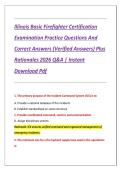
Illinois Basic Firefighter Certification
Examination Practice Questions And
Correct Answers (Verified Answers) Plus
Rationales 2026 Q&A | Instant
Download Pdf


1. The primary purpose of the Incident Command System (ICS) is to:

A. Provide a national database of fire incidents
B. Establish standardized on-scene structure
C. Provide coordinated command, control, and communication
D. Assign disciplinary actions
Rationale: ICS ensures unified command and organized management of
emergency incidents.

2. The minimum size for a fire hydrant supply hose used in fire operations
is:

,A. 1 inch
B. 1¼ inches
C. 1½ inches
D. 2½ inches
Rationale: Large-diameter supply lines (2½″ or greater) are standard for
hydrant-to-engine supply.

3. What is the most common product of combustion?

A. Sulfur dioxide
B. Hydrogen cyanide
C. Carbon monoxide
D. Nitrogen
Rationale: Carbon monoxide is produced in almost all incomplete
combustion events.

4. Firefighters should don full PPE and SCBA:

A. Only for confirmed fires
B. Only when entering IDLH
C. Whenever toxic byproducts may be present
D. Only inside structures
Rationale: PPE/SCBA required whenever smoke or toxic gases may be
present, not only in visible fires.

5. The fire tetrahedron includes heat, fuel, oxygen, and:

,A. Carbon dioxide
B. Water vapor
C. Chemical chain reaction
D. Ignition temperature
Rationale: The chemical chain reaction completes the fire tetrahedron.

6. The most effective way to control vehicle traffic at an emergency scene
is:

A. Hand signals
B. Flashlights
C. Apparatus placement and traffic cones
D. Verbal warnings
Rationale: Apparatus placement creates physical barriers and protects
crews.

7. A Class K fire involves:

A. Electrical equipment
B. Flammable liquids
C. Ordinary combustibles
D. Cooking oils and fats
Rationale: Class K fires involve commercial cooking media (oils/greases).

8. The primary goal during search operations is:

A. Salvage
B. Overhaul

, C. Life safety
D. Property conservation
Rationale: Life safety is always the top priority in searches.

9. Hydrant inspection should include checking:

A. Paint color only
B. Street address
C. Caps, threads, and obstructions
D. Water tank level
Rationale: Operational readiness depends on caps, threads, and
unobstructed hydrant access.

10. Backdraft conditions include:

A. Cold black smoke
B. Steam production
C. Pressurized smoke pulsing at openings
D. Rapid flame spread
Rationale: Pressurized, turbulent smoke suggests oxygen-limited
environment primed for backdraft.


11. A firefighter’s most valuable tool for situational awareness is:

A. Radio
B. Continuous observation
C. Thermal imager

Document information

Uploaded on
August 10, 2026
Number of pages
36
Written in
2026/2027
Type
Exam (elaborations)
Contains
Questions & answers
$21.99

Wrong document? Swap it for free Within 14 days of purchase and before downloading, you can choose a different document. You can simply spend the amount again.
Written by students who passed
Immediately available after payment
Read online or as PDF

Seller avatar
Reputation scores are based on the amount of documents a seller has sold for a fee and the reviews they have received for those documents. There are three levels: Bronze, Silver and Gold. The better the reputation, the more your can rely on the quality of the sellers work.
itsjustel
4.0
(1)
Sold
14
Followers
0
Items
785
Last sold
1 week ago


Why students choose Stuvia

Created by fellow students, verified by reviews

Quality you can trust: written by students who passed their tests and reviewed by others who've used these notes.

Didn't get what you expected? Choose another document

No worries! You can instantly pick a different document that better fits what you're looking for.

Pay as you like, start learning right away

No subscription, no commitments. Pay the way you're used to via credit card and download your PDF document instantly.

Student with book image

“Bought, downloaded, and aced it. It really can be that simple.”

Alisha Student

Working on your references?

Create accurate citations in APA, MLA and Harvard with our free citation generator.

Working on your references?

Frequently asked questions

