

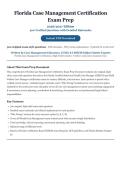
Florida Case Management Certification
Exam Prep
2026/2027 Edition
300 Verified Questions with Detailed Rationales
Instant PDF Download
300 original exam-style questions · Full rationales · Why wrong explanations · Updated for 2026/2027
Written by Case Management Educators, CCM® & CBHCM Subject Matter Experts
Florida Case Management Certification: High-Yield Content | Verified: 2026/2027 Academic Year
About This Exam Prep Document
This comprehensive Florida Case Management Certification Exam Prep Document contains 300 original, high-
yield, exam-style questions that mirror the Florida Certified Behavioral Health Case Manager (CBHCM) and Child
Welfare Case Manager certification exams in content, difficulty, and structure. Each question is paired with a
verified correct answer, a detailed expert rationale, and a "Why Wrong" breakdown for every incorrect option.
Updated for the 2026/2027 cycle, this guide covers all core case management content areas including engagement
& assessment, service planning, coordination & monitoring, documentation, and professional/legal/ethical
responsibilities.
Key Features
300 original, high-yield exam-style questions
Detailed expert rationales and clinical implications for each question
"Why Wrong" sections for every incorrect option (A, B, C, D)
Covers all Florida Case Management exam content areas with accurate weight distribution
Tests knowledge, clinical reasoning, assessment, planning, and critical thinking
Balanced range of difficulty levels
Based on Florida Certification Board CBHCM exam blueprint, DCF guidelines, and Florida Statutes Chapter
39
,Section Questions Weight
Engagement & Assessment (Initial & Ongoing) 60 20%
Service Planning & Development 55 18%
Coordination, Linkage & Monitoring 80 26%
Documentation 60 20%
Professional, Legal & Ethical Responsibilities 45 16%
,Engagement & Assessment (Initial & Ongoing) (51 questions)
1. A 14-year-old is placed in out-of-home care. The case manager must complete the
Family Functional Assessment (FFA) within what timeframe per DCF policy?
A. Within 30 days of removal
B. Within 45 days of removal
C. Within 60 days of removal
D. Prior to the disposition hearing
✓ Correct answer: A. Within 30 days of removal
Rationale: Per Florida DCF policy, the Family Functional Assessment (FFA) must be completed
within 30 days of the child's removal from the home. This assessment is critical for identifying family
strengths, needs, and service recommendations to inform the case plan.
Why the others are wrong:
B: 45 days is not the correct timeline; the FFA is required sooner.
C: 60 days exceeds the required timeframe for completion.
D: While the FFA informs the disposition hearing, it must be completed well before that hearing.
Reference: Florida Certification Board CBHCM Blueprint · DCF CFOPs · Florida Statutes Chapter 39 · ASFA · ICWA ·
HIPAA · Florida Administrative Code 65C-30.
2. According to the Florida Certification Board CBHCM exam blueprint, which
competency involves gathering information from collateral sources to assess the client's
current situation and identify immediate needs?
A. Facilitating understanding of case management services
B. Obtaining relevant information from the client and meaningful collateral sources
C. Administering assessment instruments for goal setting
D. Analyzing assessment data to identify problems
✓ Correct answer: B. Obtaining relevant information from the client and meaningful collateral
sources
Rationale: This directly matches Competency 2 under the Engagement and Assessment domain:
"Obtain relevant information from the client and meaningful collateral sources in order to assess the
client's current situation and identify any immediate needs."
Why the others are wrong:
A: This describes Competency 1 (facilitating understanding of services).
C: This is Competency 3 (administering assessment instruments).
D: This is Competency 4 (analyzing and synthesizing data).
Reference: Florida Certification Board CBHCM Blueprint · DCF CFOPs · Florida Statutes Chapter 39 · ASFA · ICWA ·
HIPAA · Florida Administrative Code 65C-30.
, 3. A case manager is conducting an initial assessment with a client who speaks only
Haitian Creole. What is the most appropriate action to ensure meaningful engagement?
A. Use a certified interpreter or qualified bilingual staff for all communication
B. Ask the client's bilingual child to interpret to build family trust
C. Rely on written translations of forms and questionnaires
D. Proceed with the assessment using gestures and simple English
✓ Correct answer: A. Use a certified interpreter or qualified bilingual staff for all
communication
Rationale: Federal and state guidelines require the use of qualified interpreters for clients with
limited English proficiency to ensure accurate assessment, informed consent, and culturally competent
care. Using family members, especially children, is inappropriate and can compromise confidentiality
and accuracy.
Why the others are wrong:
B: Using a child as an interpreter is unethical and can create conflicts of interest or inaccurate translations.
C: Written translations alone do not ensure comprehension or allow for interactive assessment.
D: Gestures and simple English are not sufficient for a comprehensive, accurate assessment.
Reference: Florida Certification Board CBHCM Blueprint · DCF CFOPs · Florida Statutes Chapter 39 · ASFA · ICWA ·
HIPAA · Florida Administrative Code 65C-30.
4. When assessing a child in out-of-home care, which of the following is a required
component of every contact documentation per Florida Administrative Code 65C-30.007?
A. Observations of the child's development, physical condition, and interaction with caregivers
B. The child's school attendance records
C. The caregiver's employment status
D. A detailed financial statement of the household
✓ Correct answer: A. Observations of the child's development, physical condition, and
interaction with caregivers
Rationale: Rule 65C-30.007(6)(d) requires documentation of "Observations of the child's
development, physical condition and interaction with the parent or caregiver and household
members." This is a required element for every contact to assess safety and well-being.
Why the others are wrong:
B: School attendance is important but not a required component of every contact per this rule.
C: Caregiver employment status is not a required documentation element for every contact.
D: Financial statements are not a required component of routine contact documentation.
Reference: Florida Certification Board CBHCM Blueprint · DCF CFOPs · Florida Statutes Chapter 39 · ASFA · ICWA ·
HIPAA · Florida Administrative Code 65C-30.
Exam Prep
2026/2027 Edition
300 Verified Questions with Detailed Rationales
Instant PDF Download
300 original exam-style questions · Full rationales · Why wrong explanations · Updated for 2026/2027
Written by Case Management Educators, CCM® & CBHCM Subject Matter Experts
Florida Case Management Certification: High-Yield Content | Verified: 2026/2027 Academic Year
About This Exam Prep Document
This comprehensive Florida Case Management Certification Exam Prep Document contains 300 original, high-
yield, exam-style questions that mirror the Florida Certified Behavioral Health Case Manager (CBHCM) and Child
Welfare Case Manager certification exams in content, difficulty, and structure. Each question is paired with a
verified correct answer, a detailed expert rationale, and a "Why Wrong" breakdown for every incorrect option.
Updated for the 2026/2027 cycle, this guide covers all core case management content areas including engagement
& assessment, service planning, coordination & monitoring, documentation, and professional/legal/ethical
responsibilities.
Key Features
300 original, high-yield exam-style questions
Detailed expert rationales and clinical implications for each question
"Why Wrong" sections for every incorrect option (A, B, C, D)
Covers all Florida Case Management exam content areas with accurate weight distribution
Tests knowledge, clinical reasoning, assessment, planning, and critical thinking
Balanced range of difficulty levels
Based on Florida Certification Board CBHCM exam blueprint, DCF guidelines, and Florida Statutes Chapter
39
,Section Questions Weight
Engagement & Assessment (Initial & Ongoing) 60 20%
Service Planning & Development 55 18%
Coordination, Linkage & Monitoring 80 26%
Documentation 60 20%
Professional, Legal & Ethical Responsibilities 45 16%
,Engagement & Assessment (Initial & Ongoing) (51 questions)
1. A 14-year-old is placed in out-of-home care. The case manager must complete the
Family Functional Assessment (FFA) within what timeframe per DCF policy?
A. Within 30 days of removal
B. Within 45 days of removal
C. Within 60 days of removal
D. Prior to the disposition hearing
✓ Correct answer: A. Within 30 days of removal
Rationale: Per Florida DCF policy, the Family Functional Assessment (FFA) must be completed
within 30 days of the child's removal from the home. This assessment is critical for identifying family
strengths, needs, and service recommendations to inform the case plan.
Why the others are wrong:
B: 45 days is not the correct timeline; the FFA is required sooner.
C: 60 days exceeds the required timeframe for completion.
D: While the FFA informs the disposition hearing, it must be completed well before that hearing.
Reference: Florida Certification Board CBHCM Blueprint · DCF CFOPs · Florida Statutes Chapter 39 · ASFA · ICWA ·
HIPAA · Florida Administrative Code 65C-30.
2. According to the Florida Certification Board CBHCM exam blueprint, which
competency involves gathering information from collateral sources to assess the client's
current situation and identify immediate needs?
A. Facilitating understanding of case management services
B. Obtaining relevant information from the client and meaningful collateral sources
C. Administering assessment instruments for goal setting
D. Analyzing assessment data to identify problems
✓ Correct answer: B. Obtaining relevant information from the client and meaningful collateral
sources
Rationale: This directly matches Competency 2 under the Engagement and Assessment domain:
"Obtain relevant information from the client and meaningful collateral sources in order to assess the
client's current situation and identify any immediate needs."
Why the others are wrong:
A: This describes Competency 1 (facilitating understanding of services).
C: This is Competency 3 (administering assessment instruments).
D: This is Competency 4 (analyzing and synthesizing data).
Reference: Florida Certification Board CBHCM Blueprint · DCF CFOPs · Florida Statutes Chapter 39 · ASFA · ICWA ·
HIPAA · Florida Administrative Code 65C-30.
, 3. A case manager is conducting an initial assessment with a client who speaks only
Haitian Creole. What is the most appropriate action to ensure meaningful engagement?
A. Use a certified interpreter or qualified bilingual staff for all communication
B. Ask the client's bilingual child to interpret to build family trust
C. Rely on written translations of forms and questionnaires
D. Proceed with the assessment using gestures and simple English
✓ Correct answer: A. Use a certified interpreter or qualified bilingual staff for all
communication
Rationale: Federal and state guidelines require the use of qualified interpreters for clients with
limited English proficiency to ensure accurate assessment, informed consent, and culturally competent
care. Using family members, especially children, is inappropriate and can compromise confidentiality
and accuracy.
Why the others are wrong:
B: Using a child as an interpreter is unethical and can create conflicts of interest or inaccurate translations.
C: Written translations alone do not ensure comprehension or allow for interactive assessment.
D: Gestures and simple English are not sufficient for a comprehensive, accurate assessment.
Reference: Florida Certification Board CBHCM Blueprint · DCF CFOPs · Florida Statutes Chapter 39 · ASFA · ICWA ·
HIPAA · Florida Administrative Code 65C-30.
4. When assessing a child in out-of-home care, which of the following is a required
component of every contact documentation per Florida Administrative Code 65C-30.007?
A. Observations of the child's development, physical condition, and interaction with caregivers
B. The child's school attendance records
C. The caregiver's employment status
D. A detailed financial statement of the household
✓ Correct answer: A. Observations of the child's development, physical condition, and
interaction with caregivers
Rationale: Rule 65C-30.007(6)(d) requires documentation of "Observations of the child's
development, physical condition and interaction with the parent or caregiver and household
members." This is a required element for every contact to assess safety and well-being.
Why the others are wrong:
B: School attendance is important but not a required component of every contact per this rule.
C: Caregiver employment status is not a required documentation element for every contact.
D: Financial statements are not a required component of routine contact documentation.
Reference: Florida Certification Board CBHCM Blueprint · DCF CFOPs · Florida Statutes Chapter 39 · ASFA · ICWA ·
HIPAA · Florida Administrative Code 65C-30.


