
• Wrong document? Swap it for free
  • Written by students who passed
  • Immediately available after payment
  • Read online or as PDF
Sell
Where do you study
Your language
Document preview thumbnail
Preview 4 out of 36 pages
Exam (elaborations)

New York Nutrition Specialist Certification Examination Study Guide | Comprehensive Practice Questions with Verified Answers & Detailed Rationales | 2025/2026 Edition

Document preview thumbnail
Preview 4 out of 36 pages

Prepare confidently for the New York Nutrition Specialist Certification Examination with this comprehensive practice study guide designed for nutrition professionals, dietetics students, wellness practitioners, healthcare professionals, and candidates preparing for nutrition-related certification assessments. This 2025/2026 Edition features an extensive collection of original practice questions with verified answers and detailed rationales, helping learners strengthen their knowledge of nutrition science, dietary assessment, clinical nutrition, food safety, wellness, nutrition counseling, and professional practice. Each practice question includes a clearly identified correct answer followed by a detailed rationale explaining the nutritional science, clinical reasoning, dietary principles, and professional considerations behind the response. Alternative answers are discussed where appropriate, helping candidates understand the reasoning behind each choice rather than relying solely on memorization. Comprehensive coverage includes: Nutrition Fundamentals: Macronutrients, micronutrients, energy metabolism, digestion and absorption, nutrient functions, dietary sources, deficiency symptoms, nutrient interactions, and essential nutrition concepts. Human Nutrition & Physiology: Metabolism, gastrointestinal function, nutrient utilization, hormonal regulation, hydration, energy balance, and the relationship between nutrition and physiological health. Nutritional Assessment: Dietary histories, food-frequency questionnaires, anthropometric measurements, BMI, biochemical indicators, clinical assessment, nutrition screening, and interpretation of nutrition-related data. Macronutrients: Carbohydrates, proteins, fats, fiber, essential fatty acids, amino acids, energy requirements, dietary sources, and metabolic functions. Vitamins & Minerals: Fat-soluble and water-soluble vitamins, calcium, iron, magnesium, zinc, potassium, sodium, phosphorus, trace minerals, nutrient deficiencies, toxicity, absorption, and supplementation considerations. Clinical Nutrition: Nutrition considerations for diabetes, cardiovascular disease, hypertension, kidney disease, gastrointestinal disorders, obesity, malnutrition, metabolic conditions, and other common health concerns. Weight Management & Wellness: Energy balance, healthy weight management, behavior modification, physical activity, meal planning, lifestyle interventions, obesity prevention, and sustainable nutrition strategies. Nutrition Across the Lifespan: Nutritional needs during pregnancy, infancy, childhood, adolescence, adulthood, and older age, including growth, development, healthy aging, and age-specific dietary considerations. Sports & Performance Nutrition: Energy requirements, hydration, electrolytes, carbohydrate strategies, protein needs, recovery nutrition, exercise nutrition, and performance-supporting dietary practices. Food Safety & Sanitation: Foodborne illness prevention, temperature control, food handling, contamination prevention, personal hygiene, storage practices, allergens, and safe food preparation. Nutrition Counseling & Education: Client communication, motivational interviewing, behavior change, goal setting, culturally appropriate counseling, nutrition education, adherence strategies, and effective communication. Therapeutic Diets: Modified diets, texture modifications, nutrient restrictions, therapeutic meal planning, dietary interventions, and nutrition considerations for common medical conditions. Dietary Supplements: Supplement safety, nutrient interactions, potential toxicity, evidence-based use, labeling considerations, contraindications, and responsible counseling regarding supplements. Public Health Nutrition: Community nutrition, nutrition education, food access, disease prevention, population health, health promotion, nutrition programs, and strategies for improving dietary behaviors. Professional Practice & Ethics: Professional boundaries, scope of practice, confidentiality, informed communication, documentation, ethical decision-making, interdisciplinary collaboration, and responsible nutrition practice. Case-Based Nutrition Scenarios: Realistic client and patient situations requiring nutritional assessment, identification of dietary concerns, interpretation of nutrition data, development of appropriate recommendations, and selection of evidence-based interventions. Exam Readiness & Professional Competency: This comprehensive resource emphasizes application-based practice to strengthen nutrition assessment, clinical reasoning, dietary planning, patient education, food safety, and professional decision-making. Detailed rationales reinforce essential nutrition concepts while helping candidates prepare for certification assessments and professional nutrition practice. Whether you are preparing for the New York Nutrition Specialist Certification Examination, reviewing nutrition science, strengthening your clinical nutrition knowledge, or preparing for a professional certification assessment, this study guide provides structured practice, detailed explanations, and practical nutrition concepts to help you approach your examination with greater confidence.

Content preview

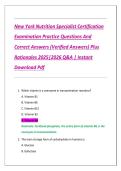
New York Nutrition Specialist Certification
Examination Practice Questions And
Correct Answers (Verified Answers) Plus
Rationales 2025|2026 Q&A | Instant
Download Pdf


1. Which vitamin is a coenzyme in transamination reactions?
A. Vitamin B1
B. Vitamin B6
C. Vitamin B12
D. Vitamin B2
B. Vitamin B6
Rationale: Pyridoxal phosphate, the active form of vitamin B6, is the
coenzyme in transamination.

2. The main storage form of carbohydrate in humans is:
A. Glucose
B. Galactose

, C. Glycogen
D. Maltose
C. Glycogen
Rationale: Glycogen is the stored polysaccharide form of glucose in
liver and muscle.

3. Which mineral is essential for thyroid hormone synthesis?
A. Selenium
B. Zinc
C. Iodine
D. Iron
C. Iodine
Rationale: Iodine is incorporated into T3 and T4 thyroid hormones.

4. The primary lipoprotein responsible for transporting cholesterol from
tissues to the liver is:
A. VLDL
B. LDL
C. HDL
D. Chylomicrons
C. HDL
Rationale: High-density lipoproteins mediate reverse cholesterol
transport.

5. Which amino acid is a precursor for serotonin?
A. Tyrosine

, B. Phenylalanine
C. Tryptophan
D. Methionine
C. Tryptophan
Rationale: Tryptophan is hydroxylated and decarboxylated to form
serotonin.

6. Which fat-soluble vitamin can be synthesized in the skin?
A. Vitamin A
B. Vitamin D
C. Vitamin E
D. Vitamin K
B. Vitamin D
Rationale: Ultraviolet light converts 7-dehydrocholesterol in skin to
vitamin D3.

7. The main intracellular cation is:
A. Sodium
B. Potassium
C. Calcium
D. Magnesium
B. Potassium
Rationale: Potassium is the primary cation inside cells, maintaining
membrane potential.

, 8. Which hormone lowers blood glucose by increasing cellular uptake?
A. Glucagon
B. Cortisol
C. Epinephrine
D. Insulin
D. Insulin
Rationale: Insulin promotes glucose uptake by muscle and adipose
tissue.

9. Which of the following is a condition of thiamine deficiency?
A. Pellagra
B. Scurvy
C. Beriberi
D. Rickets
C. Beriberi
Rationale: Thiamine deficiency causes beriberi with neurological and
cardiac symptoms.

10. The glycemic index measures:
A. Insulin secretion rate
B. Speed of gastric emptying
C. Effect of carbohydrate on blood glucose
D. Energy density of food
C. Effect of carbohydrate on blood glucose


Document information

Uploaded on
August 10, 2026
Number of pages
36
Written in
2026/2027
Type
Exam (elaborations)
Contains
Questions & answers
$21.99

Wrong document? Swap it for free Within 14 days of purchase and before downloading, you can choose a different document. You can simply spend the amount again.
Written by students who passed
Immediately available after payment
Read online or as PDF

Seller avatar
Reputation scores are based on the amount of documents a seller has sold for a fee and the reviews they have received for those documents. There are three levels: Bronze, Silver and Gold. The better the reputation, the more your can rely on the quality of the sellers work.
itsjustel
3.8
(4)
Sold
33
Followers
1
Items
827
Last sold
8 hours ago


Why students choose Stuvia

Created by fellow students, verified by reviews

Quality you can trust: written by students who passed their tests and reviewed by others who've used these notes.

Didn't get what you expected? Choose another document

No worries! You can instantly pick a different document that better fits what you're looking for.

Pay as you like, start learning right away

No subscription, no commitments. Pay the way you're used to via credit card and download your PDF document instantly.

Student with book image

“Bought, downloaded, and aced it. It really can be that simple.”

Alisha Student

Working on your references?

Create accurate citations in APA, MLA and Harvard with our free citation generator.

Working on your references?

Frequently asked questions
