

Written by students who passed Immediately available after payment Read online or as PDF Wrong document? Swap it for free 4.6 TrustPilot
logo-home
Document preview thumbnail
Preview 2 out of 8 pages
Exam (elaborations)

Foundations of Nursing (NUR 155): NUR155 Exam 3 Review Guide: Questions & Answers | Latest Fall 2026 - Galen.

Document preview thumbnail
Preview 2 out of 8 pages

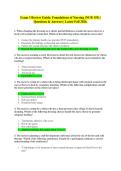
Foundations of Nursing (NUR 155): NUR155 Exam 3 Review Guide: Questions & Answers | Latest Fall 2026 - Galen. Exam 3 Review Guide: Foundations of Nursing (NUR 155) | Questions & Answers | Latest Fall 2026. 1. When changing the dressing on a clients partial-thickness wound, the nurse observes a beefy-red translucent wound bed. Which of the following actions should the nurse take? 1. Contact the primary health care provider (PCP) immediately. 2. Document the findings as abnormal and continue to observe. 3. Culture the wound and place the client in isolation. 4. Discard the old dressing and cover the wound with a new dressing. 2. The nurse is teaching a newly hired nurse about the risk factors for dehiscence for clients who have surgical incisions. Which of the following factors should the nurse include in the teaching? 1. Altered mental status 2. Nutritional deficiencies 3. Advanced age 4. Immobility 3. The nurse is caring for a client who is being discharged home with surgical wound on the coccyx that is to heal by secondary intention. Which of the following complications should the nurse prioritize on the clients care plan? 1. Contractures 2. Increased tissue perfusion 3. Self-care deficit 4. Disturbed body image. 4. The nurse is caring for a client who has a deep pressure ulcer (Stage 3) that is heavily draining. Which of the following dressing choices should the nurse choose to promote adequate healing? 1. Transparent, adhesive, film cover 2. Wet to dry gauze 3. Dry cotton gauze 4. Alginate packing, dry, gauze cover 5. The nurse is planning a staff development conference about the use of the hot and cold therapy. Which of the following statements, if made by a participant, indicates a correct understanding of the conference? 1. "Cold therapy is for treatment of open wounds because it improves blood flow to the area." 2. "Heat therapy is not used in the first 24 hours after a traumatic injury because it may cause increased swelling and bleeding." 3. "Heat therapy is not the first 24 hours after injury because it may cause arterial spasm and delayed healing" 4. "When using cold therapy, the temperature must be less than 32 degrees F to achieve the desired effects." 6. The nurse is planning a staff development conference about the use of abdominal binders. Which of the following statements, if made by a participant, indicates a correct understanding of the conference? (Incomplete: options and answer not visible in the source) 12. The nurse is caring for a client who has a gustatory impairment and is becoming malnourished because nothing tastes good. Which of the following should the nurse recommend? a. "Eat soft foods that will be easy to chew and swallow" b. "Stay away from spicy foods that could cause irritation" c. "Take sips of water between eating different foods" d. "Cleanse the mouth with glycerin swabs after each meal" 13. The nurse is teaching a client who has respiratory problems about the function of the alveoli. Which of the following information about the alveoli function should the nurse share with the client? a. Contain a thin mucus, which traps foreign substances to expel from the lungs b. Store excess oxygen, which is important when experiencing shortness of breath c. Carry out gas exchange between the heart and lungs d. Produce white blood cells, which are important for the immune system 14. The nurse is caring for a client who has hypoxia. Which of the following clinical manifestations should the nurse expect to observe? a. General malaise and wheezing in the lungs b. Confusion and crackles in the lungs c. Pallor and weak peripheral pulses d. Rapid pulse and shallow respirations 15. The nurse is returning from an in-service regarding care of the client with dyspnea. It indicates a need for further education if the nurse is seen placing the client in: a. Orthopneic position b. High-fowlers position c. Semi-fowlers position d. Prone position 16. The nurse is caring for a client who is in severe respiratory distress and has been prescribed high concentrations of oxygen (above 95%). Which of the following oxygen delivery systems should the nurse use for this client? a. Oxygen tent b. Partial rebreather mask c. Bilevel positive airway pressure (BiPAP) with oxygen d. Non rebreather mask 17. The nurse is caring for a client who has chronic obstructive pulmonary disease (COPD) and is receiving 2 L/min of oxygen. Which of the following oxygen delivery devices is MOST appropriate for the nurse to administer the oxygen? 1. Partial non rebreather mask 2. Nasal Cannula 18. The nurse preceptor is observing a newly hired nurse provide oxygen delivery to a client. The nurse preceptor should intervene if the newly hired nurse is observed: 1. Adding a humidifying bottle to prescribed oxygen delivery of 4 L or more 2. Making sure the client removes the oxygen before smoking 3. Ensuring the electrical oxygen equipment is properly grounded 4. Providing the client with a water-based jelly in the nose become dry 19. The nurse is caring for a client who has a chronic lung disease. The primary health care provider has prescribed the use of an incentive spirometer every hour while the client is awake. The nurse should recognize that this treatment: a. Is a method to loosen secretions and promote lung expansion b. Is performed by leaning forward and exhaling sharply c. Is performed by exhaling and holding the breath for three seconds d. Will promote bronchodilation of the airway 20. While caring for a client the nurse begins to suspect the client has increased afterload. Which of the following pieces of equipment should the nurse obtain to determine the presence of this condition? 1. Nasal oxygen cannula 2. Stethoscope 3. Doppler 4. Pulse oximeter 21. The nurse is conducting a comprehensive nursing history of an assigned client. Which of the following should the nurse recognize as a modifiable risk factor for cardiovascular disease? 1. Family history 2. Stress 3. Gender 4. Age 22. The nurse is teaching a client about promoting a healthy heart. Which of the following statements by the client requires follow up by the nurse? 1. I will try to get at least 30 minutes of aerobic exercise three times per week 2. I will eat a diet low in total fat saturated fat and cholesterol 3. I will try to reduce the stress in my life by using effective coping mechanisms 4. I will enroll in a smoking sensation program so that I can quit smoking cigarettes 23. The nurse is caring for a client recently diagnosed with pulmonary edema. which of the following findings should the nurse expect when performing an assessment? 1. Cyanosis, nocturia 2. Wheezing, nausea 3. Chest pain, pedal edema 4. Dyspnea, increased pulse rate 24. Earth has attended a continuing education conference about the normal physiologic changes in the cardiovascular system that occur with aging. which of the following statements by the nurse indicates a correct understanding of the conference? 1. heart valves become increasingly stiff in older adults 2. cardiac output is not affected by age 3. the heart of older adults is more responsive to stress 4. blood vessels become more elastic in older adults 25. The nurse is caring for a client who is connected to a cardiac monitor. the monitor alarms and indicates that the client has developed an abnormal rhythm pattern. which of the following actions is priority for the nurse to take? 1. assess the client's level of consciousness and pulse 2. replace the clients' electrodes and wires 3. alert the Primary Health care provider immediately 4. call the rapid response team for help 26. The nurse is caring for a hospitalized client who is recovering from a severe illness and wants to change their living will, which was signed nine months ago. which of the following responses by the nurse is most appropriate? 1. I'm sure that can be done but is someone pressuring you to make changes at this time 2. we can assist but only if you have a copy of your current living will. did you bring it with you? 3. you will need to have your power of attorney present since you have a living will 4. I will be happy to get someone who can assist you with your desired changes 27. The nurse has delegated to the UAP to assist a patient with ambulating in the hallway with a cane. Which statement by the UAP indicates a need for further education? 1. "I should report any complaints of soreness to the nurse." 2. "I should watch for indications that the patient has difficulties using the cane." 3. "I should let the nurse or PT know if the cane doesn't seem to fit correctly." 4. "I should teach the patient how to walk with the cane." 28. The nurse knows that a hydrocolloid dressing is appropriate for use on which type of wound? 1. A wound with a large amount of drainage 2. A wound that is tunneling 3. A postsurgical incision with staples 4. A wound with a moderate amount of drainage 29. While driving home an obstetric nurse witnesses a motor vehicle crash. the driver seems to have crushed upper airway. The nurse makes a cut in the trachea and inserts a straw from the purse to provide an airway. The client survives but has permanent damage to the vocal cords, making it difficult to talk. which of the following statements is correct regarding the nurses actions? 1. the nurse stayed within the guidelines of the Good Samaritan law 2. the nurse took actions beyond those that were standard and appropriate 3. the nurse acted appropriately and save the clients life 4. the nurse should have just stayed with the client and waited for help 30. The nurse is caring for a 50-year-old client who was admitted with nonspecific symptoms and passed away 36 hours later. a full code was conducted without success. the client had multiple lines and drains. which of the following questions is the priority for the nurse to ask the family before moving the body to the morgue? 1. are you aware that an autopsy will be required to be performed on your loved one at this time? 2. will you be requesting an autopsy on your loved one to determine the cause of death? 3. would you like all the lines and tubes removed before seeing your loved one? 31. Observed that client who was upset about not being permitted to smoke throw a breakfast tray on the floor out of frustration. which of the following responses by the nurse regarding the client's behavior is appropriate initially? 1. call security to assist with restraining the client and to stay with the client 2. tell the client that these actions are childish and not the way to get special privileges 3. acknowledged the clients' feelings but reinforced that the rules must be followed 4. leave the room immediately to notify the Primary Health provider 32. The nurse is caring for a client who has expressed anxiety about starting a new job. The client states, "I can't help from yelling at my family for no apparent reason." the nurse should recognize this behavior as consistent with which of the following defense mechanisms? a. Displacement b. Sublimation c. Repression d. Regression 33. The nurse working in emergency department is caring for a client who was in a motor vehicle crash. the client states, "I did not run the red light." despite very clear evidence on the street surveillance tape. which of the following defense mechanisms is the client using? 1. Dissociation 2. Reaction formation 3. Projection 4. Denial 34. The nurse is caring for a client who states, “if I didn't have to work, I would take better care of myself.” the nurse should recognize that the client is using which of the following defense mechanisms? a. Identification b. Introjection c. Projection d. Rationalization 35. The nurse is assessing a clients use of coping skills in response to stressful situations. Which of the following questions should the nurse ask? 1. “How have you managed stressful situations in the past?” 2. “Does stress cause you to experience muscle tension or headaches?” 3. “What causes you to have stress?” 4. “Do you have someone to talk to when you are stressed?” 36. The nurse is caring for assigned clients. The nurse should recognize that the client at greatest risk for sensory overload is the client who is 1. Recovering from surgery to the left eye 2. Had a stroke and has left side weakness 3. Being placed in isolation 4. Being monitored in the ICU 37. The nurse is assessing a client who has developed a decreased ability to focus and disorientation over the last 12 hours. The nurse should recognize this as a. Delirium b. Depression c. Sensory Overload d. Dementia 38. The nurse recognizes which goal to be appropriate for the patient who is postoperative day one from a hip fracture with the nursing diagnosis Impaired mobility? 1. Patient will interact with others. 2. Patient will ambulate to the bathroom with assistance. 3. Patient will have no skin breakdown. 4. Patient will have a physical therapy consult. 39. The nurse is providing education to the patient about isometric exercises. Which statement by the patient indicates a good understanding of these exercises? 1. “An example of this type of exercise is walking.” 2. “An example of this type of exercise is running.” 3. “An example of this type of exercise is Kegels.” 4. “An example of this type of exercise is weightlifting.” 40. The nurse is preparing to assist the patient to walk to the bathroom after medicating the patient with a narcotic for pain management. What possible adverse effect should the nurse be immediately aware? 1. Constipation 2. Depression 3. Dizziness 4. Pain relief 41. When interviewing a client, which nonverbal behavior should a nurse employ? A. Maintaining indirect eye contact with the client B. Providing space by leaning back away from the client C. Sitting squarely, facing the client. D. Maintaining open posture with arms and legs crossed 42. Which statement made by the nurse demonstrates the best understanding of nonverbal communication? a. "The patient's verbal and nonverbal communication is often different" b. "When my patient responds to my question, I check for congruence between verbal and nonverbal communication to help validate the response". c. "If a patient is slumped in the chair, I can be sure he's angry or depressed" d. "It's easy to understand verbal communication than nonverbal communication" 43. A patient asks the nurse to pray with him. The nurse is an atheist and uncomfortable with this request. What action by the nurse is best? a. Deny the request because of atheistic beliefs b. Offer to call the chaplain instead c. Agree to sit with the patient while he prays. d. Ask the patient if he will meditate instead 44. The nurse manager would counsel the staff nurse for delegating which task to the UAP? 1. Personal hygiene 2. Assistance with eating breakfast 3. Assistance with toileting 4. Interpretation of abnormal vital signs. 45. Which delegation of tasks would require the nurse manager to intervene? 1. The UAP re-delegates vital signs to the student nurse 2. The RN delegates assistance with bathing to the student nurse 3. The RN delegates monitoring of intake and output to the UAP 4. The RN delegates assistance with mobility to the UAP 46. A nursing faculty member is contrasting culture and ethnicity to students. Which statement is most accurate? 1. Culture is biologically determined; ethnicity is chosen 2. Culture is socially transmitted; ethnicity is identification with a group. 3. Culture is a chosen identity whereas ethnicity is biologically based. 4. Culture and ethnicity are similar constructs used interchangeably. 47. A nurse is working with a patient who has limited English proficiency. What action by the nurse is best? 1. Use a professional interpreter. 2. Ask family members to translate 3. Use drawings and pictures 4. Speak in simple sentence 48. The nurse is assessing the patient's ability to hear and knows which is the correct procedure for the doing this? 1. The nurse whispers to the patient while standing on each side of the patient. 2. The nurse speaks in a normal voice while standing on each side of the patient. 3. The nurse speaks in a normal voice while standing directly in front of the patient. 4. The nurse speaks in a normal voice while standing slightly behind the patient. 49. The nurse is providing discharge education to the patient with peripheral neuropathy. Which statement by the patient indicates a need for further education? 1. “I can go barefoot outside only in the summer.” 2. “I should wear good fitting shoes.” 3. “I cannot soak my feet in a hot tub.” 4. “I should not use an ice pack on my feet.” 50. The nurse identifies which goal to be most appropriate for the nursing diagnosis of acute confusion? 1. The patient will use the call light before getting out of bed within 48 hours. 2. The patient will use a calendar to remember the date within 48 hours. 3. The patient will respond appropriately to questions about place within 48 hours. 4. The patient will remain within the unit while in long-term care.

Content preview

Exam 3 Review Guide: Foundations of Nursing (NUR 155) |
Questions & Answers | Latest Fall 2026.

1. When changing the dressing on a clients partial-thickness wound, the nurse observes a
beefy-red translucent wound bed. Which of the following actions should the nurse take?

1. Contact the primary health care provider (PCP) immediately.
2. Document the findings as abnormal and continue to observe.
3. Culture the wound and place the client in isolation.
4. Discard the old dressing and cover the wound with a new dressing. (Correct)

2. The nurse is teaching a newly hired nurse about the risk factors for dehiscence for clients
who have surgical incisions. Which of the following factors should the nurse include in the
teaching?

1. Altered mental status
2. Nutritional deficiencies
3. Advanced age
4. Immobility (Correct)

3. The nurse is caring for a client who is being discharged home with surgical wound on the
coccyx that is to heal by secondary intention. Which of the following complications should
the nurse prioritize on the clients care plan?

1. Contractures (Correct)
2. Increased tissue perfusion
3. Self-care deficit
4. Disturbed body image.

4. The nurse is caring for a client who has a deep pressure ulcer (Stage 3) that is heavily
draining. Which of the following dressing choices should the nurse choose to promote
adequate healing?

1. Transparent, adhesive, film cover
2. Wet to dry gauze
3. Dry cotton gauze
4. Alginate packing, dry, gauze cover (Correct)

5. The nurse is planning a staff development conference about the use of the hot and cold
therapy. Which of the following statements, if made by a participant, indicates a correct
understanding of the conference?

1. "Cold therapy is for treatment of open wounds because it improves blood flow to the
area."

, 2. "Heat therapy is not used in the first 24 hours after a traumatic injury because it
may cause increased swelling and bleeding." (Correct)
3. "Heat therapy is not the first 24 hours after injury because it may cause arterial spasm and
delayed healing"
4. "When using cold therapy, the temperature must be less than 32 degrees F to achieve the
desired effects."

6. The nurse is planning a staff development conference about the use of abdominal
binders. Which of the following statements, if made by a participant, indicates a correct
understanding of the conference? (Incomplete: options and answer not visible in the source)
12. The nurse is caring for a client who has a gustatory impairment and is becoming
malnourished because nothing tastes good. Which of the following should the nurse
recommend? a. "Eat soft foods that will be easy to chew and swallow" b. "Stay away from
spicy foods that could cause irritation" (Correct) c. "Take sips of water between eating
different foods" d. "Cleanse the mouth with glycerin swabs after each meal"
13. The nurse is teaching a client who has respiratory problems about the function of the
alveoli. Which of the following information about the alveoli function should the nurse
share with the client? a. Contain a thin mucus, which traps foreign substances to expel from the
lungs b. Store excess oxygen, which is important when experiencing shortness of breath c.
Carry out gas exchange between the heart and lungs (Correct) d. Produce white blood cells,
which are important for the immune system
14. The nurse is caring for a client who has hypoxia. Which of the following clinical
manifestations should the nurse expect to observe? a. General malaise and wheezing in the
lungs b. Confusion and crackles in the lungs c. Pallor and weak peripheral pulses d. Rapid pulse
and shallow respirations (Correct)
15. The nurse is returning from an in-service regarding care of the client with dyspnea. It
indicates a need for further education if the nurse is seen placing the client in: a. Orthopneic
position b. High-fowlers position c. Semi-fowlers position d. Prone position (Correct)
16. The nurse is caring for a client who is in severe respiratory distress and has been
prescribed high concentrations of oxygen (above 95%). Which of the following oxygen
delivery systems should the nurse use for this client? a. Oxygen tent b. Partial rebreather mask
c. Bilevel positive airway pressure (BiPAP) with oxygen d. Non rebreather mask (Correct)
17. The nurse is caring for a client who has chronic obstructive pulmonary disease (COPD)
and is receiving 2 L/min of oxygen. Which of the following oxygen delivery devices is
MOST appropriate for the nurse to administer the oxygen?

1. Partial non rebreather mask
2. Nasal Cannula (Correct)

18. The nurse preceptor is observing a newly hired nurse provide oxygen delivery to a
client. The nurse preceptor should intervene if the newly hired nurse is observed:

1. Adding a humidifying bottle to prescribed oxygen delivery of 4 L or more (Correct)
2. Making sure the client removes the oxygen before smoking
3. Ensuring the electrical oxygen equipment is properly grounded
4. Providing the client with a water-based jelly in the nose become dry


Document information

Uploaded on
August 9, 2026
Number of pages
8
Written in
2025/2026
Type
Exam (elaborations)
Contains
Questions & answers
$19.49

Wrong document? Swap it for free Within 14 days of purchase and before downloading, you can choose a different document. You can simply spend the amount again.
Written by students who passed
Immediately available after payment
Read online or as PDF

Seller avatar
Reputation scores are based on the amount of documents a seller has sold for a fee and the reviews they have received for those documents. There are three levels: Bronze, Silver and Gold. The better the reputation, the more your can rely on the quality of the sellers work.
MindCraft
3.8
(47)
Sold
367
Followers
6
Items
2779
Last sold
14 hours ago


Why students choose Stuvia

Created by fellow students, verified by reviews

Quality you can trust: written by students who passed their exams and reviewed by others who've used these revision notes.

Didn't get what you expected? Choose another document

No problem! You can straightaway pick a different document that better suits what you're after.

Pay as you like, start learning straight away

No subscription, no commitments. Pay the way you're used to via credit card and download your PDF document instantly.

Student with book image

“Bought, downloaded, and smashed it. It really can be that simple.”

Alisha Student

Working on your references?

Create accurate citations in APA, MLA and Harvard with our free citation generator.

Working on your references?

Frequently asked questions
