
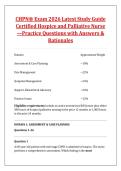
CHPN® Exam 2026 Latest Study Guide
Certified Hospice and Palliative Nurse
—Practice Questions with Answers &
Rationales
Domain Approximate Weight
Assessment & Care Planning ~18%
Pain Management ~22%
Symptom Management ~24%
Support, Education & Advocacy ~24%
Practice Issues ~12%
Eligibility requirements include an active unrestricted RN license plus either
500 hours of hospice/palliative nursing in the prior 12 months or 1,000 hours
in the prior 24 months.
DOMAIN 1: ASSESSMENT & CARE PLANNING
Questions 1–26
Question 1
A 68-year-old patient with end-stage COPD is admitted to hospice. The nurse
performs a comprehensive assessment. Which finding is the most
,important indicator that the patient is approaching the terminal phase of
illness?
A) Increased appetite and weight gain
B) Progressive decline in functional status with increasing dependence
C) Intermittent confusion that resolves with reorientation
D) Oxygen saturation consistently above 92% on room air
Answer: B) Progressive decline in functional status with increasing
dependence
Rationale: In end-stage disease, a progressive decline in functional status—
marked by increasing dependence on others for activities of daily living—is a
key indicator of disease progression and approaching death. Increased
appetite (A) is not typical in the terminal phase; anorexia and cachexia are
more common. Intermittent confusion (C) may occur but is not the most
important prognostic indicator. Stable oxygen saturation above 92% (D)
would not suggest imminent decline in a COPD patient.
Question 2
The interdisciplinary team is developing a care plan for a patient with
advanced heart failure. Which goal should be prioritized as the primary
focus of palliative care?
A) Cure the underlying cardiac condition
B) Prolong life through aggressive interventions
C) Improve quality of life by managing symptoms and addressing goals of care
D) Transfer the patient to a skilled nursing facility
Answer: C) Improve quality of life by managing symptoms and
addressing goals of care
Rationale: The primary goal of palliative care is to improve quality of life
through comprehensive symptom management and alignment of care with
patient goals. Palliative care is not focused on curing the underlying disease
(A) or prolonging life through aggressive means alone (B). Transfer to a
facility (D) may be appropriate but is not the primary goal.
,Question 3
A hospice nurse is conducting an initial assessment of a patient with
metastatic breast cancer. Which component of the spiritual assessment
is most critical to explore during the first visit?
A) The patient's favorite music and hobbies
B) The patient's sources of meaning, hope, and connection
C) The patient's preferred flavor of nutritional supplements
D) The patient's history of hospitalizations
Answer: B) The patient's sources of meaning, hope, and connection
Rationale: Spiritual assessment in hospice and palliative care focuses on
understanding what gives the patient meaning, hope, and connection—which
may include religious faith, relationships, nature, or personal values. Music
and hobbies (A) are part of psychosocial assessment but not the most critical
spiritual component. Nutritional preferences (C) and hospitalization history
(D) are relevant but not spiritual assessment priorities.
Question 4
An 82-year-old patient with dementia is being evaluated for hospice eligibility.
The nurse observes that the patient has developed swallowing difficulties,
recurrent infections, and significant weight loss over the past six months.
Which of the following is the most appropriate action?
A) Recommend placement of a feeding tube to prevent aspiration
B) Initiate hospice referral based on the FAST scale and clinical indicators
C) Discontinue all oral intake to prevent further aspiration
D) Recommend transfer to acute care for nutritional support
Answer: B) Initiate hospice referral based on the FAST scale and clinical
indicators
Rationale: Patients with advanced dementia who exhibit swallowing
difficulties, recurrent infections, and significant weight loss meet clinical
indicators for hospice eligibility. The Functional Assessment Staging (FAST)
scale helps determine disease progression. Feeding tube placement (A) is
generally not recommended in advanced dementia and does not improve
, outcomes. Discontinuing oral intake (C) without appropriate comfort
measures is inappropriate. Transfer to acute care (D) may not align with goals
of comfort care.
Question 5
During a family meeting, the daughter of a dying patient states, "I just can't
accept that Mom is dying. There must be something more we can do." The
nurse's best response is:
A) "You need to accept reality and focus on making your mother comfortable."
B) "I understand this is incredibly difficult. Tell me more about what you're
hoping for."
C) "Your mother has less than a week to live. You should say your goodbyes
now."
D) "Let me call the doctor to discuss more treatment options."
Answer: B) "I understand this is incredibly difficult. Tell me more about
what you're hoping for."
Rationale: This response validates the family member's emotions and opens
a therapeutic dialogue to explore goals and expectations. It demonstrates
empathy while gently exploring the family's understanding. Option A is
dismissive of the daughter's grief. Option C is abrupt and insensitive. Option D
may give false hope and does not address the underlying emotional need.
Question 6
Which assessment tool is most appropriate for evaluating pain in a
nonverbal patient with advanced dementia?
A) Numeric Rating Scale (0–10)
B) Wong-Baker FACES Pain Rating Scale
C) Pain Assessment in Advanced Dementia (PAINAD) scale
D) Visual Analog Scale
Answer: C) Pain Assessment in Advanced Dementia (PAINAD) scale
Certified Hospice and Palliative Nurse
—Practice Questions with Answers &
Rationales
Domain Approximate Weight
Assessment & Care Planning ~18%
Pain Management ~22%
Symptom Management ~24%
Support, Education & Advocacy ~24%
Practice Issues ~12%
Eligibility requirements include an active unrestricted RN license plus either
500 hours of hospice/palliative nursing in the prior 12 months or 1,000 hours
in the prior 24 months.
DOMAIN 1: ASSESSMENT & CARE PLANNING
Questions 1–26
Question 1
A 68-year-old patient with end-stage COPD is admitted to hospice. The nurse
performs a comprehensive assessment. Which finding is the most
,important indicator that the patient is approaching the terminal phase of
illness?
A) Increased appetite and weight gain
B) Progressive decline in functional status with increasing dependence
C) Intermittent confusion that resolves with reorientation
D) Oxygen saturation consistently above 92% on room air
Answer: B) Progressive decline in functional status with increasing
dependence
Rationale: In end-stage disease, a progressive decline in functional status—
marked by increasing dependence on others for activities of daily living—is a
key indicator of disease progression and approaching death. Increased
appetite (A) is not typical in the terminal phase; anorexia and cachexia are
more common. Intermittent confusion (C) may occur but is not the most
important prognostic indicator. Stable oxygen saturation above 92% (D)
would not suggest imminent decline in a COPD patient.
Question 2
The interdisciplinary team is developing a care plan for a patient with
advanced heart failure. Which goal should be prioritized as the primary
focus of palliative care?
A) Cure the underlying cardiac condition
B) Prolong life through aggressive interventions
C) Improve quality of life by managing symptoms and addressing goals of care
D) Transfer the patient to a skilled nursing facility
Answer: C) Improve quality of life by managing symptoms and
addressing goals of care
Rationale: The primary goal of palliative care is to improve quality of life
through comprehensive symptom management and alignment of care with
patient goals. Palliative care is not focused on curing the underlying disease
(A) or prolonging life through aggressive means alone (B). Transfer to a
facility (D) may be appropriate but is not the primary goal.
,Question 3
A hospice nurse is conducting an initial assessment of a patient with
metastatic breast cancer. Which component of the spiritual assessment
is most critical to explore during the first visit?
A) The patient's favorite music and hobbies
B) The patient's sources of meaning, hope, and connection
C) The patient's preferred flavor of nutritional supplements
D) The patient's history of hospitalizations
Answer: B) The patient's sources of meaning, hope, and connection
Rationale: Spiritual assessment in hospice and palliative care focuses on
understanding what gives the patient meaning, hope, and connection—which
may include religious faith, relationships, nature, or personal values. Music
and hobbies (A) are part of psychosocial assessment but not the most critical
spiritual component. Nutritional preferences (C) and hospitalization history
(D) are relevant but not spiritual assessment priorities.
Question 4
An 82-year-old patient with dementia is being evaluated for hospice eligibility.
The nurse observes that the patient has developed swallowing difficulties,
recurrent infections, and significant weight loss over the past six months.
Which of the following is the most appropriate action?
A) Recommend placement of a feeding tube to prevent aspiration
B) Initiate hospice referral based on the FAST scale and clinical indicators
C) Discontinue all oral intake to prevent further aspiration
D) Recommend transfer to acute care for nutritional support
Answer: B) Initiate hospice referral based on the FAST scale and clinical
indicators
Rationale: Patients with advanced dementia who exhibit swallowing
difficulties, recurrent infections, and significant weight loss meet clinical
indicators for hospice eligibility. The Functional Assessment Staging (FAST)
scale helps determine disease progression. Feeding tube placement (A) is
generally not recommended in advanced dementia and does not improve
, outcomes. Discontinuing oral intake (C) without appropriate comfort
measures is inappropriate. Transfer to acute care (D) may not align with goals
of comfort care.
Question 5
During a family meeting, the daughter of a dying patient states, "I just can't
accept that Mom is dying. There must be something more we can do." The
nurse's best response is:
A) "You need to accept reality and focus on making your mother comfortable."
B) "I understand this is incredibly difficult. Tell me more about what you're
hoping for."
C) "Your mother has less than a week to live. You should say your goodbyes
now."
D) "Let me call the doctor to discuss more treatment options."
Answer: B) "I understand this is incredibly difficult. Tell me more about
what you're hoping for."
Rationale: This response validates the family member's emotions and opens
a therapeutic dialogue to explore goals and expectations. It demonstrates
empathy while gently exploring the family's understanding. Option A is
dismissive of the daughter's grief. Option C is abrupt and insensitive. Option D
may give false hope and does not address the underlying emotional need.
Question 6
Which assessment tool is most appropriate for evaluating pain in a
nonverbal patient with advanced dementia?
A) Numeric Rating Scale (0–10)
B) Wong-Baker FACES Pain Rating Scale
C) Pain Assessment in Advanced Dementia (PAINAD) scale
D) Visual Analog Scale
Answer: C) Pain Assessment in Advanced Dementia (PAINAD) scale


