
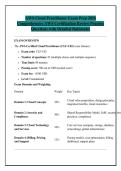
AWS Cloud Practitioner Exam Prep 2026
Comprehensive AWS Certification Review Practice
Questions with Detailed Rationales
EXAM OVERVIEW
The AWS Certified Cloud Practitioner (CLF-C02) exam features:
• Exam code: CLF-C02
• Number of questions: 65 (multiple-choice and multiple-response)
• Time limit: 90 minutes
• Passing score: 700 out of 1000 (scaled score)
• Exam fee: ~$100 USD
• Level: Foundational
Exam Domains and Weighting
Domain Weight Key Topics
Cloud value proposition, design principles,
Domain 1: Cloud Concepts 24%
migration benefits, cloud economics
Domain 2: Security and Shared Responsibility Model, IAM, security best
30%
Compliance practices, compliance
Domain 3: Cloud Technology Core services (compute, storage, database,
34%
and Services networking), global infrastructure
Domain 4: Billing, Pricing, Pricing models, cost optimization, billing
12%
and Support dashboard, support plans
,DOMAIN 1: CLOUD CONCEPTS (24%) — Questions 1-24
Question 1
A company is considering migrating its on-premises data center to the AWS
Cloud. The CFO wants to understand how cloud computing changes the company's
cost structure. Which of the following best describes the primary economic benefit
of cloud computing?
A) Cloud computing requires significant upfront capital investment for hardware
B) Cloud computing allows companies to trade capital expense (CapEx) for
variable expense (OpEx)
C) Cloud computing eliminates all IT costs
D) Cloud computing requires long-term contracts for all services
Answer: B
Rationale: One of the fundamental value propositions of cloud computing is the
ability to trade capital expense (CapEx) for variable expense (OpEx). Instead of
making large upfront investments in hardware and data centers, companies pay
only for the resources they consume. This shift from CapEx to OpEx improves
cash flow and reduces financial risk. Option A is incorrect because cloud
computing reduces upfront capital investment. Option C is incorrect because IT
costs still exist but are operational rather than capital. Option D is incorrect
because AWS offers pay-as-you-go pricing without long-term commitments for
most services.
Question 2
A company is experiencing rapid growth and needs to scale its infrastructure to
handle unpredictable traffic spikes. Which cloud computing benefit directly
addresses this need?
A) Economies of scale
B) Stop guessing capacity
C) Go global in minutes
D) Increase speed and agility
Answer: B
,Rationale: The ability to "stop guessing capacity" is a key benefit of cloud
computing. With on-premises infrastructure, companies often over-provision to
handle peak demand or under-provision and risk capacity issues. In the cloud,
companies can scale resources up or down based on actual demand, eliminating the
need to guess capacity requirements. Economies of scale refer to cost advantages
from aggregated usage. Going global in minutes refers to geographic expansion.
Speed and agility refer to rapid deployment capabilities.
Question 3
A startup wants to launch a new application globally with minimal latency for
users in different regions. Which AWS Cloud benefit enables this capability?
A) Massive economies of scale
B) Go global in minutes
C) Stop spending money on running data centers
D) Trade capital expense for variable expense
Answer: B
Rationale: The AWS Cloud enables companies to "go global in minutes" by
deploying applications in multiple AWS Regions around the world. This allows
startups and enterprises to serve customers globally with low latency without
building their own data centers in each location. Economies of scale refer to cost
advantages, stopping data center spending refers to operational cost savings, and
trading CapEx for OpEx refers to financial benefits.
Question 4
A company is considering cloud adoption and learns that AWS has aggregated
purchasing power that allows them to offer lower prices than individual companies
could achieve on their own. This is an example of which cloud benefit?
A) Economies of scale
B) Increased speed and agility
C) Stop guessing capacity
D) Go global in minutes
Answer: A
, Rationale: Economies of scale refer to the cost advantages that AWS achieves
through massive aggregate usage across all customers. AWS's scale allows them to
negotiate better prices for hardware, optimize data center operations, and pass
these savings on to customers. Individual companies could not achieve these same
cost efficiencies on their own.
Question 5
According to the AWS Well-Architected Framework, which pillar focuses on the
ability of a system to recover from infrastructure or service disruptions and
dynamically acquire computing resources to meet demand?
A) Security
B) Performance Efficiency
C) Reliability
D) Cost Optimization
Answer: C
Rationale: The Reliability pillar of the AWS Well-Architected Framework focuses
on a system's ability to recover from failures and dynamically scale to meet
demand. It includes design principles such as testing recovery procedures,
automatically recovering from failure, and scaling horizontally to increase
aggregate system availability. Security focuses on protecting data and systems,
Performance Efficiency focuses on using resources efficiently, and Cost
Optimization focuses on avoiding unnecessary costs.
Question 6
Which of the following is a design principle of the AWS Cloud?
A) Manual capacity planning for all workloads
B) Invest in large data centers before knowing workload requirements
C) Design for failure and assume nothing will fail
D) Use monolithic architectures for all applications
Answer: C
Rationale: "Design for failure" is a key design principle of the AWS Cloud.
Instead of assuming infrastructure is reliable, cloud architects design systems that
Comprehensive AWS Certification Review Practice
Questions with Detailed Rationales
EXAM OVERVIEW
The AWS Certified Cloud Practitioner (CLF-C02) exam features:
• Exam code: CLF-C02
• Number of questions: 65 (multiple-choice and multiple-response)
• Time limit: 90 minutes
• Passing score: 700 out of 1000 (scaled score)
• Exam fee: ~$100 USD
• Level: Foundational
Exam Domains and Weighting
Domain Weight Key Topics
Cloud value proposition, design principles,
Domain 1: Cloud Concepts 24%
migration benefits, cloud economics
Domain 2: Security and Shared Responsibility Model, IAM, security best
30%
Compliance practices, compliance
Domain 3: Cloud Technology Core services (compute, storage, database,
34%
and Services networking), global infrastructure
Domain 4: Billing, Pricing, Pricing models, cost optimization, billing
12%
and Support dashboard, support plans
,DOMAIN 1: CLOUD CONCEPTS (24%) — Questions 1-24
Question 1
A company is considering migrating its on-premises data center to the AWS
Cloud. The CFO wants to understand how cloud computing changes the company's
cost structure. Which of the following best describes the primary economic benefit
of cloud computing?
A) Cloud computing requires significant upfront capital investment for hardware
B) Cloud computing allows companies to trade capital expense (CapEx) for
variable expense (OpEx)
C) Cloud computing eliminates all IT costs
D) Cloud computing requires long-term contracts for all services
Answer: B
Rationale: One of the fundamental value propositions of cloud computing is the
ability to trade capital expense (CapEx) for variable expense (OpEx). Instead of
making large upfront investments in hardware and data centers, companies pay
only for the resources they consume. This shift from CapEx to OpEx improves
cash flow and reduces financial risk. Option A is incorrect because cloud
computing reduces upfront capital investment. Option C is incorrect because IT
costs still exist but are operational rather than capital. Option D is incorrect
because AWS offers pay-as-you-go pricing without long-term commitments for
most services.
Question 2
A company is experiencing rapid growth and needs to scale its infrastructure to
handle unpredictable traffic spikes. Which cloud computing benefit directly
addresses this need?
A) Economies of scale
B) Stop guessing capacity
C) Go global in minutes
D) Increase speed and agility
Answer: B
,Rationale: The ability to "stop guessing capacity" is a key benefit of cloud
computing. With on-premises infrastructure, companies often over-provision to
handle peak demand or under-provision and risk capacity issues. In the cloud,
companies can scale resources up or down based on actual demand, eliminating the
need to guess capacity requirements. Economies of scale refer to cost advantages
from aggregated usage. Going global in minutes refers to geographic expansion.
Speed and agility refer to rapid deployment capabilities.
Question 3
A startup wants to launch a new application globally with minimal latency for
users in different regions. Which AWS Cloud benefit enables this capability?
A) Massive economies of scale
B) Go global in minutes
C) Stop spending money on running data centers
D) Trade capital expense for variable expense
Answer: B
Rationale: The AWS Cloud enables companies to "go global in minutes" by
deploying applications in multiple AWS Regions around the world. This allows
startups and enterprises to serve customers globally with low latency without
building their own data centers in each location. Economies of scale refer to cost
advantages, stopping data center spending refers to operational cost savings, and
trading CapEx for OpEx refers to financial benefits.
Question 4
A company is considering cloud adoption and learns that AWS has aggregated
purchasing power that allows them to offer lower prices than individual companies
could achieve on their own. This is an example of which cloud benefit?
A) Economies of scale
B) Increased speed and agility
C) Stop guessing capacity
D) Go global in minutes
Answer: A
, Rationale: Economies of scale refer to the cost advantages that AWS achieves
through massive aggregate usage across all customers. AWS's scale allows them to
negotiate better prices for hardware, optimize data center operations, and pass
these savings on to customers. Individual companies could not achieve these same
cost efficiencies on their own.
Question 5
According to the AWS Well-Architected Framework, which pillar focuses on the
ability of a system to recover from infrastructure or service disruptions and
dynamically acquire computing resources to meet demand?
A) Security
B) Performance Efficiency
C) Reliability
D) Cost Optimization
Answer: C
Rationale: The Reliability pillar of the AWS Well-Architected Framework focuses
on a system's ability to recover from failures and dynamically scale to meet
demand. It includes design principles such as testing recovery procedures,
automatically recovering from failure, and scaling horizontally to increase
aggregate system availability. Security focuses on protecting data and systems,
Performance Efficiency focuses on using resources efficiently, and Cost
Optimization focuses on avoiding unnecessary costs.
Question 6
Which of the following is a design principle of the AWS Cloud?
A) Manual capacity planning for all workloads
B) Invest in large data centers before knowing workload requirements
C) Design for failure and assume nothing will fail
D) Use monolithic architectures for all applications
Answer: C
Rationale: "Design for failure" is a key design principle of the AWS Cloud.
Instead of assuming infrastructure is reliable, cloud architects design systems that


