
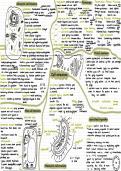
Eukaryotic cell structure
magnification - number of times greater an
Microscopy Transmission Electron Microscope
image is compared to the real object very thin object ·black white racu-
.
-globular protein - um
...
⑧
1
cytoskeleton microtubules movementof organelles
resolution -
ability
to distinguish between organelles ·stream of electrons dead objects
~
- -
crystal violet t
↳
ge
60%.? through
size
two - image
microfilaments points sample expensive, large
-> cytokinesis
⑧ t
12 - -
made of actin I
methylene blue
actual
A M-magnification
⑧
O
↑ ~
:·.. Se
-
-cel movement outside cells-nigrosin 2D
image hard to
0
size
centriole + contraction use
.. i
~
!
2 -
E stain? d Scanning Electron Microscope
de
⑳ why do contrast and
congo red
⑧
used in cell division
10 -
O
· we
5
15,000,000 3D
.. 9
· dead
110 -
⑧
#I
made of microtubules
-
between different parts absorb plants iodine image ·blackt white
-i
- - ·
1
- objects
o8
· 2
res.
·· M different amounts of stain viewed in
surface
only
-come
2 centriole centrosome
·
vacuum
"
· .
-
1000
x
high
⑧
~
3 cell
surface membrane bilayer dry mount no liquid-hair/pollen Laser Scanning electrons .
15,000,000 x
W
res.
-
-
I ...
partially permeable
x1000 wet mount-water, oil/stain used Confocal reflected back expensive
·
large
.. ·
holds interior
together place gently air bubbles ·
laser beam to
Light microscope
x 1000
squash slide between slide t illuminate stains colour limited mag-tresolution
↑Cytoplasm-gel-like substance
8
-
4 1000
-
· ↓
↳M cover slip-soft tissue root ends living cells 2D
organelles held together/suspended eg.
·
to
⑧
·
" up
track molecules
objects affordable
.
Smear slides slide blood ·alive 2000x
I
where chemical reactions take smear across -
place
-
secretary high res.
·
vesicles: ·i ⑧ 5
endoplasmic reticulum
smooth
differential stainingtypes
staining for
of cells
expensive +
~ ⑪ gram
-
↑
complex
·makest packages lipids + carbohydrates bacteria
Protein synthesis
-
-
st
8 ↑
I·......
W
golgi ·made
of flattened membrane discs 888
I
mitochondria respiration, makes ATP proteins synthesised ribosome
at RER
·go
apparatus 6 aerobic on
soffgin
- -
2 proteins pass into cisternal of RER and packaged
·modifies, packages labels matrix, outer tinner membranes, cristal ⑧
.
·
-see
double
sends to other intermembrane 2 into vesicles
proteins,
mem.
space
+
To matrix
organelles
-
I 3 vesicles towards golgi via cytoskeleton
·collection of fusedcisternae 7 nuclear envelope -
double membrane with
·
move
cisttrans networks nuclear pores
4
vesicles fuse with cis (half) surface
golgi control molecules int out
·
Cell structure
-
9
nucleus-contains DNA surrounded
by histone proteins forms -
of the golgi apparatus
and
10
nucleolus - makes ribosomal DNA,
largercircular chromosomes proteins enter are modified before
golgi vesicles via the trans
"bosomes, help synthesise proteins assemble them leaving in face of
the
-
some bound to 10 20 material
golgi
some gree in
no nucleus-genetic free
-
cytoplasm organelles
Brough endoplasmic reticulum-flattened membrane discs num in gloating sometimes in
- the form of vesicles
5 move to plasma membrane in
cisternae ribosomes size a plasmid order to release the proteins to where
containing
-
on
surface
-
produces
proteins lysosomes vesicle containing -
type
different of ribosomes -
made
they are needed
"vesicles-bubbles of membrane of proteins RNA
hydrolytic enzymes to break
+
bonds smaller TOS
energy -
from enzymes antibodies storage
capsule -
around the cell chemiosmosis proteins
I
↳ occurs in
Structural
cellulose cell wall-fully permeable
·
defence againsthost cells
cell proteins
supports cell + cells aroundit Plant cell structure cell wall-made
of peptidoglycan/ membrane
·
contents push againstit murein
plant cells only & I
·prevents bursting
~pili
-
collapsing Specialised organelles
or
·cellulose cell wall capsule
-
-
~
permanent vacuole
2
cell
⑯
permanentvacuole membrane surface
·
Lonoplast flagella
-
used to the
chloroplasts I - move cell
-
bound that stores
&
- membrane
⑧
sac cell ↳
10 used
sensory organelle detectchemical to
↑
-> cell as a
-
I -
chromosomal
sap O SER 8 free
-
100 wall the cell's environment
& changes in
mi DNA
~
·membrane
-
called the
Es ·whip-like extensions
en
s protuce
that
0
in size from the
0
cell
o
·
12 ER -
&
tonoplast
8
·O
cilia-
o
&
2
..↳
chloroplasts
flagellum
3
nucleus
· ·stationary
-
t nucleolus -
sensing - in nose
·foundin areas above ground
⑧
& ->
↓ mobile -
move mucus in respiratory system
double membrane -
③ only in
·
some
ribosomes, each cilium contains two central
·
·
stroma-fluid in centre &
⑤
microtubules and a wheel of microtubules
thylaboids membranes of
I S
·
-
⑧ 9 +2
arrangement
slattened mitochondria-
in a
0.1-10am
sacs 00
microtubules so
pairs of parralel 00
grana-stacked thy la hoids in size
D
slide each other ⑧
as
over 00
↳ contain photosynthetic enzymes
Like -
⑤
an
Prokaryotic cell structure causing the cilia move
to 8
chlorophyll golgi motion o
apparatus
in a
beating
magnification - number of times greater an
Microscopy Transmission Electron Microscope
image is compared to the real object very thin object ·black white racu-
.
-globular protein - um
...
⑧
1
cytoskeleton microtubules movementof organelles
resolution -
ability
to distinguish between organelles ·stream of electrons dead objects
~
- -
crystal violet t
↳
ge
60%.? through
size
two - image
microfilaments points sample expensive, large
-> cytokinesis
⑧ t
12 - -
made of actin I
methylene blue
actual
A M-magnification
⑧
O
↑ ~
:·.. Se
-
-cel movement outside cells-nigrosin 2D
image hard to
0
size
centriole + contraction use
.. i
~
!
2 -
E stain? d Scanning Electron Microscope
de
⑳ why do contrast and
congo red
⑧
used in cell division
10 -
O
· we
5
15,000,000 3D
.. 9
· dead
110 -
⑧
#I
made of microtubules
-
between different parts absorb plants iodine image ·blackt white
-i
- - ·
1
- objects
o8
· 2
res.
·· M different amounts of stain viewed in
surface
only
-come
2 centriole centrosome
·
vacuum
"
· .
-
1000
x
high
⑧
~
3 cell
surface membrane bilayer dry mount no liquid-hair/pollen Laser Scanning electrons .
15,000,000 x
W
res.
-
-
I ...
partially permeable
x1000 wet mount-water, oil/stain used Confocal reflected back expensive
·
large
.. ·
holds interior
together place gently air bubbles ·
laser beam to
Light microscope
x 1000
squash slide between slide t illuminate stains colour limited mag-tresolution
↑Cytoplasm-gel-like substance
8
-
4 1000
-
· ↓
↳M cover slip-soft tissue root ends living cells 2D
organelles held together/suspended eg.
·
to
⑧
·
" up
track molecules
objects affordable
.
Smear slides slide blood ·alive 2000x
I
where chemical reactions take smear across -
place
-
secretary high res.
·
vesicles: ·i ⑧ 5
endoplasmic reticulum
smooth
differential stainingtypes
staining for
of cells
expensive +
~ ⑪ gram
-
↑
complex
·makest packages lipids + carbohydrates bacteria
Protein synthesis
-
-
st
8 ↑
I·......
W
golgi ·made
of flattened membrane discs 888
I
mitochondria respiration, makes ATP proteins synthesised ribosome
at RER
·go
apparatus 6 aerobic on
soffgin
- -
2 proteins pass into cisternal of RER and packaged
·modifies, packages labels matrix, outer tinner membranes, cristal ⑧
.
·
-see
double
sends to other intermembrane 2 into vesicles
proteins,
mem.
space
+
To matrix
organelles
-
I 3 vesicles towards golgi via cytoskeleton
·collection of fusedcisternae 7 nuclear envelope -
double membrane with
·
move
cisttrans networks nuclear pores
4
vesicles fuse with cis (half) surface
golgi control molecules int out
·
Cell structure
-
9
nucleus-contains DNA surrounded
by histone proteins forms -
of the golgi apparatus
and
10
nucleolus - makes ribosomal DNA,
largercircular chromosomes proteins enter are modified before
golgi vesicles via the trans
"bosomes, help synthesise proteins assemble them leaving in face of
the
-
some bound to 10 20 material
golgi
some gree in
no nucleus-genetic free
-
cytoplasm organelles
Brough endoplasmic reticulum-flattened membrane discs num in gloating sometimes in
- the form of vesicles
5 move to plasma membrane in
cisternae ribosomes size a plasmid order to release the proteins to where
containing
-
on
surface
-
produces
proteins lysosomes vesicle containing -
type
different of ribosomes -
made
they are needed
"vesicles-bubbles of membrane of proteins RNA
hydrolytic enzymes to break
+
bonds smaller TOS
energy -
from enzymes antibodies storage
capsule -
around the cell chemiosmosis proteins
I
↳ occurs in
Structural
cellulose cell wall-fully permeable
·
defence againsthost cells
cell proteins
supports cell + cells aroundit Plant cell structure cell wall-made
of peptidoglycan/ membrane
·
contents push againstit murein
plant cells only & I
·prevents bursting
~pili
-
collapsing Specialised organelles
or
·cellulose cell wall capsule
-
-
~
permanent vacuole
2
cell
⑯
permanentvacuole membrane surface
·
Lonoplast flagella
-
used to the
chloroplasts I - move cell
-
bound that stores
&
- membrane
⑧
sac cell ↳
10 used
sensory organelle detectchemical to
↑
-> cell as a
-
I -
chromosomal
sap O SER 8 free
-
100 wall the cell's environment
& changes in
mi DNA
~
·membrane
-
called the
Es ·whip-like extensions
en
s protuce
that
0
in size from the
0
cell
o
·
12 ER -
&
tonoplast
8
·O
cilia-
o
&
2
..↳
chloroplasts
flagellum
3
nucleus
· ·stationary
-
t nucleolus -
sensing - in nose
·foundin areas above ground
⑧
& ->
↓ mobile -
move mucus in respiratory system
double membrane -
③ only in
·
some
ribosomes, each cilium contains two central
·
·
stroma-fluid in centre &
⑤
microtubules and a wheel of microtubules
thylaboids membranes of
I S
·
-
⑧ 9 +2
arrangement
slattened mitochondria-
in a
0.1-10am
sacs 00
microtubules so
pairs of parralel 00
grana-stacked thy la hoids in size
D
slide each other ⑧
as
over 00
↳ contain photosynthetic enzymes
Like -
⑤
an
Prokaryotic cell structure causing the cilia move
to 8
chlorophyll golgi motion o
apparatus
in a
beating


