

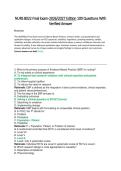
NURS 8022 Final Exam-2026/2027 Edition 100 Questions With
Verified Answer
Overview
This NURS8022 Final Exam covers Evidence-Based Practice, research ethics, and quantitative and
qualitative designs. It focuses on PICO questions, variables, hypothesis, sampling methods, validity,
reliability, and data collection. Key areas include statistical analysis, p-values, confidence intervals, and
threats to validity. It also addresses qualitative rigor, literature reviews, and research dissemination to
prepare advanced nurses to critique evidence and apply findings to improve patient care outcomes.
Correct answers are bold Green.
1. What is the primary purpose of Evidence-Based Practice (EBP) in nursing?
A. To rely solely on clinical experience
B. To integrate best research evidence with clinical expertise and patient
preferences
C. To follow hospital tradition
D. To reduce the need for research
Rationale: EBP is defined as the integration of best current evidence, clinical expertise,
and patient values/preferences.
2. The first step of the EBP process is:
A. Evaluating outcomes
B. Asking a clinical question in PICO(T) format
C. Searching for evidence
D. Implementing change
Rationale: EBP begins with formulating an answerable clinical question.
3. In PICO, the 'P' stands for:
A. Problem
B. Procedure
C. Population / Patient
D. Prediction
Rationale: P = Population, Patient, or Problem of interest.
4. A randomized controlled trial (RCT) is considered which level of evidence?
A. Level VII
B. Level V
C. Level II
D. Level I only if systematic review
Rationale: Individual RCTs are Level II; systematic review of RCTs is Level I.
5. Which research design is most appropriate for causality?
A. Descriptive correlational
B. Phenomenology
, C. Experimental
D. Cross-sectional
Rationale: Experimental designs with randomization and manipulation are strongest for
causality.
6. Informed consent must include all EXCEPT:
A. Guarantee of positive outcomes
B. Risks and benefits
C. Right to withdraw
D. Purpose of study
Rationale: Researchers cannot guarantee outcomes; consent must cover risks,
benefits, purpose, and voluntary withdrawal.
7. The Belmont Report principle of Justice refers to:
A. Fair distribution of benefits and burdens of research
B. Doing no harm
C. Informed consent
D. Maintaining confidentiality
Rationale: Justice = fair selection and treatment of subjects.
8. What is a null hypothesis?
A. There is a relationship between variables
B. The study will prove the theory
C. There is no relationship between variables
D. The intervention is effective
Rationale: Null hypothesis (H0) states no relationship or no difference.
9. A Type I error occurs when:
A. Researcher fails to reject a false null
B. Researcher rejects a true null hypothesis
C. Sample is too small
D. Data is not normally distributed
Rationale: Type I = false positive, rejecting a true null.
10. Which sampling method is considered probability sampling?
A. Simple random sampling
B. Convenience sampling
C. Purposive sampling
D. Snowball sampling
Rationale: Simple random gives every member equal chance, it's probability sampling.
11. The extent to which an instrument measures what it claims to measure is:
A. Reliability
B. Generalizability
C. Objectivity
D. Validity
Rationale: Validity = accuracy of measurement; reliability = consistency.
12. Cronbach's alpha measures:
A. Inter-rater reliability
B. Content validity
C. Internal consistency reliability
Verified Answer
Overview
This NURS8022 Final Exam covers Evidence-Based Practice, research ethics, and quantitative and
qualitative designs. It focuses on PICO questions, variables, hypothesis, sampling methods, validity,
reliability, and data collection. Key areas include statistical analysis, p-values, confidence intervals, and
threats to validity. It also addresses qualitative rigor, literature reviews, and research dissemination to
prepare advanced nurses to critique evidence and apply findings to improve patient care outcomes.
Correct answers are bold Green.
1. What is the primary purpose of Evidence-Based Practice (EBP) in nursing?
A. To rely solely on clinical experience
B. To integrate best research evidence with clinical expertise and patient
preferences
C. To follow hospital tradition
D. To reduce the need for research
Rationale: EBP is defined as the integration of best current evidence, clinical expertise,
and patient values/preferences.
2. The first step of the EBP process is:
A. Evaluating outcomes
B. Asking a clinical question in PICO(T) format
C. Searching for evidence
D. Implementing change
Rationale: EBP begins with formulating an answerable clinical question.
3. In PICO, the 'P' stands for:
A. Problem
B. Procedure
C. Population / Patient
D. Prediction
Rationale: P = Population, Patient, or Problem of interest.
4. A randomized controlled trial (RCT) is considered which level of evidence?
A. Level VII
B. Level V
C. Level II
D. Level I only if systematic review
Rationale: Individual RCTs are Level II; systematic review of RCTs is Level I.
5. Which research design is most appropriate for causality?
A. Descriptive correlational
B. Phenomenology
, C. Experimental
D. Cross-sectional
Rationale: Experimental designs with randomization and manipulation are strongest for
causality.
6. Informed consent must include all EXCEPT:
A. Guarantee of positive outcomes
B. Risks and benefits
C. Right to withdraw
D. Purpose of study
Rationale: Researchers cannot guarantee outcomes; consent must cover risks,
benefits, purpose, and voluntary withdrawal.
7. The Belmont Report principle of Justice refers to:
A. Fair distribution of benefits and burdens of research
B. Doing no harm
C. Informed consent
D. Maintaining confidentiality
Rationale: Justice = fair selection and treatment of subjects.
8. What is a null hypothesis?
A. There is a relationship between variables
B. The study will prove the theory
C. There is no relationship between variables
D. The intervention is effective
Rationale: Null hypothesis (H0) states no relationship or no difference.
9. A Type I error occurs when:
A. Researcher fails to reject a false null
B. Researcher rejects a true null hypothesis
C. Sample is too small
D. Data is not normally distributed
Rationale: Type I = false positive, rejecting a true null.
10. Which sampling method is considered probability sampling?
A. Simple random sampling
B. Convenience sampling
C. Purposive sampling
D. Snowball sampling
Rationale: Simple random gives every member equal chance, it's probability sampling.
11. The extent to which an instrument measures what it claims to measure is:
A. Reliability
B. Generalizability
C. Objectivity
D. Validity
Rationale: Validity = accuracy of measurement; reliability = consistency.
12. Cronbach's alpha measures:
A. Inter-rater reliability
B. Content validity
C. Internal consistency reliability


