

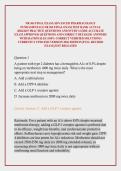
NR 565 FINAL EXAM /ADVANCED PHARMACOLOGY
FUNDAMENTALS NR 565 FINAL EXAM TEST BANK ACTUAL
2026/2027 PRACTICE QUESTIONS AND STUDY GUIDE ACCURATE
EXAM APPROVED QUESTIONS AND CORRECT DETAILED ANSWERS
WITH RATIONALES (100% CORRECT VERIFIED SOLUTIONS)
CURRENTLY UPDATED VERSION 2026 EDITION |FULL REVISED
EXAM |JUST RELEASED
Question 1
A patient with type 2 diabetes has a hemoglobin A1c of 8.5% despite
being on metformin 1000 mg twice daily. What is the most
appropriate next step in management?
A. Add a sulfonylurea
B. Add a DPP-4 inhibitor
C. Add a GLP-1 receptor agonist
D. Increase metformin to 2000 mg twice daily
Correct Answer: C. Add a GLP-1 receptor agonist
Rationale: For a patient with an A1c above 8.0% despite maximal
metformin therapy, adding a GLP-1 receptor agonist is preferred due
to its efficacy, weight loss benefits, and cardiovascular protective
effects. Sulfonylureas carry hypoglycemia risk and weight gain. DPP-
4 inhibitors are less potent for A1c reduction. Metformin should not
exceed 2500-2550 mg daily (or 2000 mg extended-release), so
increasing above 1000 mg twice daily is not appropriate without
confirming renal function and tolerability.
,Question 2
Which organ is the primary site for drug metabolism?
A. Kidneys
B. Liver
C. Lungs
D. Spleen
Correct Answer: B. Liver
Rationale: The liver contains the cytochrome P450 enzyme
system, which is essential for drug metabolism through Phase I
and Phase II reactions. The kidneys are the main organs for drug
excretion, not metabolism. The lungs excrete volatile gases but are
not the primary site of metabolism. The spleen filters blood and
recycles red blood cells but does not metabolize drugs.
Question 3
What does the term "bioavailability" refer to in pharmacokinetics?
A. The amount of drug excreted in the urine
B. The percentage of an administered dose of unchanged drug that
reaches the systemic circulation
C. The half-life of the drug in the body
D. The volume of fluid into which the drug distributes
,Correct Answer: B. The percentage of an administered dose of
unchanged drug that reaches the systemic circulation
Rationale: Bioavailability measures the extent and rate at which
the active drug enters systemic circulation, thereby reaching the
site of action. Renal clearance refers to the amount of drug
excreted in urine. Half-life is the time required for drug
concentration to decrease by half. Volume of distribution describes
the fluid volume into which the drug distributes.
Question 4
A drug that binds to a receptor and produces a biological response is
called a(n):
A. Antagonist
B. Agonist
C. Partial agonist
D. Inverse agonist
Correct Answer: B. Agonist
Rationale: An agonist binds to a receptor and activates it to
produce a biological response. An antagonist binds to a receptor
but blocks or inhibits a biological response. A partial agonist
produces a weaker response than a full agonist. An inverse agonist
produces an effect opposite to that of an agonist.
, Question 5
Untreated maternal hypothyroidism in early pregnancy most
increases the risk of which fetal problem?
A. Cleft palate
B. Reduced cognitive development
C. Limb deformities
D. Congenital heart block
Correct Answer: B. Reduced cognitive development
Rationale: Inadequate maternal thyroid hormone during early
gestation can impair fetal brain development, which may result in
lower IQ and other neurodevelopmental deficits even if treated
later. Cleft palate, limb deformities, and congenital heart block
are not the primary risks associated with untreated maternal
hypothyroidism.
Question 6
A 44-year-old with newly diagnosed Graves' disease is started on
methimazole. She reports severe palpitations and tremor while
awaiting hormone levels to fall. Which medication best controls
these symptoms?
A. Lisinopril
B. Propranolol
C. Verapamil
D. Digoxin
FUNDAMENTALS NR 565 FINAL EXAM TEST BANK ACTUAL
2026/2027 PRACTICE QUESTIONS AND STUDY GUIDE ACCURATE
EXAM APPROVED QUESTIONS AND CORRECT DETAILED ANSWERS
WITH RATIONALES (100% CORRECT VERIFIED SOLUTIONS)
CURRENTLY UPDATED VERSION 2026 EDITION |FULL REVISED
EXAM |JUST RELEASED
Question 1
A patient with type 2 diabetes has a hemoglobin A1c of 8.5% despite
being on metformin 1000 mg twice daily. What is the most
appropriate next step in management?
A. Add a sulfonylurea
B. Add a DPP-4 inhibitor
C. Add a GLP-1 receptor agonist
D. Increase metformin to 2000 mg twice daily
Correct Answer: C. Add a GLP-1 receptor agonist
Rationale: For a patient with an A1c above 8.0% despite maximal
metformin therapy, adding a GLP-1 receptor agonist is preferred due
to its efficacy, weight loss benefits, and cardiovascular protective
effects. Sulfonylureas carry hypoglycemia risk and weight gain. DPP-
4 inhibitors are less potent for A1c reduction. Metformin should not
exceed 2500-2550 mg daily (or 2000 mg extended-release), so
increasing above 1000 mg twice daily is not appropriate without
confirming renal function and tolerability.
,Question 2
Which organ is the primary site for drug metabolism?
A. Kidneys
B. Liver
C. Lungs
D. Spleen
Correct Answer: B. Liver
Rationale: The liver contains the cytochrome P450 enzyme
system, which is essential for drug metabolism through Phase I
and Phase II reactions. The kidneys are the main organs for drug
excretion, not metabolism. The lungs excrete volatile gases but are
not the primary site of metabolism. The spleen filters blood and
recycles red blood cells but does not metabolize drugs.
Question 3
What does the term "bioavailability" refer to in pharmacokinetics?
A. The amount of drug excreted in the urine
B. The percentage of an administered dose of unchanged drug that
reaches the systemic circulation
C. The half-life of the drug in the body
D. The volume of fluid into which the drug distributes
,Correct Answer: B. The percentage of an administered dose of
unchanged drug that reaches the systemic circulation
Rationale: Bioavailability measures the extent and rate at which
the active drug enters systemic circulation, thereby reaching the
site of action. Renal clearance refers to the amount of drug
excreted in urine. Half-life is the time required for drug
concentration to decrease by half. Volume of distribution describes
the fluid volume into which the drug distributes.
Question 4
A drug that binds to a receptor and produces a biological response is
called a(n):
A. Antagonist
B. Agonist
C. Partial agonist
D. Inverse agonist
Correct Answer: B. Agonist
Rationale: An agonist binds to a receptor and activates it to
produce a biological response. An antagonist binds to a receptor
but blocks or inhibits a biological response. A partial agonist
produces a weaker response than a full agonist. An inverse agonist
produces an effect opposite to that of an agonist.
, Question 5
Untreated maternal hypothyroidism in early pregnancy most
increases the risk of which fetal problem?
A. Cleft palate
B. Reduced cognitive development
C. Limb deformities
D. Congenital heart block
Correct Answer: B. Reduced cognitive development
Rationale: Inadequate maternal thyroid hormone during early
gestation can impair fetal brain development, which may result in
lower IQ and other neurodevelopmental deficits even if treated
later. Cleft palate, limb deformities, and congenital heart block
are not the primary risks associated with untreated maternal
hypothyroidism.
Question 6
A 44-year-old with newly diagnosed Graves' disease is started on
methimazole. She reports severe palpitations and tremor while
awaiting hormone levels to fall. Which medication best controls
these symptoms?
A. Lisinopril
B. Propranolol
C. Verapamil
D. Digoxin


