

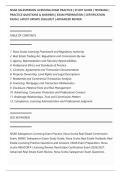
NSAR SALESPERSON LICENSING EXAM PRACTICE | STUDY GUIDE | TESTBANK |
PRACTICE QUESTIONS & ANSWERS | EXAM PREPARATION | CERTIFICATION
EXAM | LATEST UPDATE 2026/2027 | ADVANCED REVIEW
════════════════════════════════════════════════════
═══════════
TABLE OF CONTENTS
════════════════════════════════════════════════════
═══════════
1. Nova Scotia Licensing Framework and Regulatory Authority
2. Real Estate Trading Act, Regulations and Commission By-law
3. Agency, Representation and Fiduciary Responsibilities
4. Professional Ethics and Standards of Practice
5. Contracts, Agreements and Transaction Documentation
6. Property Ownership, Land Rights and Legal Descriptions
7. Residential and Commercial Transaction Analysis
8. Financing, Mortgages and Transaction Mathematics
9. Disclosure, Material Facts and Risk Management
10. Advertising, Consumer Protection and Professional Conduct
11. Brokerage Relationships, Trust and Commission Matters
12. Compliance, Licensing Administration and Professional Judgment
════════════════════════════════════════════════════
═══════════
SEO KEYWORDS
════════════════════════════════════════════════════
═══════════
NSAR Salesperson Licensing Exam Practice, Nova Scotia Real Estate Commission
Exam, NSREC Salesperson Exam Study Guide, Nova Scotia Real Estate Testbank, Real
Estate Licensing Practice Questions and Answers, NSAR Exam Preparation, Nova
Scotia REALTOR® Licensing Review, Real Estate Certification Exam 2026/2027,
Advanced Real Estate Exam Review, Nova Scotia Salesperson Exam Questions.
,════════════════════════════════════════════════════
═══════════
DESCRIPTION
════════════════════════════════════════════════════
═══════════
This advanced study resource is designed to help candidates prepare for the Nova
Scotia salesperson licensing examination by concentrating on the legal, regulatory,
transactional, ethical, and professional concepts a prospective licensee must
understand. The questions emphasize application rather than simple memorization,
including agency relationships, licensing obligations, contracts, disclosure,
professional conduct, advertising, financing, property interests, brokerage
responsibilities, and regulatory compliance. The scenarios are intentionally
challenging and require careful interpretation of facts, competing duties, calculations,
and appropriate professional judgment. The material is an independently generated
study aid and is not an actual NSAR or Nova Scotia Real Estate Commission
examination, nor does it reproduce confidential or proprietary examination questions.
Regulatory details should always be verified against the applicable Nova Scotia
requirements and current course materials.
EXAMINER: ADVANCED STUDY-REFERENCE QUESTION SET
════════════════════════════════════════════════════
═══════════
QUESTION 1.
A prospective applicant has completed the Nova Scotia Salesperson Licensing
Course but has not yet passed the salesperson licensing examination. The applicant
argues that because the course has been completed, they may begin negotiating
purchases for members of the public while waiting to write the examination. Which
conclusion is most appropriate?
A. The applicant may trade in real estate provided the brokerage has agreed to
supervise them.
B. The applicant may trade only if all transactions are reviewed by a broker before
submission.
C. The applicant may perform negotiations if they disclose that they are an
,unlicensed applicant.
D. The applicant must complete the licensing requirements and obtain the
appropriate licence before engaging in activities requiring authorization to trade in
real estate.
🔴 Correct Answer: D. The applicant must complete the licensing requirements
and obtain the appropriate licence before engaging in activities requiring
authorization to trade in real estate.
🔵 Explanation: Completion of an educational course does not itself confer authority
to trade in real estate. Licensing is a regulatory requirement, and supervision or
disclosure does not substitute for the required licence. The distinction between
education and legal authorization to practise is fundamental to compliance.
QUESTION 2.
A salesperson has completed the Salesperson Licensing Course and passes the
licensing examination on the second permitted attempt. Which statement most
accurately reflects the relationship between passing the examination and obtaining
a licence?
A. Passing the examination automatically creates an unrestricted salesperson
licence.
B. Passing the examination satisfies the examination component, but the applicant
must still complete the licensing application and applicable requirements before
becoming licensed.
C. Passing the examination permits the individual to trade independently until a
brokerage is selected.
D. Passing the examination creates a temporary licence valid for twelve months.
🔴 Correct Answer: B. Passing the examination satisfies the examination
component, but the applicant must still complete the licensing application and
applicable requirements before becoming licensed.
🔵 Explanation: The licensing process contains multiple requirements, and
successfully completing the examination does not itself create a licence. The applicant
must proceed through the Commission's licensing process and satisfy the applicable
, application and documentation requirements. A salesperson also operates through
the brokerage with which the licence is associated.
QUESTION 3.
A salesperson receives confidential information from a client that the client would
accept substantially less than the asking price. A cooperating licensee asks whether
the seller is "desperate to sell." The salesperson knows that revealing the
information could materially weaken the client's negotiating position. What is the
most professionally appropriate response?
A. Disclose the information because the cooperating licensee also represents a
consumer in the transaction.
B. Disclose only if the cooperating licensee promises not to repeat it.
C. Protect the confidential information unless disclosure is authorized or otherwise
legally required.
D. Disclose the information because obtaining the highest possible price is not
guaranteed.
🔴 Correct Answer: C. Protect the confidential information unless disclosure is
authorized or otherwise legally required.
🔵 Explanation: Confidential client information cannot ordinarily be disclosed merely
because another licensee requests it or because disclosure might facilitate a
transaction. The salesperson must distinguish information that can properly be shared
from information entrusted to the salesperson within the professional relationship.
Unauthorized disclosure can undermine the client's interests and create regulatory
and civil exposure.
QUESTION 4.
A salesperson discovers that a property being marketed has an unresolved issue
that could materially affect a reasonable purchaser's decision to proceed. The seller
instructs the salesperson not to mention the issue to anyone. What is the strongest
compliance-oriented response?
A. Follow the seller's instruction because the seller owns the property.
B. Disclose the issue only after an offer has been accepted.
C. Remove the property from the market permanently without explaining why.
PRACTICE QUESTIONS & ANSWERS | EXAM PREPARATION | CERTIFICATION
EXAM | LATEST UPDATE 2026/2027 | ADVANCED REVIEW
════════════════════════════════════════════════════
═══════════
TABLE OF CONTENTS
════════════════════════════════════════════════════
═══════════
1. Nova Scotia Licensing Framework and Regulatory Authority
2. Real Estate Trading Act, Regulations and Commission By-law
3. Agency, Representation and Fiduciary Responsibilities
4. Professional Ethics and Standards of Practice
5. Contracts, Agreements and Transaction Documentation
6. Property Ownership, Land Rights and Legal Descriptions
7. Residential and Commercial Transaction Analysis
8. Financing, Mortgages and Transaction Mathematics
9. Disclosure, Material Facts and Risk Management
10. Advertising, Consumer Protection and Professional Conduct
11. Brokerage Relationships, Trust and Commission Matters
12. Compliance, Licensing Administration and Professional Judgment
════════════════════════════════════════════════════
═══════════
SEO KEYWORDS
════════════════════════════════════════════════════
═══════════
NSAR Salesperson Licensing Exam Practice, Nova Scotia Real Estate Commission
Exam, NSREC Salesperson Exam Study Guide, Nova Scotia Real Estate Testbank, Real
Estate Licensing Practice Questions and Answers, NSAR Exam Preparation, Nova
Scotia REALTOR® Licensing Review, Real Estate Certification Exam 2026/2027,
Advanced Real Estate Exam Review, Nova Scotia Salesperson Exam Questions.
,════════════════════════════════════════════════════
═══════════
DESCRIPTION
════════════════════════════════════════════════════
═══════════
This advanced study resource is designed to help candidates prepare for the Nova
Scotia salesperson licensing examination by concentrating on the legal, regulatory,
transactional, ethical, and professional concepts a prospective licensee must
understand. The questions emphasize application rather than simple memorization,
including agency relationships, licensing obligations, contracts, disclosure,
professional conduct, advertising, financing, property interests, brokerage
responsibilities, and regulatory compliance. The scenarios are intentionally
challenging and require careful interpretation of facts, competing duties, calculations,
and appropriate professional judgment. The material is an independently generated
study aid and is not an actual NSAR or Nova Scotia Real Estate Commission
examination, nor does it reproduce confidential or proprietary examination questions.
Regulatory details should always be verified against the applicable Nova Scotia
requirements and current course materials.
EXAMINER: ADVANCED STUDY-REFERENCE QUESTION SET
════════════════════════════════════════════════════
═══════════
QUESTION 1.
A prospective applicant has completed the Nova Scotia Salesperson Licensing
Course but has not yet passed the salesperson licensing examination. The applicant
argues that because the course has been completed, they may begin negotiating
purchases for members of the public while waiting to write the examination. Which
conclusion is most appropriate?
A. The applicant may trade in real estate provided the brokerage has agreed to
supervise them.
B. The applicant may trade only if all transactions are reviewed by a broker before
submission.
C. The applicant may perform negotiations if they disclose that they are an
,unlicensed applicant.
D. The applicant must complete the licensing requirements and obtain the
appropriate licence before engaging in activities requiring authorization to trade in
real estate.
🔴 Correct Answer: D. The applicant must complete the licensing requirements
and obtain the appropriate licence before engaging in activities requiring
authorization to trade in real estate.
🔵 Explanation: Completion of an educational course does not itself confer authority
to trade in real estate. Licensing is a regulatory requirement, and supervision or
disclosure does not substitute for the required licence. The distinction between
education and legal authorization to practise is fundamental to compliance.
QUESTION 2.
A salesperson has completed the Salesperson Licensing Course and passes the
licensing examination on the second permitted attempt. Which statement most
accurately reflects the relationship between passing the examination and obtaining
a licence?
A. Passing the examination automatically creates an unrestricted salesperson
licence.
B. Passing the examination satisfies the examination component, but the applicant
must still complete the licensing application and applicable requirements before
becoming licensed.
C. Passing the examination permits the individual to trade independently until a
brokerage is selected.
D. Passing the examination creates a temporary licence valid for twelve months.
🔴 Correct Answer: B. Passing the examination satisfies the examination
component, but the applicant must still complete the licensing application and
applicable requirements before becoming licensed.
🔵 Explanation: The licensing process contains multiple requirements, and
successfully completing the examination does not itself create a licence. The applicant
must proceed through the Commission's licensing process and satisfy the applicable
, application and documentation requirements. A salesperson also operates through
the brokerage with which the licence is associated.
QUESTION 3.
A salesperson receives confidential information from a client that the client would
accept substantially less than the asking price. A cooperating licensee asks whether
the seller is "desperate to sell." The salesperson knows that revealing the
information could materially weaken the client's negotiating position. What is the
most professionally appropriate response?
A. Disclose the information because the cooperating licensee also represents a
consumer in the transaction.
B. Disclose only if the cooperating licensee promises not to repeat it.
C. Protect the confidential information unless disclosure is authorized or otherwise
legally required.
D. Disclose the information because obtaining the highest possible price is not
guaranteed.
🔴 Correct Answer: C. Protect the confidential information unless disclosure is
authorized or otherwise legally required.
🔵 Explanation: Confidential client information cannot ordinarily be disclosed merely
because another licensee requests it or because disclosure might facilitate a
transaction. The salesperson must distinguish information that can properly be shared
from information entrusted to the salesperson within the professional relationship.
Unauthorized disclosure can undermine the client's interests and create regulatory
and civil exposure.
QUESTION 4.
A salesperson discovers that a property being marketed has an unresolved issue
that could materially affect a reasonable purchaser's decision to proceed. The seller
instructs the salesperson not to mention the issue to anyone. What is the strongest
compliance-oriented response?
A. Follow the seller's instruction because the seller owns the property.
B. Disclose the issue only after an offer has been accepted.
C. Remove the property from the market permanently without explaining why.


