
Chapter
How Forces Affect
6 Motion
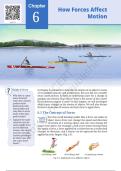
Think It Over In Chapter 4, you learnt to describe the motion of an object in terms
of its position, velocity and acceleration. But you did not consider
y Why does a canoe what causes motion. Is there an underlying cause for a change in
move forward position and velocity of an object? What is the nature of this cause?
when the canoeist Do all motions require a cause? In this chapter, we will investigate
pushes water
what causes changes in the motion of objects. We will also discuss
backwards with
their paddle and
Newton’s three laws of motion and learn how to apply them.
why does it move
faster when they 6.1 The Concept of Force
push harder? You may recall learning earlier that a force can make an
Grade 8
y Suppose the same object move from rest, change the speed and direction
Curiosity
Chapter 5
canoeist uses the of motion of a moving object, and can even change the
same paddle force shape of an object. For example, a ball at rest starts moving when
in two different
you apply a force, a force applied by a cricket bat on a cricket ball
canoes, one empty
and one carrying
changes its direction, and a lemon can be squeezed by the force
another passenger. applied by your fingers (Fig. 6.1).
In which case will
the canoe move
faster?
(a) Kicking a ball (b) Striking a ball (c) Squeezing a lemon
Fig. 6.1: Applying force on different objects
, How Forces Affect Motion 95
While learning about force earlier, did you notice that whenever any
type of force acting on an object was described, its direction was also Grade 6
specified? For example, the phrases used were, force of friction acting on Curiosity
Chapter 4
an object in a direction opposite to the direction of its motion; like poles of
a magnet repelling each other or unlike poles attracting each other due to Grade 8
Curiosity
the magnetic force; like charges repelling or unlike charges attracting each Chapter 5
other due to the electrostatic force; the Earth attracting objects towards
itself due to the gravitational force; buoyant force exerted by liquid in an
upward direction on an object placed in it, and so on. Force is a physical
quantity for which we need to specify direction along with its magnitude
and unit, just like for the physical quantities — position, displacement,
velocity and acceleration of an object which were introduced in Chapter 4.
The SI unit of force is the newton (written with a small ‘n’) and its symbol
is N. The magnitude of the force expresses its strength.
Note
If either the magnitude or direction, or the both, of a force applied on an
object changes, the effect of the force also changes.
6.1.1 Measuring the magnitude of a force
How can we measure the magnitude of a force? Do you remember using
Grade 8
a spring balance earlier to measure the weight of objects (Fig. 6.2)? Do you Curiosity
also remember that the weight of an object is the gravitational force with Chapter 5
which the Earth pulls the object? A spring balance can be used to measure
not just the weight of an object but the magnitude of the force in general.
If you pull on the free end of the spring balance, it measures the force with
which you pull on the spring inside the balance.
Fig. 6.2: Measuring the
weight of an object using a
Threads of Curiosity spring balance
In everyday life, the smallest forces we can directly feel are of the order of
millinewtons (10–3 N), such as a light touch. Scientists, however, can measure
forces far smaller than this, down to yoctonewtons (10–24 N) in specialised Force by hand
experiments (as of 2026).
6.2 Balanced and Unbalanced Forces Force of friction
In real life, situations seldom exist where only one force acts on an object. Fig. 6.3: (a) Pushing a box
Usually, there is more than one force acting on an object. For example, when kept on table or floor
you are pushing a box placed on a surface then, apart from the force with
which you are pushing it, the force of friction is also acting on the box in the Buoyant force
direction opposite to that of the motion (Fig. 6.3a).
Or, take the example of a ball floating on water (Fig. 6.3b). Two forces
are acting upon it — gravitational force by the Earth acting downwards and
buoyant force applied by the liquid acting upwards. In such cases, what is Gravitational
force
the effect of forces when more than one force is acting on an object at rest
or in motion?
Have you ever played a game of tug of war where two teams pull at Fig. 6.3: (b) A ball
a rope in opposite directions? If both the teams pull the rope with equal floating on water
, force, the rope does not move
(Fig. 6.4a). Such two forces, which
are equal in magnitude but opposite
in direction are called balanced
(a) forces. However, if one team pulls
Net force
harder, i.e., it applies a force of
larger magnitude, the forces are
no longer balanced and the rope
moves in the direction of the larger
force (Fig. 6.4b). The rope does not
move if the forces applied on it are
(b) balanced but moves if the forces are
Fig. 6.4: Two forces applied in opposite direction of (a) equal unbalanced.
magnitudes, (b) unequal magnitudes
If the forces applied on an object are not balanced, a non-zero net force
acts on the object. When two forces are opposite in direction but unequal in
magnitude (Fig. 6.4b), the magnitude of net force is equal to the difference
between the magnitudes of two forces and the direction is along the force
Net force of the larger magnitude.
Now, think of a situation where two people are
applying forces in the same direction on a stalled car
to make it move (Fig. 6.5). In this case, the magnitude
of the net force applied by them on the car is the sum
of the magnitudes of two forces. The direction of the
net force is in the same direction as the two individual
Fig. 6.5: Two forces applied in the same direction forces.
Example 6.1: Two forces of 10 N and 6 N are acting on a block lying on the
table as shown in Fig. 6.6. What is the magnitude and the direction of the
net force acting on the block in each case?
10 N
10 N 6N 6N 10 N
6N
(a) (b) (c)
Fig. 6.6: Two forces acting on a block in three different manner
Answer:
(a) Net force = 10 N + 6 N = 16 N, acting towards the right side.
(b) Net force = 10 N – 6 N = 4 N, acting towards the right side.
(c) Net force = 10 N – 6 N = 4 N, acting towards the left side.
Ready to Go Beyond
There are situations in which forces do not act parallel or
opposite to each other but act at an angle to each other. You
will learn in higher grades how to calculate the net force
in such cases. Also, there are situations where equal and
opposite forces are applied to the two ends of an extended
Next object which make the object rotate (Fig. 6.7). For example,
Level
Up applying equal and opposite forces to a handlebar or a tap Fig. 6.7: Equal and opposite
makes it turn. You will also learn about this in higher grades. forces on an extended object
96 Exploration|Grade 9
How Forces Affect
6 Motion
Think It Over In Chapter 4, you learnt to describe the motion of an object in terms
of its position, velocity and acceleration. But you did not consider
y Why does a canoe what causes motion. Is there an underlying cause for a change in
move forward position and velocity of an object? What is the nature of this cause?
when the canoeist Do all motions require a cause? In this chapter, we will investigate
pushes water
what causes changes in the motion of objects. We will also discuss
backwards with
their paddle and
Newton’s three laws of motion and learn how to apply them.
why does it move
faster when they 6.1 The Concept of Force
push harder? You may recall learning earlier that a force can make an
Grade 8
y Suppose the same object move from rest, change the speed and direction
Curiosity
Chapter 5
canoeist uses the of motion of a moving object, and can even change the
same paddle force shape of an object. For example, a ball at rest starts moving when
in two different
you apply a force, a force applied by a cricket bat on a cricket ball
canoes, one empty
and one carrying
changes its direction, and a lemon can be squeezed by the force
another passenger. applied by your fingers (Fig. 6.1).
In which case will
the canoe move
faster?
(a) Kicking a ball (b) Striking a ball (c) Squeezing a lemon
Fig. 6.1: Applying force on different objects
, How Forces Affect Motion 95
While learning about force earlier, did you notice that whenever any
type of force acting on an object was described, its direction was also Grade 6
specified? For example, the phrases used were, force of friction acting on Curiosity
Chapter 4
an object in a direction opposite to the direction of its motion; like poles of
a magnet repelling each other or unlike poles attracting each other due to Grade 8
Curiosity
the magnetic force; like charges repelling or unlike charges attracting each Chapter 5
other due to the electrostatic force; the Earth attracting objects towards
itself due to the gravitational force; buoyant force exerted by liquid in an
upward direction on an object placed in it, and so on. Force is a physical
quantity for which we need to specify direction along with its magnitude
and unit, just like for the physical quantities — position, displacement,
velocity and acceleration of an object which were introduced in Chapter 4.
The SI unit of force is the newton (written with a small ‘n’) and its symbol
is N. The magnitude of the force expresses its strength.
Note
If either the magnitude or direction, or the both, of a force applied on an
object changes, the effect of the force also changes.
6.1.1 Measuring the magnitude of a force
How can we measure the magnitude of a force? Do you remember using
Grade 8
a spring balance earlier to measure the weight of objects (Fig. 6.2)? Do you Curiosity
also remember that the weight of an object is the gravitational force with Chapter 5
which the Earth pulls the object? A spring balance can be used to measure
not just the weight of an object but the magnitude of the force in general.
If you pull on the free end of the spring balance, it measures the force with
which you pull on the spring inside the balance.
Fig. 6.2: Measuring the
weight of an object using a
Threads of Curiosity spring balance
In everyday life, the smallest forces we can directly feel are of the order of
millinewtons (10–3 N), such as a light touch. Scientists, however, can measure
forces far smaller than this, down to yoctonewtons (10–24 N) in specialised Force by hand
experiments (as of 2026).
6.2 Balanced and Unbalanced Forces Force of friction
In real life, situations seldom exist where only one force acts on an object. Fig. 6.3: (a) Pushing a box
Usually, there is more than one force acting on an object. For example, when kept on table or floor
you are pushing a box placed on a surface then, apart from the force with
which you are pushing it, the force of friction is also acting on the box in the Buoyant force
direction opposite to that of the motion (Fig. 6.3a).
Or, take the example of a ball floating on water (Fig. 6.3b). Two forces
are acting upon it — gravitational force by the Earth acting downwards and
buoyant force applied by the liquid acting upwards. In such cases, what is Gravitational
force
the effect of forces when more than one force is acting on an object at rest
or in motion?
Have you ever played a game of tug of war where two teams pull at Fig. 6.3: (b) A ball
a rope in opposite directions? If both the teams pull the rope with equal floating on water
, force, the rope does not move
(Fig. 6.4a). Such two forces, which
are equal in magnitude but opposite
in direction are called balanced
(a) forces. However, if one team pulls
Net force
harder, i.e., it applies a force of
larger magnitude, the forces are
no longer balanced and the rope
moves in the direction of the larger
force (Fig. 6.4b). The rope does not
move if the forces applied on it are
(b) balanced but moves if the forces are
Fig. 6.4: Two forces applied in opposite direction of (a) equal unbalanced.
magnitudes, (b) unequal magnitudes
If the forces applied on an object are not balanced, a non-zero net force
acts on the object. When two forces are opposite in direction but unequal in
magnitude (Fig. 6.4b), the magnitude of net force is equal to the difference
between the magnitudes of two forces and the direction is along the force
Net force of the larger magnitude.
Now, think of a situation where two people are
applying forces in the same direction on a stalled car
to make it move (Fig. 6.5). In this case, the magnitude
of the net force applied by them on the car is the sum
of the magnitudes of two forces. The direction of the
net force is in the same direction as the two individual
Fig. 6.5: Two forces applied in the same direction forces.
Example 6.1: Two forces of 10 N and 6 N are acting on a block lying on the
table as shown in Fig. 6.6. What is the magnitude and the direction of the
net force acting on the block in each case?
10 N
10 N 6N 6N 10 N
6N
(a) (b) (c)
Fig. 6.6: Two forces acting on a block in three different manner
Answer:
(a) Net force = 10 N + 6 N = 16 N, acting towards the right side.
(b) Net force = 10 N – 6 N = 4 N, acting towards the right side.
(c) Net force = 10 N – 6 N = 4 N, acting towards the left side.
Ready to Go Beyond
There are situations in which forces do not act parallel or
opposite to each other but act at an angle to each other. You
will learn in higher grades how to calculate the net force
in such cases. Also, there are situations where equal and
opposite forces are applied to the two ends of an extended
Next object which make the object rotate (Fig. 6.7). For example,
Level
Up applying equal and opposite forces to a handlebar or a tap Fig. 6.7: Equal and opposite
makes it turn. You will also learn about this in higher grades. forces on an extended object
96 Exploration|Grade 9


