

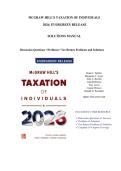
MCGRAW HILL'S TAXATION OF INDIVIDUALS
2026: EVERGREEN RELEASE
SOLUTIONS MANUAL
Discussion Questions • Problems • Tax Return Problems and Solutions
Brian C. Spilker
Benjamin C. Ayers
John A. Barrick
John Robinson
Troy Lewis
Connie Weaver
Ronald G. Worsham
ISBN: 9781265747169
INCLUDED IN THIS RESOURCE
✓ Discussion Questions & Answers
✓ Problems & Solutions
✓ Tax Return Problems & Solutions
✓ Complete 14-Chapter Coverage
,TABLE OF CONTENTS
Chapter 1: An Introduction to Tax
Chapter 2: Tax Compliance, the IRS, and Tax Authorities
Chapter 3: Tax Planning Strategies and Related Limitations
Chapter 4: Individual Income Tax Overview, Dependents, and Filing Status
Chapter 5: Gross Income and Exclusions
Chapter 6: Individual Deductions
Chapter 7: Investments
Chapter 8: Individual Income Tax Computation and Tax Credits
Chapter 9: Business Income, Deductions, and Accounting Methods
Chapter 10: Property Acquisition and Cost Recovery
Chapter 11: Property Dispositions
Chapter 12: Compensation
Chapter 13: Retirement Savings and Deferred Compensation
Chapter 14: Tax Consequences of Home Ownership
CHAPTER NO. 01: AN INTRODUCTION TO TAX
Discussion Questions
(1) [LO 1] Jessica’s friend Zachary once said he couldn’t understand why someone
would take a tax course. Why is this a rather naïve view?
Taxes are a part of everyday life and have a financial effect on many of
individuals’ major personal decisions (e.g., investment decisions, evaluating
alternative job offers, saving for education expenses, gift or estate planning,
etc.).
(2) [LO 1] What aspects of business require knowledge of taxation? What are some
aspects of personal finance that require knowledge of taxation?
Taxes play an essential role in fundamental business decisions such as the
following:
• What organizational form should a business use?
, • Where should the business be located?
• How should business acquisitions be structured?
• How should the business compensate employees?
• What is the appropriate mix of debt and equity for the business?
• Should the business rent or own its equipment and property?
• How should the business distribute profits to its owners?
One must consider all transaction costs (including taxes) to evaluate the
merits of a transaction.
Common personal financial decisions that taxes influence include: choosing
investments, retirement planning, choosing to rent or buy a home, evaluating
alternative job offers, saving for education expenses, and doing gift or estate
planning.
(3) [LO 1] Describe how taxes affect the political process in the United States.
U.S. presidential candidates often distinguish themselves from their
opponents based on their tax rhetoric. Likewise, the major political parties
generally have diverse views of the appropriate way to tax the public.
Determining who is taxed, what is taxed, and how much is taxed are
complicated. Voters must have a basic understanding of taxes to evaluate the
merits of alternative tax proposals offered by opposing political candidates
and their political parties.
(4) [LO 2] Courtney recently received a speeding ticket on her way to the university.
Her fine was $200. Is this considered a tax? Why or why not?
The $200 speeding ticket is not considered a tax. Instead, it is viewed as a fine
or penalty. Taxes differ from fines and penalties because taxes are not
intended to punish or prevent illegal behavior.
(5) [LO 2] Marlon and Latoya recently started building a house. They had to pay
$300 to the county government for a building permit. Is the $300 payment a tax?
Why or why not?
The building permit is not considered a tax because the $300 payment is
directly linked to a benefit they received (e.g., the ability to build a house).
(6) [LO 2] To help pay for the city’s new stadium, the city of Birmingham recently
enacted a 1 percent surcharge on hotel rooms. Is this a tax? Why or why not?
The 1 percent surcharge is a tax. It is an earmarked tax—i.e., collected for a
specific purpose. The surcharge is considered a tax because the tax payments
made by taxpayers do not directly relate to the specific benefit received by
the taxpayers.
, (7) [LO 2] As noted in Example 1-2, tolls, parking meter fees, and annual licensing
fees are not considered taxes. Can you identify other similar fees?
There are several possible answers to this question. Some common examples
include entrance fees to national parks and tag fees paid to the local/state
government for automobiles and boats.
(8) [LO 2] If the general objective of our tax system is to raise revenue, why does the
income tax allow deductions for charitable contributions and retirement plan
contributions?
In addition to the general objective of raising revenue, Congress uses the
federal tax system to encourage certain behaviors and discourage other
behaviors. The charitable contribution deduction is intended to encourage
taxpayers to support the initiatives of charitable organizations, whereas
deductions for retirement contributions are designed to encourage
retirement savings. Another objective of the tax system is to redistribute
wealth.
(9) [LO 2] One common argument for imposing so-called sin taxes is the social goal
of reducing demand for such products. Using cigarettes as an example, is there a
segment of the population that might be sensitive to price and for whom high
taxes might discourage purchases?
The most obvious segment sensitive to price may be teenagers and younger
adults, who typically have less disposable income, although price sensitivity
or elasticity will vary by taxpayer.
(10) [LO 3] Dontae stated that he didn’t want to earn any more money because it
would “put him in a higher tax bracket.” What is wrong with Dontae’s reasoning?
Although earning additional taxable income may increase Dontae’s marginal
tax rate (i.e., put him in a higher tax bracket), the extra income earned does
not affect the taxes that Dontae will pay on his existing income. Moving to a
higher tax bracket means that Dontae will pay a higher tax rate on the
additional income earned (not income he already has).
(11) [LO 3] Describe the three tax rates discussed in the chapter and how taxpayers
might use them.
The marginal tax rate is the tax rate that applies to the taxpayer’s additional
taxable income or deductions the taxpayer is evaluating in a decision.
Specifically,
∆Tax (𝑵𝑵𝑵𝑵𝑵𝑵𝑵𝑵𝑵𝑵𝑵𝑵𝑵𝑵𝑵𝑵𝑵𝑵𝑵𝑵𝑵𝑵−𝑶𝑶𝑶𝑶𝑶𝑶𝑶𝑶𝑶𝑶𝑶𝑶𝑶𝑶𝑶𝑶𝑶𝑶𝑶𝑶𝑶𝑶)
Marginal Tax Rate = = (𝑵𝑵𝑵𝑵𝑵𝑵𝑵𝑵𝑵𝑵𝑵𝑵𝑵𝑵𝑵𝑵𝑵𝑵𝑵𝑵𝑵𝑵𝑵𝑵𝑵𝑵𝑵𝑵𝑵𝑵𝑵𝑵−𝑶𝑶𝑶𝑶𝑶𝑶𝑶𝑶𝑶𝑶𝑶𝑶𝑶𝑶𝑶𝑶𝑶𝑶𝑶𝑶𝑶𝑶𝑶𝑶𝑶𝑶𝑶𝑶𝑶𝑶𝑶𝑶)
∆TaxableIncome
2026: EVERGREEN RELEASE
SOLUTIONS MANUAL
Discussion Questions • Problems • Tax Return Problems and Solutions
Brian C. Spilker
Benjamin C. Ayers
John A. Barrick
John Robinson
Troy Lewis
Connie Weaver
Ronald G. Worsham
ISBN: 9781265747169
INCLUDED IN THIS RESOURCE
✓ Discussion Questions & Answers
✓ Problems & Solutions
✓ Tax Return Problems & Solutions
✓ Complete 14-Chapter Coverage
,TABLE OF CONTENTS
Chapter 1: An Introduction to Tax
Chapter 2: Tax Compliance, the IRS, and Tax Authorities
Chapter 3: Tax Planning Strategies and Related Limitations
Chapter 4: Individual Income Tax Overview, Dependents, and Filing Status
Chapter 5: Gross Income and Exclusions
Chapter 6: Individual Deductions
Chapter 7: Investments
Chapter 8: Individual Income Tax Computation and Tax Credits
Chapter 9: Business Income, Deductions, and Accounting Methods
Chapter 10: Property Acquisition and Cost Recovery
Chapter 11: Property Dispositions
Chapter 12: Compensation
Chapter 13: Retirement Savings and Deferred Compensation
Chapter 14: Tax Consequences of Home Ownership
CHAPTER NO. 01: AN INTRODUCTION TO TAX
Discussion Questions
(1) [LO 1] Jessica’s friend Zachary once said he couldn’t understand why someone
would take a tax course. Why is this a rather naïve view?
Taxes are a part of everyday life and have a financial effect on many of
individuals’ major personal decisions (e.g., investment decisions, evaluating
alternative job offers, saving for education expenses, gift or estate planning,
etc.).
(2) [LO 1] What aspects of business require knowledge of taxation? What are some
aspects of personal finance that require knowledge of taxation?
Taxes play an essential role in fundamental business decisions such as the
following:
• What organizational form should a business use?
, • Where should the business be located?
• How should business acquisitions be structured?
• How should the business compensate employees?
• What is the appropriate mix of debt and equity for the business?
• Should the business rent or own its equipment and property?
• How should the business distribute profits to its owners?
One must consider all transaction costs (including taxes) to evaluate the
merits of a transaction.
Common personal financial decisions that taxes influence include: choosing
investments, retirement planning, choosing to rent or buy a home, evaluating
alternative job offers, saving for education expenses, and doing gift or estate
planning.
(3) [LO 1] Describe how taxes affect the political process in the United States.
U.S. presidential candidates often distinguish themselves from their
opponents based on their tax rhetoric. Likewise, the major political parties
generally have diverse views of the appropriate way to tax the public.
Determining who is taxed, what is taxed, and how much is taxed are
complicated. Voters must have a basic understanding of taxes to evaluate the
merits of alternative tax proposals offered by opposing political candidates
and their political parties.
(4) [LO 2] Courtney recently received a speeding ticket on her way to the university.
Her fine was $200. Is this considered a tax? Why or why not?
The $200 speeding ticket is not considered a tax. Instead, it is viewed as a fine
or penalty. Taxes differ from fines and penalties because taxes are not
intended to punish or prevent illegal behavior.
(5) [LO 2] Marlon and Latoya recently started building a house. They had to pay
$300 to the county government for a building permit. Is the $300 payment a tax?
Why or why not?
The building permit is not considered a tax because the $300 payment is
directly linked to a benefit they received (e.g., the ability to build a house).
(6) [LO 2] To help pay for the city’s new stadium, the city of Birmingham recently
enacted a 1 percent surcharge on hotel rooms. Is this a tax? Why or why not?
The 1 percent surcharge is a tax. It is an earmarked tax—i.e., collected for a
specific purpose. The surcharge is considered a tax because the tax payments
made by taxpayers do not directly relate to the specific benefit received by
the taxpayers.
, (7) [LO 2] As noted in Example 1-2, tolls, parking meter fees, and annual licensing
fees are not considered taxes. Can you identify other similar fees?
There are several possible answers to this question. Some common examples
include entrance fees to national parks and tag fees paid to the local/state
government for automobiles and boats.
(8) [LO 2] If the general objective of our tax system is to raise revenue, why does the
income tax allow deductions for charitable contributions and retirement plan
contributions?
In addition to the general objective of raising revenue, Congress uses the
federal tax system to encourage certain behaviors and discourage other
behaviors. The charitable contribution deduction is intended to encourage
taxpayers to support the initiatives of charitable organizations, whereas
deductions for retirement contributions are designed to encourage
retirement savings. Another objective of the tax system is to redistribute
wealth.
(9) [LO 2] One common argument for imposing so-called sin taxes is the social goal
of reducing demand for such products. Using cigarettes as an example, is there a
segment of the population that might be sensitive to price and for whom high
taxes might discourage purchases?
The most obvious segment sensitive to price may be teenagers and younger
adults, who typically have less disposable income, although price sensitivity
or elasticity will vary by taxpayer.
(10) [LO 3] Dontae stated that he didn’t want to earn any more money because it
would “put him in a higher tax bracket.” What is wrong with Dontae’s reasoning?
Although earning additional taxable income may increase Dontae’s marginal
tax rate (i.e., put him in a higher tax bracket), the extra income earned does
not affect the taxes that Dontae will pay on his existing income. Moving to a
higher tax bracket means that Dontae will pay a higher tax rate on the
additional income earned (not income he already has).
(11) [LO 3] Describe the three tax rates discussed in the chapter and how taxpayers
might use them.
The marginal tax rate is the tax rate that applies to the taxpayer’s additional
taxable income or deductions the taxpayer is evaluating in a decision.
Specifically,
∆Tax (𝑵𝑵𝑵𝑵𝑵𝑵𝑵𝑵𝑵𝑵𝑵𝑵𝑵𝑵𝑵𝑵𝑵𝑵𝑵𝑵𝑵𝑵−𝑶𝑶𝑶𝑶𝑶𝑶𝑶𝑶𝑶𝑶𝑶𝑶𝑶𝑶𝑶𝑶𝑶𝑶𝑶𝑶𝑶𝑶)
Marginal Tax Rate = = (𝑵𝑵𝑵𝑵𝑵𝑵𝑵𝑵𝑵𝑵𝑵𝑵𝑵𝑵𝑵𝑵𝑵𝑵𝑵𝑵𝑵𝑵𝑵𝑵𝑵𝑵𝑵𝑵𝑵𝑵𝑵𝑵−𝑶𝑶𝑶𝑶𝑶𝑶𝑶𝑶𝑶𝑶𝑶𝑶𝑶𝑶𝑶𝑶𝑶𝑶𝑶𝑶𝑶𝑶𝑶𝑶𝑶𝑶𝑶𝑶𝑶𝑶𝑶𝑶)
∆TaxableIncome


