

Page 1 of 113
NYC Compliance Investigator EXAM QUESTIONS AND CORRECT
VERIFIED SOLUTIONS LATEST UPDATE THIS YEAR – JUST
RELEASED
NYC Compliance Investigator Exam
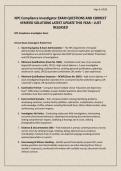
10-Line Exam Coverage in Points Form
1. Governing Agency & Exam Administration – The NYC Department of Citywide
Administrative Services (DCAS) administers the civil service examination and eligible list;
investigations are performed for agencies like DCWP (Consumer and Worker Protection)
and DOI (Department of Investigation).
2. Minimum Qualifications (Exam No. 5083) – Candidates must have (1) an associate
degree/60 semester credits, OR (2) a high school diploma + 2 years investigative
experience (evaluating creditworthiness, verifying personal qualifications, gathering
evidence for cases), OR (3) equivalent combination (30 credits = 1 year experience).
3. Minimum Qualifications (Inspector – DCWP) (Exam No. 6065) – High school diploma + 4
years investigative/inspection experience for a consumer/worker protection agency, OR
a bachelor's degree, OR equivalent combination.
4. Examination Format – Computer-based multiple-choice "Education and Experience
Exam" (EEE) where candidates answer detailed questions about their background;
candidates must final submit by application deadline.
5. Exam Content Domains – Tests complex problem solving (identifying problems,
developing solutions), number facility (addition, subtraction, multiplication, division),
and knowledge of office software including Microsoft Excel, Word, Adobe Acrobat, video
conferencing, and search engines.
6. Investigator Job Duties – Conducting undercover field investigations, interviewing
consumers/businesses/witnesses, obtaining and analyzing documentary evidence,
writing comprehensive reports, testifying at hearings and in court, utilizing
photographic/video equipment.
7. Evidence & Documentation Skills – Field notebook is primary contemporaneous record;
correct errors by striking through, initialing, dating; label and secure evidence
immediately; maintain chain of custody; use objective language avoiding personal
opinions/speculation in reports.
8. Interviewing & Witness Handling – Identify yourself and explain purpose first; avoid
leading questions (can bias/invalidate responses); use active listening (focus fully on
speaker's responses); corroborate information with multiple sources; document refusals
without coercion.
, Page 2 of 113
9. Legal & Ethical Principles – Freedom of Information Law (FOIL) governs public records
access; probable cause = reasonable belief based on facts and circumstances; due
process ensures fairness; conflicts of interest must be disclosed to supervisor;
professionalism requires impartiality and objectivity.
10. Special Working Conditions & Training – DOI offers Investigative Officer Training
Academy (IOTA): 10-week program covering defensive tactics, crisis intervention,
surveillance, interviewing, report writing; may lead to NYS Peace Officer certification.
100 Practice MCQs with Rationales
1. According to the NYC Department of Citywide Administrative Services (DCAS) Notice of
Examination for Investigator (Exam No. 5083), which of the following is a minimum
qualification requirement?
A) A four-year high school diploma and four years of investigative experience
B) An associate degree or 60 semester credits from an accredited college or university
C) A bachelor's degree and one year of investigative experience
D) A high school diploma and six months of investigative training
Answer: B
Rationale: According to the DCAS Notice of Examination, candidates must have an associate
degree or 60 semester credits from an accredited college. Alternatively, candidates with a high
school diploma must have two years of investigative experience. A bachelor's degree alone is
not listed for this exam title (though it qualifies for the Inspector title).
2. The primary responsibility of a NYC Field Investigator is to:
A) Provide legal advice to city agencies
B) Conduct audits of financial records only
, Page 3 of 113
C) Collect facts and evidence related to alleged violations
D) Represent the city in court proceedings
Answer: C
Rationale: Field Investigators focus on gathering factual information, conducting interviews, and
documenting evidence to support enforcement actions. They do not provide legal advice, which
is the role of attorneys. While they may testify, representing the city in court is not their primary
responsibility.
3. Which document is most important for accurately recording observations during an
investigation?
A) Incident summary memo
B) Interview transcript
C) Field notebook
D) Case closure report
Answer: C
Rationale: A field notebook is the primary contemporaneous record of observations, times,
locations, and actions taken during investigations. It serves as the foundational document for all
subsequent reports and testimony. The case closure report and interview transcripts are derived
from field notes.
4. When interviewing a witness, the investigator should FIRST:
A) Ask leading questions to focus the witness
B) Explain possible penalties for false statements
, Page 4 of 113
C) Identify themselves and explain the purpose of the interview
D) Record the interview secretly to preserve testimony
Answer: C
Rationale: Proper identification and explanation of purpose establish transparency, credibility,
and cooperation during interviews. Leading questions should be avoided as they can bias
responses. Secret recordings are generally prohibited without consent.
5. The NYC Department of Investigation (DOI) is BEST described as:
A) An agency that prosecutes criminal offenses in NYC
B) An independent and nonpartisan watchdog for NYC government, agencies, employees, and
vendors
C) A division of the NYPD that investigates police misconduct
D) A consumer protection agency that licenses businesses
Answer: B
Rationale: The Department of Investigation oversees integrity, fraud prevention, and
compliance within NYC agencies. It acts as an independent watchdog combating municipal
corruption. DCWP (not DOI) licenses businesses.
6. Which NYC principle requires investigators to treat all individuals fairly?
A) Probable cause
B) Due diligence
C) Due process
D) Chain of custody
NYC Compliance Investigator EXAM QUESTIONS AND CORRECT
VERIFIED SOLUTIONS LATEST UPDATE THIS YEAR – JUST
RELEASED
NYC Compliance Investigator Exam
10-Line Exam Coverage in Points Form
1. Governing Agency & Exam Administration – The NYC Department of Citywide
Administrative Services (DCAS) administers the civil service examination and eligible list;
investigations are performed for agencies like DCWP (Consumer and Worker Protection)
and DOI (Department of Investigation).
2. Minimum Qualifications (Exam No. 5083) – Candidates must have (1) an associate
degree/60 semester credits, OR (2) a high school diploma + 2 years investigative
experience (evaluating creditworthiness, verifying personal qualifications, gathering
evidence for cases), OR (3) equivalent combination (30 credits = 1 year experience).
3. Minimum Qualifications (Inspector – DCWP) (Exam No. 6065) – High school diploma + 4
years investigative/inspection experience for a consumer/worker protection agency, OR
a bachelor's degree, OR equivalent combination.
4. Examination Format – Computer-based multiple-choice "Education and Experience
Exam" (EEE) where candidates answer detailed questions about their background;
candidates must final submit by application deadline.
5. Exam Content Domains – Tests complex problem solving (identifying problems,
developing solutions), number facility (addition, subtraction, multiplication, division),
and knowledge of office software including Microsoft Excel, Word, Adobe Acrobat, video
conferencing, and search engines.
6. Investigator Job Duties – Conducting undercover field investigations, interviewing
consumers/businesses/witnesses, obtaining and analyzing documentary evidence,
writing comprehensive reports, testifying at hearings and in court, utilizing
photographic/video equipment.
7. Evidence & Documentation Skills – Field notebook is primary contemporaneous record;
correct errors by striking through, initialing, dating; label and secure evidence
immediately; maintain chain of custody; use objective language avoiding personal
opinions/speculation in reports.
8. Interviewing & Witness Handling – Identify yourself and explain purpose first; avoid
leading questions (can bias/invalidate responses); use active listening (focus fully on
speaker's responses); corroborate information with multiple sources; document refusals
without coercion.
, Page 2 of 113
9. Legal & Ethical Principles – Freedom of Information Law (FOIL) governs public records
access; probable cause = reasonable belief based on facts and circumstances; due
process ensures fairness; conflicts of interest must be disclosed to supervisor;
professionalism requires impartiality and objectivity.
10. Special Working Conditions & Training – DOI offers Investigative Officer Training
Academy (IOTA): 10-week program covering defensive tactics, crisis intervention,
surveillance, interviewing, report writing; may lead to NYS Peace Officer certification.
100 Practice MCQs with Rationales
1. According to the NYC Department of Citywide Administrative Services (DCAS) Notice of
Examination for Investigator (Exam No. 5083), which of the following is a minimum
qualification requirement?
A) A four-year high school diploma and four years of investigative experience
B) An associate degree or 60 semester credits from an accredited college or university
C) A bachelor's degree and one year of investigative experience
D) A high school diploma and six months of investigative training
Answer: B
Rationale: According to the DCAS Notice of Examination, candidates must have an associate
degree or 60 semester credits from an accredited college. Alternatively, candidates with a high
school diploma must have two years of investigative experience. A bachelor's degree alone is
not listed for this exam title (though it qualifies for the Inspector title).
2. The primary responsibility of a NYC Field Investigator is to:
A) Provide legal advice to city agencies
B) Conduct audits of financial records only
, Page 3 of 113
C) Collect facts and evidence related to alleged violations
D) Represent the city in court proceedings
Answer: C
Rationale: Field Investigators focus on gathering factual information, conducting interviews, and
documenting evidence to support enforcement actions. They do not provide legal advice, which
is the role of attorneys. While they may testify, representing the city in court is not their primary
responsibility.
3. Which document is most important for accurately recording observations during an
investigation?
A) Incident summary memo
B) Interview transcript
C) Field notebook
D) Case closure report
Answer: C
Rationale: A field notebook is the primary contemporaneous record of observations, times,
locations, and actions taken during investigations. It serves as the foundational document for all
subsequent reports and testimony. The case closure report and interview transcripts are derived
from field notes.
4. When interviewing a witness, the investigator should FIRST:
A) Ask leading questions to focus the witness
B) Explain possible penalties for false statements
, Page 4 of 113
C) Identify themselves and explain the purpose of the interview
D) Record the interview secretly to preserve testimony
Answer: C
Rationale: Proper identification and explanation of purpose establish transparency, credibility,
and cooperation during interviews. Leading questions should be avoided as they can bias
responses. Secret recordings are generally prohibited without consent.
5. The NYC Department of Investigation (DOI) is BEST described as:
A) An agency that prosecutes criminal offenses in NYC
B) An independent and nonpartisan watchdog for NYC government, agencies, employees, and
vendors
C) A division of the NYPD that investigates police misconduct
D) A consumer protection agency that licenses businesses
Answer: B
Rationale: The Department of Investigation oversees integrity, fraud prevention, and
compliance within NYC agencies. It acts as an independent watchdog combating municipal
corruption. DCWP (not DOI) licenses businesses.
6. Which NYC principle requires investigators to treat all individuals fairly?
A) Probable cause
B) Due diligence
C) Due process
D) Chain of custody


