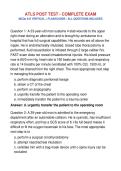
ATLS POST TEST - COMPLETE EXAM
MCQs A-E VERTICAL + FLASHCARDS - ALL QUESTIONS INCLUDED
Question 1: A 23-year-old man sustains 4 stab wounds to the upper
right chest during an altercation and is brought by ambulance to a
hospital that has full surgical capabilities. His wounds are all above the
nipple. He is endotracheally intubated, closed tube thoracostomy is
performed, fluid resuscitation is initiated through 2 large-caliber IVs.
FAST exam does not reveal intraabdominal injuries. His blood pressure
now is 60/0 mm Hg, heart rate is 160 beats per minute, and respiratory
rate is 14 breaths per minute (ventilated with 100% O2). 1500 mL of
blood has drained from the right chest. The most appropriate next step
in managing this patient is to
a. perform diagnostic peritoneal lavage
b. obtain a CT of the chest
c. perform an angiography
d. urgently transfer the patient to the operating room
e. immediately transfer the patient to a trauma center
Answer: d. urgently transfer the patient to the operating room
Question 2: A 39-year-old man is admitted to the emergency
department after an automobile collision. He is cyanotic, has insufficient
respiratory effort, and has a GCS score of 6. His full beard makes it
difficult to fit the oxygen facemask to his face. The most appropriate
next step is to
a. perform a surgical cricothyroidotomy
b. attempt nasotracheal intubation
c. ventilate him with a bag-mask device until c-spine injury can be
excluded
, d. restrict cervical motion and attempt orotracheal intubation using 2
people
e. ventilate the patient with a bag-mask device until his beard can be
shaved for better mask fit
Answer: d. restrict cervical motion and attempt orotracheal
intubation using 2 people
Question 3: A patient is brought to the emergency department after a
motor vehicle crash. He is conscious and there is no obvious external
trauma. His blood pressure is 60/40 mm Hg and his heart rate is 70
beats per minute. His skin is warm. Which one of the following
statements is TRUE?
a. Vasoactive medications have no role in this patient's management.
b. The hypotension should be managed with volume resuscitation
alone.
c. Flexion and extension views of the c-spine should be performed
early.
d. Abdominal visceral injuries can be excluded as a cause of
hypotension.
e. Flaccidity of the lower extremities and loss of deep tendon reflexes
are expected.
Answer: e. Flaccidity of the lower extremities and loss of deep
tendon reflexes are expected.
Question 4: Which one of the following is the most effective method for
initially treating frostbite?
a. moist heat
b. early amputation
c. padding and elevation
d. vasodilators and heparin
e. topical application of silver sulfadiazine
, Answer: a. moist heat
Question 5: A 32-year-old man's right leg is trapped beneath his
overturned car for nearly 2 hours before he is extricated. On arrival to
the emergency department, his right lower extremity is cool, mottled,
insensate, and motionless. Despite normal vital signs, a pulse cannot
be palpated below the right femoral artery and the muscles of the lower
extremity are firm and hard. During the management of this patient,
which of the following is most likely to improve the chances for limb
salvage?
a. applying skeletal traction
b. administering anticoagulant drugs
c. administering thrombolytic therapy
d. surgical consultation for right lower extremity fasciotomy
e. transferring the patient to the trauma center 120 km away
Answer: d. surgical consultation for right lower extremity
fasciotomy
Question 6: A patient arrives in the emergency department after being
beaten about the head and face with a wooden club. He is comatose
and has a palpable depressed skull fracture. His face is swollen and
ecchymotic. He has gurgling respirations and vomitus on his face and
clothing. The most appropriate step after providing supplemental
oxygen and elevating his jaw is to:
a. request a CT scan
b. insert a gastric tube
c. suction the oropharynx
d. obtain a lateral cervical spine x-ray
e. ventilate the patient with a bag-mask
Answer: c. suction the oropharynx
MCQs A-E VERTICAL + FLASHCARDS - ALL QUESTIONS INCLUDED
Question 1: A 23-year-old man sustains 4 stab wounds to the upper
right chest during an altercation and is brought by ambulance to a
hospital that has full surgical capabilities. His wounds are all above the
nipple. He is endotracheally intubated, closed tube thoracostomy is
performed, fluid resuscitation is initiated through 2 large-caliber IVs.
FAST exam does not reveal intraabdominal injuries. His blood pressure
now is 60/0 mm Hg, heart rate is 160 beats per minute, and respiratory
rate is 14 breaths per minute (ventilated with 100% O2). 1500 mL of
blood has drained from the right chest. The most appropriate next step
in managing this patient is to
a. perform diagnostic peritoneal lavage
b. obtain a CT of the chest
c. perform an angiography
d. urgently transfer the patient to the operating room
e. immediately transfer the patient to a trauma center
Answer: d. urgently transfer the patient to the operating room
Question 2: A 39-year-old man is admitted to the emergency
department after an automobile collision. He is cyanotic, has insufficient
respiratory effort, and has a GCS score of 6. His full beard makes it
difficult to fit the oxygen facemask to his face. The most appropriate
next step is to
a. perform a surgical cricothyroidotomy
b. attempt nasotracheal intubation
c. ventilate him with a bag-mask device until c-spine injury can be
excluded
, d. restrict cervical motion and attempt orotracheal intubation using 2
people
e. ventilate the patient with a bag-mask device until his beard can be
shaved for better mask fit
Answer: d. restrict cervical motion and attempt orotracheal
intubation using 2 people
Question 3: A patient is brought to the emergency department after a
motor vehicle crash. He is conscious and there is no obvious external
trauma. His blood pressure is 60/40 mm Hg and his heart rate is 70
beats per minute. His skin is warm. Which one of the following
statements is TRUE?
a. Vasoactive medications have no role in this patient's management.
b. The hypotension should be managed with volume resuscitation
alone.
c. Flexion and extension views of the c-spine should be performed
early.
d. Abdominal visceral injuries can be excluded as a cause of
hypotension.
e. Flaccidity of the lower extremities and loss of deep tendon reflexes
are expected.
Answer: e. Flaccidity of the lower extremities and loss of deep
tendon reflexes are expected.
Question 4: Which one of the following is the most effective method for
initially treating frostbite?
a. moist heat
b. early amputation
c. padding and elevation
d. vasodilators and heparin
e. topical application of silver sulfadiazine
, Answer: a. moist heat
Question 5: A 32-year-old man's right leg is trapped beneath his
overturned car for nearly 2 hours before he is extricated. On arrival to
the emergency department, his right lower extremity is cool, mottled,
insensate, and motionless. Despite normal vital signs, a pulse cannot
be palpated below the right femoral artery and the muscles of the lower
extremity are firm and hard. During the management of this patient,
which of the following is most likely to improve the chances for limb
salvage?
a. applying skeletal traction
b. administering anticoagulant drugs
c. administering thrombolytic therapy
d. surgical consultation for right lower extremity fasciotomy
e. transferring the patient to the trauma center 120 km away
Answer: d. surgical consultation for right lower extremity
fasciotomy
Question 6: A patient arrives in the emergency department after being
beaten about the head and face with a wooden club. He is comatose
and has a palpable depressed skull fracture. His face is swollen and
ecchymotic. He has gurgling respirations and vomitus on his face and
clothing. The most appropriate step after providing supplemental
oxygen and elevating his jaw is to:
a. request a CT scan
b. insert a gastric tube
c. suction the oropharynx
d. obtain a lateral cervical spine x-ray
e. ventilate the patient with a bag-mask
Answer: c. suction the oropharynx