

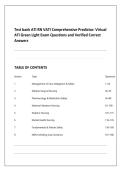
Test bank ATI RN VATI Comprehensive Predictor: Virtual
ATI Green Light Exam Questions and Verified Correct
Answers
TABLE OF CONTENTS
Section Topic Questions
1 Management of Care, Delegation & Safety 1–25
2 Medical-Surgical Nursing 26–55
3 Pharmacology & Medication Safety 56–80
4 Maternal-Newborn Nursing 81–100
5 Pediatric Nursing 101–115
6 Mental Health Nursing 116–135
7 Fundamentals & Patient Safety 136–160
8 NGN Unfolding Case Scenarios 161–180
,SECTION 1 – MANAGEMENT OF CARE, DELEGATION &
SAFETY
Question 1
A nurse is caring for a group of clients. Which of the following clients should the nurse
assess first?
A) A client who is 3 hours post-Foley catheter removal and has not voided
B) A client who is 3 days postoperative colectomy with a large, loose melena stool
C) A client who is 1-day postoperative total hip replacement with a pain level of 7 on a
scale of 0 to 10
D) A client who received a blood transfusion 2 hours ago and reports itching
Answer: D) A client who received a blood transfusion 2 hours ago and reports
itching
Rationale: Itching after a blood transfusion could indicate a transfusion reaction, which
requires immediate assessment and intervention. This is a potential life-threatening
emergency. Urgent needs take priority over scheduled procedures, pain management, or
discharge teaching .
Question 2
A nurse receives change-of-shift report on four clients. Based on the shift report
information, which of the following clients should the nurse assess first?
A) A client who had a hip arthroplasty reports pain and erythema in their calf
B) A client who is postoperative day 2 from a cholecystectomy
C) A client who has pneumonia and a fever of 38.5°C
D) A client who is scheduled for discharge
Answer: A) A client who had a hip arthroplasty reports pain and erythema in their
calf
Rationale: Pain and erythema in the calf after hip arthroplasty is a classic sign of deep
,vein thrombosis (DVT), which can lead to pulmonary embolism. This is the priority
assessment .
Question 3
A nurse discovers that the wrong dosage of a medication was given to a client. When
determining what action to take, the nurse should recognize that which of the following
ethical principles should be applied?
A) Utility
B) Paternalism
C) Fidelity
D) Veracity
Answer: D) Veracity
Rationale: Veracity is the ethical principle of truthfulness. Medication errors must be
reported through proper channels to ensure client safety and system improvement. Lack of
visible harm does not excuse an error .
Question 4
A nurse notices smoke coming from a client's room and discovers a fire in the
wastebasket. After moving the client to safety, which of the following is the priority
action?
A) Pull the fire alarm
B) Use a fire extinguisher
C) Close the fire door on the unit
D) Notify the fire department
Answer: C) Close the fire door on the unit
Rationale: Closing the fire door contains the fire and prevents its spread to other areas.
This follows the RACE (Rescue, Alarm, Contain, Extinguish) fire safety protocol.
Containment of the fire is the priority after rescue .
, Question 5
A charge nurse is teaching a group of unit nurses about the policy for clients who have a
history of methicillin-resistant Staphylococcus aureus (MRSA). Which of the following
information should the nurse include?
A) A client who has a history of MRSA will need antibiotics
B) A client who has a history of MRSA can develop immunity to the infection
C) A client who has a history of MRSA requires a protective environment
D) A client who has a history of MRSA can still transmit the infection
Answer: D) A client who has a history of MRSA can still transmit the infection
Rationale: MRSA colonization can persist, and the client can still transmit the infection
even without active symptoms. Colonization does not confer immunity, and contact
precautions are typically implemented .
Question 6
A nurse is preparing to witness a client's signature on an informed consent for a total
knee arthroplasty. Which of the following statements by the client indicates the nurse
should contact the surgeon?
A) "I am thankful there are no serious complications from this type of surgery"
B) "I understand the risks, but I want to proceed"
C) "I have questions about the recovery time"
D) "My doctor explained everything to me"
Answer: A) "I am thankful there are no serious complications from this type of
surgery"
Rationale: This statement indicates the client may not understand that all surgeries carry
inherent risks. The nurse must ensure the client has been adequately informed and contact
the surgeon if there is any misunderstanding .
ATI Green Light Exam Questions and Verified Correct
Answers
TABLE OF CONTENTS
Section Topic Questions
1 Management of Care, Delegation & Safety 1–25
2 Medical-Surgical Nursing 26–55
3 Pharmacology & Medication Safety 56–80
4 Maternal-Newborn Nursing 81–100
5 Pediatric Nursing 101–115
6 Mental Health Nursing 116–135
7 Fundamentals & Patient Safety 136–160
8 NGN Unfolding Case Scenarios 161–180
,SECTION 1 – MANAGEMENT OF CARE, DELEGATION &
SAFETY
Question 1
A nurse is caring for a group of clients. Which of the following clients should the nurse
assess first?
A) A client who is 3 hours post-Foley catheter removal and has not voided
B) A client who is 3 days postoperative colectomy with a large, loose melena stool
C) A client who is 1-day postoperative total hip replacement with a pain level of 7 on a
scale of 0 to 10
D) A client who received a blood transfusion 2 hours ago and reports itching
Answer: D) A client who received a blood transfusion 2 hours ago and reports
itching
Rationale: Itching after a blood transfusion could indicate a transfusion reaction, which
requires immediate assessment and intervention. This is a potential life-threatening
emergency. Urgent needs take priority over scheduled procedures, pain management, or
discharge teaching .
Question 2
A nurse receives change-of-shift report on four clients. Based on the shift report
information, which of the following clients should the nurse assess first?
A) A client who had a hip arthroplasty reports pain and erythema in their calf
B) A client who is postoperative day 2 from a cholecystectomy
C) A client who has pneumonia and a fever of 38.5°C
D) A client who is scheduled for discharge
Answer: A) A client who had a hip arthroplasty reports pain and erythema in their
calf
Rationale: Pain and erythema in the calf after hip arthroplasty is a classic sign of deep
,vein thrombosis (DVT), which can lead to pulmonary embolism. This is the priority
assessment .
Question 3
A nurse discovers that the wrong dosage of a medication was given to a client. When
determining what action to take, the nurse should recognize that which of the following
ethical principles should be applied?
A) Utility
B) Paternalism
C) Fidelity
D) Veracity
Answer: D) Veracity
Rationale: Veracity is the ethical principle of truthfulness. Medication errors must be
reported through proper channels to ensure client safety and system improvement. Lack of
visible harm does not excuse an error .
Question 4
A nurse notices smoke coming from a client's room and discovers a fire in the
wastebasket. After moving the client to safety, which of the following is the priority
action?
A) Pull the fire alarm
B) Use a fire extinguisher
C) Close the fire door on the unit
D) Notify the fire department
Answer: C) Close the fire door on the unit
Rationale: Closing the fire door contains the fire and prevents its spread to other areas.
This follows the RACE (Rescue, Alarm, Contain, Extinguish) fire safety protocol.
Containment of the fire is the priority after rescue .
, Question 5
A charge nurse is teaching a group of unit nurses about the policy for clients who have a
history of methicillin-resistant Staphylococcus aureus (MRSA). Which of the following
information should the nurse include?
A) A client who has a history of MRSA will need antibiotics
B) A client who has a history of MRSA can develop immunity to the infection
C) A client who has a history of MRSA requires a protective environment
D) A client who has a history of MRSA can still transmit the infection
Answer: D) A client who has a history of MRSA can still transmit the infection
Rationale: MRSA colonization can persist, and the client can still transmit the infection
even without active symptoms. Colonization does not confer immunity, and contact
precautions are typically implemented .
Question 6
A nurse is preparing to witness a client's signature on an informed consent for a total
knee arthroplasty. Which of the following statements by the client indicates the nurse
should contact the surgeon?
A) "I am thankful there are no serious complications from this type of surgery"
B) "I understand the risks, but I want to proceed"
C) "I have questions about the recovery time"
D) "My doctor explained everything to me"
Answer: A) "I am thankful there are no serious complications from this type of
surgery"
Rationale: This statement indicates the client may not understand that all surgeries carry
inherent risks. The nurse must ensure the client has been adequately informed and contact
the surgeon if there is any misunderstanding .


