

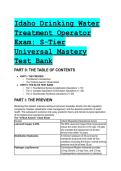
Idaho Drinking Water
Treatment Operator
Exam: S-Tier
Universal Mastery
Test Bank
PART 0: THE TABLE OF CONTENTS
● PART I: THE PREVIEW
○ The Mentor's Introduction
○ The "Critical Axioms" Cheat Sheet
● PART II: THE ELITE TEST BANK
○ Tier 1: Foundational Syntax & Application (Questions 1–10)
○ Tier 2: Complex Application & Simulation (Questions 11–20)
○ Tier 3: Grandmaster Synthesis (Questions 21–30)
PART I: THE PREVIEW
Mastering this isolated, intensive testing environment translates directly into elite regulatory
compliance, flawless catastrophic crisis management, and the absolute protection of public
health. The subsequent scenarios strip away academic theory and demand surgical application
of the highest-level operational standards.
The "Critical Axioms" Cheat Sheet
Domain Critical Regulatory/Operational Axiom
Lead and Copper (LCRI) The EPA Lead and Copper Rule Improvements
reduce the action level to 0.010 mg/L (10 ppb)
and mandate the replacement of all lead
service lines within 10 years.
Distribution Hydraulics A minimum pressure of 20 psi must be
maintained at ground level under all flow
conditions (including fire flows); normal working
pressure must be at least 35 psi.
Pathogen Log Removal Conventional filtration inherently provides
2.5-log Giardia, 2.0-log Virus, and 2.5-log
Cryptosporidium removal prior to chemical
,Domain Critical Regulatory/Operational Axiom
disinfection.
Membrane Integrity (LT2ESWTR) Direct integrity testing (PDT) must resolve
breaches ≤3 µm daily; any test exceeding the
Upper Control Limit (UCL) mandates immediate
unit isolation.
AWWA Disinfection Standards C651 (Mains) and C652 (Tanks) dictate strict
Concentration-Time (CT) metrics. Method 1
utilizes 10 mg/L for 24 hours; Method 2 utilizes
200 mg/L for 30 minutes.
PART II: THE ELITE TEST BANK
Tier 1: Foundational Syntax & Application
Q1: A municipal water system serving 15,000 residents completes its mandated compliance tap
sampling. The laboratory reports that the 90th percentile for lead concentration has reached
0.012 mg/L. Based on the principles of the Lead and Copper Rule Improvements (LCRI)
incorporated into IDAPA 58.01.08, which action/conclusion is the MOST ACCURATE? A) The
system remains below the legacy action level of 0.015 mg/L and requires no immediate
corrective action other than standard triennial monitoring. B) The system has triggered the lead
action level, mandating immediate implementation of corrosion control treatment enhancements
and point-of-use filter provisioning. C) The system has entered a "trigger level" warning state,
which requires public education but explicitly suspends mandatory lead service line
replacements. D) The system has exceeded the regulatory Maximum Contaminant Level (MCL)
for lead and must immediately issue a Tier 1 boil water advisory to all consumers.
● Answer: B (The system has triggered the lead action level, mandating immediate
implementation of corrosion control treatment enhancements and point-of-use filter
provisioning.)
● Distractor Analysis:
○ A is incorrect: While 0.015 mg/L (15 ppb) served as the legacy action level under
previous regulatory iterations, the finalized LCRI explicitly lowered the action level
to 0.010 mg/L (10 ppb).
○ C is incorrect: The LCRI framework entirely eliminated the concept of the "trigger
level" while simultaneously lowering the hard action level to 0.010 mg/L.
○ D is incorrect: Lead is regulated via an Action Level (AL) driven by Treatment
Technique requirements, not an absolute Maximum Contaminant Level (MCL). A
Tier 1 boil water notice is reserved for acute biological threats or nitrate
exceedances, not heavy metal AL exceedances.
The Mentor's Analysis: Regulatory frameworks evolve to eradicate safety gaps. When facing
updated compliance mandates, the immediate priority is discarding outdated legacy metrics. By
utilizing the LCRI 0.010 mg/L Action Level, you bypass the common trap of relying on obsolete
15 ppb thresholds for system management. Professional/Academic Intuition: Never apply
legacy action levels to modern regulatory environments; the LCRI strictly enforces a
0.010 mg/L action level for lead.
Q2: A highly specialized public water system operator currently holds both an active Class II
Drinking Water Treatment license and an active Class II Wastewater Treatment license.
According to IDAPA 24.05.01 regarding professional continuing education, what is the
, MINIMUM annual continuing education unit (CEU) requirement to maintain both licenses in
good standing? A) 6 hours of general occupational safety and hazard training applicable to
either utility discipline. B) 12 hours total, requiring exactly 6 hours of training germane to
drinking water and 6 hours germane to wastewater. C) 6 hours total, provided the submitted
coursework is directly germane to either the water or wastewater field. D) 24 hours total,
calculating 12 hours per discipline to account for the heightened responsibilities of dual-license
status.
● Answer: B (12 hours total, requiring exactly 6 hours of training germane to drinking water
and 6 hours germane to wastewater.)
● Distractor Analysis:
○ A is incorrect: While safety training is permitted as germane content, holding dual
licenses across two distinctly separate disciplines (drinking water and wastewater)
requires fulfilling the distinct minimum CEU requirements for both.
○ C is incorrect: A licensee holding multiple licenses within a single discipline (e.g.,
Water Treatment Class I and Water Distribution Class II) needs only 6 hours.
However, holding licenses in both drinking water and wastewater mandates 6 hours
for the drinking water license plus an additional 6 hours for the wastewater license.
○ D is incorrect: This calculation represents an outdated or out-of-state regulatory
trap; Idaho mandates exactly 6 hours per license type annually.
The Mentor's Analysis: Professional licensure dictates strict adherence to domain-specific
continued learning. When facing dual-discipline licensure, the immediate priority is satisfying the
unique educational mandates of each separate field. By utilizing License Type Segregation, you
bypass the common trap of assuming a single 6-hour seminar covers cross-discipline
requirements. Professional/Academic Intuition: Continuing education is
discipline-specific; dual-licensed operators in water and wastewater must accrue 6 hours
independently for each distinct field.
Q3: During a peak summer demand period accompanied by a major localized structure fire, a
municipal distribution system experiences severe hydraulic strain. Based on IDAPA 58.01.08
standards, what is the absolute minimum pressure that MUST be maintained at ground level
across the distribution grid under these extreme combined flow conditions? A) 40 psi B) 35 psi
C) 20 psi D) 0 psi (Atmospheric), provided premises isolation cross-connection control is active.
● Answer: C (20 psi)
● Distractor Analysis:
○ A is incorrect: 40 psi is the standard design working pressure minimum excluding
fire flows, not the absolute emergency minimum required during active fire
suppression.
○ B is incorrect: 35 psi is the minimum normal working pressure threshold allowed in
the distribution system under standard, non-emergency operating conditions.
○ D is incorrect: Allowing distribution pressure to drop to 0 psi guarantees
backsiphonage and catastrophic widespread contamination of the potable water
supply, rendering local cross-connection programs mathematically insufficient to
protect the entire grid.
The Mentor's Analysis: Hydraulic integrity acts as the primary physical barrier against
contamination. When facing extreme demand events like fire flows, the immediate priority is
preventing negative pressure zones. By utilizing Hydraulic Buffering Limits, you bypass the
common trap of allowing localized vacuums that draw external pathogens into the potable
supply. Professional/Academic Intuition: Under absolute worst-case flow conditions,
including fire suppression, distribution pressure must never drop below 20 psi to prevent
Treatment Operator
Exam: S-Tier
Universal Mastery
Test Bank
PART 0: THE TABLE OF CONTENTS
● PART I: THE PREVIEW
○ The Mentor's Introduction
○ The "Critical Axioms" Cheat Sheet
● PART II: THE ELITE TEST BANK
○ Tier 1: Foundational Syntax & Application (Questions 1–10)
○ Tier 2: Complex Application & Simulation (Questions 11–20)
○ Tier 3: Grandmaster Synthesis (Questions 21–30)
PART I: THE PREVIEW
Mastering this isolated, intensive testing environment translates directly into elite regulatory
compliance, flawless catastrophic crisis management, and the absolute protection of public
health. The subsequent scenarios strip away academic theory and demand surgical application
of the highest-level operational standards.
The "Critical Axioms" Cheat Sheet
Domain Critical Regulatory/Operational Axiom
Lead and Copper (LCRI) The EPA Lead and Copper Rule Improvements
reduce the action level to 0.010 mg/L (10 ppb)
and mandate the replacement of all lead
service lines within 10 years.
Distribution Hydraulics A minimum pressure of 20 psi must be
maintained at ground level under all flow
conditions (including fire flows); normal working
pressure must be at least 35 psi.
Pathogen Log Removal Conventional filtration inherently provides
2.5-log Giardia, 2.0-log Virus, and 2.5-log
Cryptosporidium removal prior to chemical
,Domain Critical Regulatory/Operational Axiom
disinfection.
Membrane Integrity (LT2ESWTR) Direct integrity testing (PDT) must resolve
breaches ≤3 µm daily; any test exceeding the
Upper Control Limit (UCL) mandates immediate
unit isolation.
AWWA Disinfection Standards C651 (Mains) and C652 (Tanks) dictate strict
Concentration-Time (CT) metrics. Method 1
utilizes 10 mg/L for 24 hours; Method 2 utilizes
200 mg/L for 30 minutes.
PART II: THE ELITE TEST BANK
Tier 1: Foundational Syntax & Application
Q1: A municipal water system serving 15,000 residents completes its mandated compliance tap
sampling. The laboratory reports that the 90th percentile for lead concentration has reached
0.012 mg/L. Based on the principles of the Lead and Copper Rule Improvements (LCRI)
incorporated into IDAPA 58.01.08, which action/conclusion is the MOST ACCURATE? A) The
system remains below the legacy action level of 0.015 mg/L and requires no immediate
corrective action other than standard triennial monitoring. B) The system has triggered the lead
action level, mandating immediate implementation of corrosion control treatment enhancements
and point-of-use filter provisioning. C) The system has entered a "trigger level" warning state,
which requires public education but explicitly suspends mandatory lead service line
replacements. D) The system has exceeded the regulatory Maximum Contaminant Level (MCL)
for lead and must immediately issue a Tier 1 boil water advisory to all consumers.
● Answer: B (The system has triggered the lead action level, mandating immediate
implementation of corrosion control treatment enhancements and point-of-use filter
provisioning.)
● Distractor Analysis:
○ A is incorrect: While 0.015 mg/L (15 ppb) served as the legacy action level under
previous regulatory iterations, the finalized LCRI explicitly lowered the action level
to 0.010 mg/L (10 ppb).
○ C is incorrect: The LCRI framework entirely eliminated the concept of the "trigger
level" while simultaneously lowering the hard action level to 0.010 mg/L.
○ D is incorrect: Lead is regulated via an Action Level (AL) driven by Treatment
Technique requirements, not an absolute Maximum Contaminant Level (MCL). A
Tier 1 boil water notice is reserved for acute biological threats or nitrate
exceedances, not heavy metal AL exceedances.
The Mentor's Analysis: Regulatory frameworks evolve to eradicate safety gaps. When facing
updated compliance mandates, the immediate priority is discarding outdated legacy metrics. By
utilizing the LCRI 0.010 mg/L Action Level, you bypass the common trap of relying on obsolete
15 ppb thresholds for system management. Professional/Academic Intuition: Never apply
legacy action levels to modern regulatory environments; the LCRI strictly enforces a
0.010 mg/L action level for lead.
Q2: A highly specialized public water system operator currently holds both an active Class II
Drinking Water Treatment license and an active Class II Wastewater Treatment license.
According to IDAPA 24.05.01 regarding professional continuing education, what is the
, MINIMUM annual continuing education unit (CEU) requirement to maintain both licenses in
good standing? A) 6 hours of general occupational safety and hazard training applicable to
either utility discipline. B) 12 hours total, requiring exactly 6 hours of training germane to
drinking water and 6 hours germane to wastewater. C) 6 hours total, provided the submitted
coursework is directly germane to either the water or wastewater field. D) 24 hours total,
calculating 12 hours per discipline to account for the heightened responsibilities of dual-license
status.
● Answer: B (12 hours total, requiring exactly 6 hours of training germane to drinking water
and 6 hours germane to wastewater.)
● Distractor Analysis:
○ A is incorrect: While safety training is permitted as germane content, holding dual
licenses across two distinctly separate disciplines (drinking water and wastewater)
requires fulfilling the distinct minimum CEU requirements for both.
○ C is incorrect: A licensee holding multiple licenses within a single discipline (e.g.,
Water Treatment Class I and Water Distribution Class II) needs only 6 hours.
However, holding licenses in both drinking water and wastewater mandates 6 hours
for the drinking water license plus an additional 6 hours for the wastewater license.
○ D is incorrect: This calculation represents an outdated or out-of-state regulatory
trap; Idaho mandates exactly 6 hours per license type annually.
The Mentor's Analysis: Professional licensure dictates strict adherence to domain-specific
continued learning. When facing dual-discipline licensure, the immediate priority is satisfying the
unique educational mandates of each separate field. By utilizing License Type Segregation, you
bypass the common trap of assuming a single 6-hour seminar covers cross-discipline
requirements. Professional/Academic Intuition: Continuing education is
discipline-specific; dual-licensed operators in water and wastewater must accrue 6 hours
independently for each distinct field.
Q3: During a peak summer demand period accompanied by a major localized structure fire, a
municipal distribution system experiences severe hydraulic strain. Based on IDAPA 58.01.08
standards, what is the absolute minimum pressure that MUST be maintained at ground level
across the distribution grid under these extreme combined flow conditions? A) 40 psi B) 35 psi
C) 20 psi D) 0 psi (Atmospheric), provided premises isolation cross-connection control is active.
● Answer: C (20 psi)
● Distractor Analysis:
○ A is incorrect: 40 psi is the standard design working pressure minimum excluding
fire flows, not the absolute emergency minimum required during active fire
suppression.
○ B is incorrect: 35 psi is the minimum normal working pressure threshold allowed in
the distribution system under standard, non-emergency operating conditions.
○ D is incorrect: Allowing distribution pressure to drop to 0 psi guarantees
backsiphonage and catastrophic widespread contamination of the potable water
supply, rendering local cross-connection programs mathematically insufficient to
protect the entire grid.
The Mentor's Analysis: Hydraulic integrity acts as the primary physical barrier against
contamination. When facing extreme demand events like fire flows, the immediate priority is
preventing negative pressure zones. By utilizing Hydraulic Buffering Limits, you bypass the
common trap of allowing localized vacuums that draw external pathogens into the potable
supply. Professional/Academic Intuition: Under absolute worst-case flow conditions,
including fire suppression, distribution pressure must never drop below 20 psi to prevent


