Hydrology and fluvial
geomorphology
1.1) The drainage basin as a system
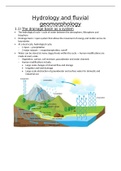
The hydrological cycle = cycle of water between the atmosphere, lithosphere and
biosphere
Drainage basin = open system that allows the movement of energy and matter across its
boundaries
At a local scale, hydrological cycle:
1 input precipitation
2 major outputs evapotranspiration, runoff
Water can be stored at many stages/levels within the cycle human modifications are
made at every scale
Vegetation, surface, soil moisture, groundwater and water channels
Human modifications include:
Large scale changes of channel flow and storage
Irrigation and land drainage
Large-scale abstraction of groundwater and surface water for domestic and
industrial use
,Outputs
Evaporation
Process where liquid is changed into a gas (sublimation = solid gas)
Most important is evaporation from oceans and seas
Increases under warm, dry conditions
Decreases under cold, calm conditions
Losses are greater in arid/semi-arid climates than in polar regions
Affecting factors = meteorological factors (temperature, humidity, wind speed)
Other factors include the amount of water available, vegetation cover, colour of the
surface (albedo/reflectivity of the surface)
Evapotranspiration
Transpiration is the process where water vapour escapes from a living plant, principally
the leaves, and enters the atmosphere. It is a combined effect of evaporation and
transpiration
Represents most important aspect of water loss
Accounts for nearly 100% of annual precipitation in arid areas and 75% in humid
areas
Only over ice/snow fields, bare rock slopes, desert area, water surfaces and bare soil
will purely evaporative losses occur
Potential evapotranspiration
The distinction between evapotranspiration and potential evapotranspiration is the
concept of moisture availability
Potential evapotranspiration is the water loss that would occur if an unlimited supply of
water was in the soil for use by the vegetation
River discharge
Refers to the movement of water in channels (streams and channels)
May enter the river as direct channel precipitation (falls on the channel) or by surface
runoff, groundwater flow (base flow) or throughflow
Stores
Interception
Refers to the water that is caught and stored in vegetation
Interception loss
Water retained by plant surfaces that is later evaporated/absorbed by the plant
Throughfall
Water that falls through the gaps in vegetation
Drops through from leaves and twigs
Stemflow
Water that trickles along twigs/branches then down the trunk
Interception loss varies with different types of vegetation
Less from grasses than deciduous woodland (smaller surface area of grass shoots)
Agricultural crops dependant on the crop density
Coniferous trees = more than deciduous trees in winter but reversed in the summer
, Soil moisture (water in soil)
Sub-surface water in the soil and subsurface layers above the water table where water
may be absorbed, held, transmitted down towards the water table or transmitted up
towards the soil surface and the atmosphere
In coarse textured soil, water is held in fairly large pores at fairly low suctions very
little water held in small pores
In finer textured clay soils, the range of pore sizes is much greater and so there is a
higher proportion of small pores where water is held at high suctions
Field capacity: the amount of water held in the soil after excess water drains away
Wilting point: the range of moisture content where permanent wilting of plants occurs
There is a number of important seasonal variations in soil moisture budgets
Soil moisture deficit
Degree to which soil moisture falls below field capacity. In temperate areas (late
winter/early spring) soil moisture deficit is very low due to high levels of
precipitation and limited evapotranspiration
Soil moisture recharge
When precipitation exceeds potential evapotranspiration
There is a sense of refilling of water in the dried-up pores of the soil
Soil moisture surplus
The period when the soil is saturated, and water cannot enter the soil pores, so it
flows over the surface
Soil moisture utilisation
The process whereby water is drawn to the surface through capillary action
Surface water
2 types:
Temporary e.g. small puddles, turloughs
Permanent e.g. lakes, wetlands, swamps, peat bogs, marshes
Groundwater
Refers to the subsurface water that is stored under the ground in rocks
Accounts for 96.5% of the Earth’s freshwater
Some soil moisture is recycled by evaporation into atmosphere moisture with a few
days/weeks, other ground water takes up to 20 000yrs
Recharge is the refilling of water in the pores where water has been dried up by human
activity in some places where recharge is not taking place, groundwater is considered
a non-renewable resource
Channel storage
All water that is stored in rivers, streams or other drainage channels
Some rivers are seasonal, other disappear underground
Naturally = coniferous limestone
Covered = urban areas culverted
Flows
Above ground
geomorphology
1.1) The drainage basin as a system
The hydrological cycle = cycle of water between the atmosphere, lithosphere and
biosphere
Drainage basin = open system that allows the movement of energy and matter across its
boundaries
At a local scale, hydrological cycle:
1 input precipitation
2 major outputs evapotranspiration, runoff
Water can be stored at many stages/levels within the cycle human modifications are
made at every scale
Vegetation, surface, soil moisture, groundwater and water channels
Human modifications include:
Large scale changes of channel flow and storage
Irrigation and land drainage
Large-scale abstraction of groundwater and surface water for domestic and
industrial use
,Outputs
Evaporation
Process where liquid is changed into a gas (sublimation = solid gas)
Most important is evaporation from oceans and seas
Increases under warm, dry conditions
Decreases under cold, calm conditions
Losses are greater in arid/semi-arid climates than in polar regions
Affecting factors = meteorological factors (temperature, humidity, wind speed)
Other factors include the amount of water available, vegetation cover, colour of the
surface (albedo/reflectivity of the surface)
Evapotranspiration
Transpiration is the process where water vapour escapes from a living plant, principally
the leaves, and enters the atmosphere. It is a combined effect of evaporation and
transpiration
Represents most important aspect of water loss
Accounts for nearly 100% of annual precipitation in arid areas and 75% in humid
areas
Only over ice/snow fields, bare rock slopes, desert area, water surfaces and bare soil
will purely evaporative losses occur
Potential evapotranspiration
The distinction between evapotranspiration and potential evapotranspiration is the
concept of moisture availability
Potential evapotranspiration is the water loss that would occur if an unlimited supply of
water was in the soil for use by the vegetation
River discharge
Refers to the movement of water in channels (streams and channels)
May enter the river as direct channel precipitation (falls on the channel) or by surface
runoff, groundwater flow (base flow) or throughflow
Stores
Interception
Refers to the water that is caught and stored in vegetation
Interception loss
Water retained by plant surfaces that is later evaporated/absorbed by the plant
Throughfall
Water that falls through the gaps in vegetation
Drops through from leaves and twigs
Stemflow
Water that trickles along twigs/branches then down the trunk
Interception loss varies with different types of vegetation
Less from grasses than deciduous woodland (smaller surface area of grass shoots)
Agricultural crops dependant on the crop density
Coniferous trees = more than deciduous trees in winter but reversed in the summer
, Soil moisture (water in soil)
Sub-surface water in the soil and subsurface layers above the water table where water
may be absorbed, held, transmitted down towards the water table or transmitted up
towards the soil surface and the atmosphere
In coarse textured soil, water is held in fairly large pores at fairly low suctions very
little water held in small pores
In finer textured clay soils, the range of pore sizes is much greater and so there is a
higher proportion of small pores where water is held at high suctions
Field capacity: the amount of water held in the soil after excess water drains away
Wilting point: the range of moisture content where permanent wilting of plants occurs
There is a number of important seasonal variations in soil moisture budgets
Soil moisture deficit
Degree to which soil moisture falls below field capacity. In temperate areas (late
winter/early spring) soil moisture deficit is very low due to high levels of
precipitation and limited evapotranspiration
Soil moisture recharge
When precipitation exceeds potential evapotranspiration
There is a sense of refilling of water in the dried-up pores of the soil
Soil moisture surplus
The period when the soil is saturated, and water cannot enter the soil pores, so it
flows over the surface
Soil moisture utilisation
The process whereby water is drawn to the surface through capillary action
Surface water
2 types:
Temporary e.g. small puddles, turloughs
Permanent e.g. lakes, wetlands, swamps, peat bogs, marshes
Groundwater
Refers to the subsurface water that is stored under the ground in rocks
Accounts for 96.5% of the Earth’s freshwater
Some soil moisture is recycled by evaporation into atmosphere moisture with a few
days/weeks, other ground water takes up to 20 000yrs
Recharge is the refilling of water in the pores where water has been dried up by human
activity in some places where recharge is not taking place, groundwater is considered
a non-renewable resource
Channel storage
All water that is stored in rivers, streams or other drainage channels
Some rivers are seasonal, other disappear underground
Naturally = coniferous limestone
Covered = urban areas culverted
Flows
Above ground